
Credit card EMI converts large purchases into smaller monthly installments, making expensive items more affordable. While convenient, it comes with interest costs and conditions that every cardholder should understand before opting for EMI conversion.
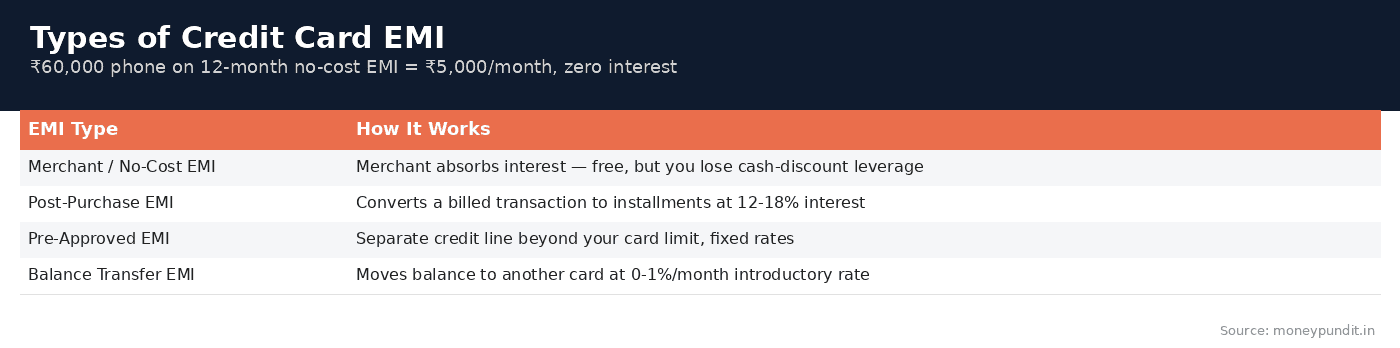
Types of Credit Card EMI
Merchant EMI or No-Cost EMI is offered at checkout on e-commerce sites and retail stores. The merchant absorbs the interest, making it genuinely free for you, though the discount you could have negotiated for full payment is effectively the hidden cost. Post-purchase EMI converts an already-billed transaction into installments at 12-18% annual interest through your bank app or customer care. Pre-approved EMI offers a credit line beyond your card limit specifically for EMI purchases at predefined interest rates. Balance transfer EMI moves outstanding balance from one card to another at lower rates (often 0-1% per month introductory).
How No-Cost EMI Actually Works
On a ₹60,000 phone purchase on 12-month no-cost EMI, you pay ₹5,000 per month with zero interest. The merchant pays the interest to the bank from their margin. However, many merchants price products slightly higher when EMI is available, and you lose the opportunity to negotiate a cash discount of 3-5% that is often available for full payments. Calculate whether the full payment price with a cash discount is cheaper than the no-cost EMI price.
When Credit Card EMI Makes Sense
Genuine no-cost EMI on large necessary purchases (appliances, electronics) where the price is identical to full payment. When the interest rate is lower than the returns you could earn by investing the money, for example, 12% EMI interest versus 15% expected equity returns (though this is risky). For managing cash flow during temporarily tight months, provided you have a clear repayment plan.
When to Avoid Credit Card EMI
Post-purchase EMI at 15-18% interest for discretionary purchases is expensive borrowing. Multiple concurrent EMIs can consume your available credit limit, leading to a debt spiral. If you regularly need EMI for routine purchases, it signals that your spending exceeds your means. Never use EMI to buy depreciating assets or consumables.
Does EMI affect my credit score?
Active EMIs reduce your available credit limit, increasing your utilization ratio, which can lower your score. However, regular EMI payments demonstrate repayment discipline. Keep total EMI commitments below 30% of your credit limit.
Can I foreclose credit card EMI early?
Yes, most banks allow prepayment of credit card EMI. Some charge a foreclosure fee of 2-3% while others allow free prepayment. Check your bank’s policy before converting to EMI.
How Credit Card EMI Conversion Works
Credit card EMI converts a large transaction into smaller monthly instalments at a predetermined interest rate. There are two types: no-cost EMI (the merchant absorbs the interest: you pay the exact product price split into EMIs) and regular EMI (you pay interest at 12-18% annually, much lower than the standard 36-42% revolving credit rate). EMI conversion is offered at the point of sale (for eligible transactions above ₹2,500-5,000) or post-purchase through your card’s app or customer service.
No-Cost EMI: Is It Really Free?
No-cost EMI appears free but has subtle costs. The merchant pays the bank a processing fee, which may be passed on through a slightly higher product price compared to full payment with a discount coupon. Also, once an amount is on EMI, it blocks your credit limit, a ₹60,000 phone on 12-month no-cost EMI blocks ₹60,000 of your limit for the entire year, potentially affecting your ability to make other purchases. Use our EMI calculator to compare the total cost of EMI vs paying upfront with available cashback offers.
When Credit Card EMI Makes Sense
Use credit card EMI when: the item is a genuine need (not an impulse purchase), no-cost EMI is available, the blocked credit limit doesn’t affect your regular card usage, and you have the discipline to pay EMIs on time. Good use cases: buying a laptop for work, replacing a broken appliance, or medical expenses. Bad use cases: lifestyle upgrades, fashion purchases, or anything you wouldn’t buy at full price upfront. The golden rule: if you can’t afford the item’s full price from your savings, EMI doesn’t make you more able to afford it, it just delays the impact.
Alternatives to Credit Card EMI
Before using credit card EMI, compare: debit card EMI (some banks offer this at lower rates), personal loan (10-14% for good credit scores, lower than credit card EMI), buy-now-pay-later services (often 0% for short durations), or simply saving up: a 3-6 month SIP in a liquid fund to accumulate the purchase amount means you buy it with your own money, pay zero interest, and earn returns while saving. This disciplined approach also gives you time to evaluate whether you truly need the item.
Final Tip: Never invest in instruments you don’t understand, regardless of how attractive the returns seem. Build your knowledge progressively, start with simple products like index funds and FDs, then graduate to more complex investments as your understanding grows. Our SIP Calculator can help you project returns for your first investments.
References: Amfiindia.com
Source: amfiindia.com