
Credit card balance transfer in brief: The new bank pays off your old card’s outstanding balance.
Transferring a high-interest credit card balance to a card offering 0% for the first few months can save thousands in interest, but only if you clear it before the promotional period ends, since the rate that kicks in afterward is often worse than what you started with. Here’s when balance transfer actually pays off.
A credit card balance transfer moves outstanding debt from a high-interest card to another card offering a lower introductory rate. For anyone carrying credit card debt, this strategy can save thousands of rupees in interest charges and help you pay off debt faster.
How Balance Transfer Works
You apply for a balance transfer through the receiving bank (the one offering low rates). The new bank pays off your old card’s outstanding balance. You repay the transferred amount in fixed EMIs at the promotional rate, typically 0.5-1.5% per month versus the standard 3-3.5% per month. Transfer amounts are usually limited to 75-80% of the new card’s credit limit. Processing fees of 1-2% apply to the transferred amount.
When Balance Transfer Saves Money
Consider a ₹2,00,000 balance at 42% annual interest (3.5% monthly). Monthly interest alone is ₹7,000. Transferring to a card offering 1% monthly promotional rate for 12 months reduces monthly interest to ₹2,000, saving ₹5,000 per month or ₹60,000 annually. Even after a 2% processing fee (₹4,000), the net saving is ₹56,000. The key is using the low-interest period to aggressively pay down the principal.
Top Banks Offering Balance Transfer
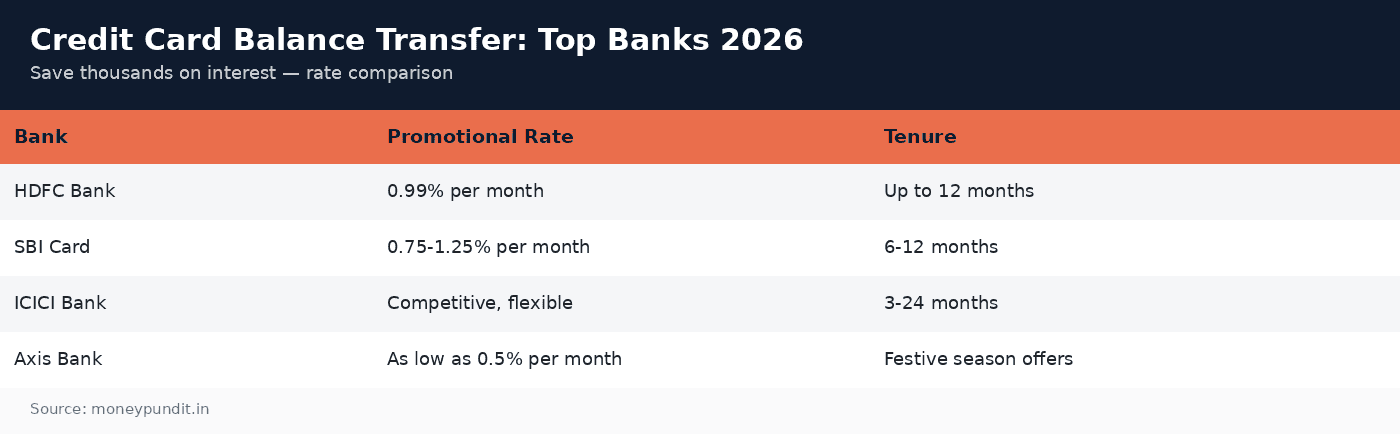
HDFC Bank offers balance transfers at 0.99% per month for up to 12 months. SBI Card provides 0.75-1.25% monthly rates for 6-12 months. ICICI Bank offers flexible tenure of 3-24 months at competitive rates. Axis Bank has promotional offers during festive seasons with rates as low as 0.5% per month. Always compare the total cost (interest + processing fee) across banks before choosing.
Balance Transfer Mistakes to Avoid
Continuing to spend on the old card after transferring the balance, this creates new debt while you are paying off old debt. Not paying more than the minimum on the new card, the promotional rate is temporary and standard rates apply afterward. Applying for multiple transfers simultaneously, which generates hard inquiries and may signal financial stress. Using balance transfer as a recurring strategy without addressing the root cause of overspending.
Alternatives to Balance Transfer
Personal loans typically offer 10-16% annual interest versus 36-42% on credit cards, making them a cheaper option for larger outstanding amounts. Some banks offer EMI conversion on existing balances at 12-18% annual rates. For smaller amounts, accelerating payments through the debt avalanche method (paying the highest-rate debt first) is often simpler and fee-free.
Does balance transfer affect my credit score?
The hard inquiry from the new card application may temporarily lower your score by 5-10 points. However, reducing your overall debt and utilization ratio through the transfer will improve your score over the medium term.
How Credit Card Balance Transfer Works
A balance transfer allows you to move your outstanding credit card debt from one card (usually charging 24%-42% annual interest) to another card offering a significantly lower introductory rate, often 0% to 12% for a promotional period of 3 to 12 months. This can save you thousands in interest charges and help you pay off debt faster since more of your payment goes toward the principal rather than interest.
For example, if you have ₹1 lakh outstanding on a credit card charging 36% APR, you’re paying roughly ₹3,000 per month just in interest. Transferring this balance to a card offering 0% for 6 months means every rupee you pay goes directly toward reducing your debt. Over 6 months, you could save ₹18,000 in interest alone, a substantial amount that accelerates your path to becoming debt-free.
Eligibility and Process
To qualify for a balance transfer, you typically need a good CIBIL score (700+), a stable income, and the receiving bank must approve the transfer. The process involves applying for a balance transfer with the new card issuer, who then pays off your old card directly. Most banks charge a one-time processing fee of 1%-3% of the transferred amount, factor this into your savings calculation.
Key banks offering competitive balance transfer rates in 2026 include HDFC Bank (low-interest BT at ~0.99% per month), ICICI Bank (promotional 0% periods on select cards), SBI Card (balance transfer at reduced rates for 3-6 months), and Axis Bank (customised offers based on profile). The transfer typically takes 3-7 working days to process, and you should continue making minimum payments on your old card until the transfer is confirmed.
Smart Balance Transfer Strategy
The biggest mistake people make with balance transfers is treating the low-interest period as a breathing room to accumulate more debt. Instead, calculate the exact monthly payment needed to clear the entire transferred balance before the promotional period ends. Once the introductory rate expires, the interest rate typically jumps to the standard 36%-42%, negating all your savings.
Avoid making new purchases on the balance transfer card, as these may not enjoy the promotional rate and could attract regular interest from day one. Don’t transfer balances between cards from the same bank, most banks don’t allow this. If you have debt across multiple cards, prioritise transferring the balance with the highest interest rate first. For a comprehensive view of your loan repayment strategy, use our Loan Prepayment Calculator to model different payoff scenarios and see how extra payments reduce your total interest burden.
References: Rbi.org.in
Source: rbi.org.in
Compare: credit card charges India 2026: interest rates and late fees by bank to compare interest rates across issuers.
Frequently Asked Questions About Credit card balance transfer
How does a credit card balance transfer work?
You apply through the receiving bank, the one offering the lower rate. That bank pays off your old card, and you repay the new bank at the lower rate.
When does a balance transfer save money?
On a ₹2,00,000 balance at 42% a year, the monthly interest alone is about ₹7,000. Moving it to a low-rate offer cuts that cost sharply, provided you repay within the offer period.
Which banks offer balance transfers?
As compared on this page, HDFC Bank offered 0.99% a month for up to 12 months and SBI Card 0.75% to 1.25% a month. Offers change, so confirm the current rate and processing fee with the bank.
What mistakes should I avoid with a balance transfer?
The most common one is continuing to spend on the old card after the transfer, which creates fresh debt while you are still repaying the old one.
Is a personal loan cheaper than a balance transfer?
Personal loans typically charge 10% to 16% a year against 36% to 42% on credit cards, so a loan can be a cheaper way to clear card debt if a balance transfer offer is not available.
Credit card balance transfer: Key Takeaways
Key points on credit card balance transfer:
- You apply for a balance transfer through the receiving bank (the one offering low rates).
- Consider a ₹2,00,000 balance at 42% annual interest (3.5% monthly).
- HDFC Bank offers balance transfers at 0.99% per month for up to 12 months.
Verify the latest credit card balance transfer figures with RBI before you act.