
Credit card fraud protection in brief: Call the bank’s dedicated fraud reporting number within 3 days, RBI mandates zero liability for fraud reported within 3 working days.
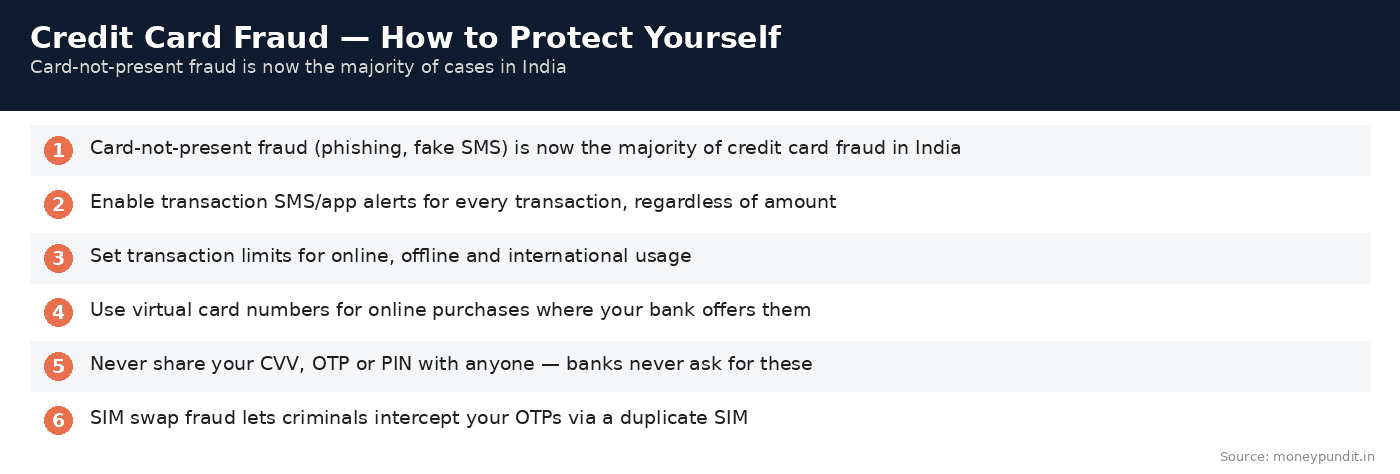
Card-not-present fraud: where a scammer never touches your physical card but still drains your account through a phishing link or fake SMS, now accounts for the majority of credit card fraud in India. Here’s how the common scams actually work, and the specific habits that block them.
Credit card fraud in India has grown significantly with the increase in digital transactions. Understanding the types of fraud and protective measures can save you from financial loss and the hassle of dispute resolution. Here is everything you need to know about keeping your credit card safe.
Common Types of Credit Card Fraud
Card skimming involves criminals attaching devices to ATMs or POS terminals that copy your card data. Online phishing uses fake websites or emails mimicking your bank to steal card details. SIM swap fraud involves criminals getting a duplicate SIM to intercept OTPs. Vishing is voice phishing where fraudsters call pretending to be bank representatives asking for card details or OTPs. Merchant fraud occurs when dishonest merchants charge your card multiple times or for higher amounts.
Prevention Measures
Enable transaction SMS and app alerts for every transaction regardless of amount. Set transaction limits for online, offline, and international usage through your banking app. Enable and disable international transactions only when needed. Use virtual card numbers for online purchases, most banking apps now offer this feature. Never share your CVV, OTP, or PIN with anyone, including bank employees (banks never ask for these). Check ATMs for loose card slots or unusual attachments before inserting your card.
What to Do If You Suspect Fraud
Immediately block your card through the banking app or customer care helpline. Call the bank’s dedicated fraud reporting number within 3 days, RBI mandates zero liability for fraud reported within 3 working days. File a complaint on the RBI Sachet portal and your local cyber crime cell. Keep records of all communication with the bank including complaint numbers and email confirmations. The bank must resolve your complaint within 90 days.
RBI Guidelines on Card Fraud Liability
Under RBI’s 2017 circular on customer liability, you have zero liability for unauthorized transactions reported within 3 working days of receiving the transaction alert. Liability is limited to ₹10,000-₹25,000 if reported between 4-7 working days. Beyond 7 days, liability is determined by the bank’s policy. This makes quick reporting absolutely critical for protecting yourself.
Are contactless payments safe?
Contactless payments (tap-to-pay) have a ₹5,000 transaction limit without PIN, which limits fraud exposure. The transaction uses encrypted tokenized data rather than actual card numbers, making it more secure than traditional swipe transactions. However, if your card is stolen, someone could make multiple small contactless transactions before you block it.
Should I use my credit card internationally?
Enable international transactions only when traveling or making legitimate foreign purchases. Disable immediately afterward. International transactions incur 1-3.5% forex markup charges. For regular foreign spending, consider cards with lower forex markups like Niyo or IDFC FIRST.
Common Types of Credit Card Fraud in India
Credit card fraud in India has evolved beyond simple card theft. The most prevalent types in 2026 include phishing (fake emails/SMS impersonating banks to steal card details), SIM swap fraud (fraudsters clone your mobile number to intercept OTPs), skimming (devices on ATMs/POS machines that copy card data), online data breaches (stolen card details from compromised e-commerce databases), and social engineering (scammers calling as “bank representatives” requesting card details for “verification”).
RBI data shows digital payment fraud cases have been rising, with losses running into hundreds of crores annually. The good news is that RBI’s circular on customer liability limits your loss to zero if you report unauthorised transactions within 3 working days. Between 4-7 days, your liability is capped at ₹10,000-₹25,000 depending on your account type. Beyond 7 days, the bank determines liability based on its investigation.
Essential Protection Measures
Enable transaction alerts via SMS and email for every card transaction, this is your first line of defence for spotting unauthorised charges immediately. Set transaction limits on your card through your bank’s app: lower the online transaction limit and international transaction limit to your typical usage level, and increase temporarily only when needed.
Never share your CVV, OTP, PIN, or card number over phone calls or messages, regardless of who the caller claims to be. Banks never ask for these details. Use virtual card numbers for online shopping, most banks now offer temporary virtual card numbers that expire after one use. Enable two-factor authentication on all online transactions and use your bank’s app to instantly block/unblock your card when not in use.
What to Do If You’re a Victim
If you notice an unauthorised transaction, act immediately: call your bank’s 24/7 helpline to block the card (save this number in your phone now, don’t wait for an emergency). File a complaint through your bank’s app or website within 3 days to ensure zero liability under RBI guidelines. Follow up with a written complaint to the bank’s nodal officer via email, keeping a copy for your records.
File an FIR at your local police station and a complaint on the National Cyber Crime Reporting Portal (cybercrime.gov.in) or call the helpline 1930. These reports are essential for the bank’s investigation and for your protection if the matter escalates. If the bank doesn’t resolve your complaint within 30 days, escalate to the RBI Banking Ombudsman. Protect your CIBIL score by ensuring disputed charges don’t appear as defaults: request the bank to mark them as “under dispute” during investigation. Prevention is always better: review your credit card statement thoroughly every month and report any discrepancy, however small, immediately.
References: Rbi.org.in
Source: rbi.org.in
Compare: debit card charges India 2026: annual fees, ATM fees and minimum balance penalties by bank for the fees banks charge on cards.
Credit card fraud protection: Key Takeaways
Key points on credit card fraud protection:
- Card skimming involves criminals attaching devices to ATMs or POS terminals that copy your card data.
- Enable transaction SMS and app alerts for every transaction regardless of amount.
- Immediately block your card through the banking app or customer care helpline.
Verify the latest credit card fraud protection figures with RBI before you act.
Related guides: Best Credit Cards in India 2026, Best Cashback Credit Cards in India for 2026, How to Use Credit Cards Without Ever Paying Interest.