
Best credit cards in india 2026 in brief: Finding the best credit cards in India 2026 genuinely depends on your spending pattern, a card built for travel rewards can be a poor value pick for someone who mostly spends on groceries and fuel.
Finding the best credit cards in India 2026 genuinely depends on your spending pattern, a card built for travel rewards can be a poor value pick for someone who mostly spends on groceries and fuel. Here’s how to match a card to your category, with current top picks by use case.
Credit cards, when used wisely, are powerful financial tools that offer rewards, cashback, purchase protection, and interest-free credit periods of up to 50 days. India’s credit card market has expanded rapidly with over 10 crore cards in circulation, and banks now offer specialized cards for every spending pattern, travel, shopping, fuel, dining, and more. Choosing the right credit card based on your lifestyle can save you lakhs over time. That’s why we’ve broken down the best credit cards in India 2026 by spending category below.
Best Credit Cards by Category – 2026
Best for Overall Rewards
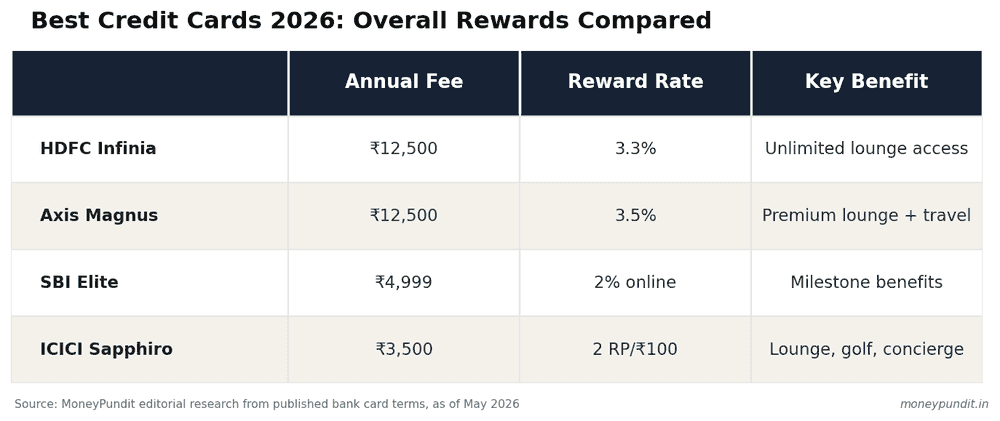
| Card | Annual Fee | Reward Rate | Key Benefits |
|---|---|---|---|
| HDFC Infinia | ₹12,500 | 3.3% (5 RP/₹150) | Unlimited lounge access, 1:1 airmile transfer |
| SBI Elite | ₹4,999 | 2% on online spends | Milestone benefits, movie tickets |
| Axis Magnus | ₹12,500 | 3.5% via EDGE points | Premium lounge, travel benefits |
| ICICI Sapphiro | ₹3,500 | 2 RP/₹100 | Lounge access, golf, concierge |
Best for Cashback
| Card | Annual Fee | Cashback Rate | Key Benefits |
|---|---|---|---|
| IDFC First Select | ₹500 | 3x on categories | No annual fee with ₹1L spend |
| Amazon Pay ICICI | Nil | 1-5% on Amazon | No joining fee, instant approval |
| Flipkart Axis Bank | ₹500 | 1.5-4% cashback | Flipkart Plus membership |
| AU Small Finance LIT | Nil | Choose 3 categories | Customizable rewards |
Best for Travel
| Card | Annual Fee | Travel Benefits | Lounge Access |
|---|---|---|---|
| HDFC Diners Club Black | ₹10,000 | Unlimited lounge, 10x on SmartBuy | Unlimited domestic + international |
| Axis Atlas | ₹5,000 | 5 EDGE miles/₹100, travel portal | 8 international + 8 domestic |
| Amex Platinum Travel | ₹3,500 | 5x on travel bookings | Complimentary flight vouchers |
How to Choose the Right Credit Card
Picking from the best credit cards in India 2026 comes down to matching a card’s reward structure to how you actually spend, not just chasing the highest headline reward rate.
Analyse Your Spending Pattern
Before choosing a card, track your spending for 2-3 months. If most of your spending is on online shopping, a card like Amazon Pay ICICI or Flipkart Axis gives you the highest returns. If you travel frequently, a travel card with lounge access and air mile conversions provides more value. If your spending is distributed across categories, a general rewards card like HDFC Infinia or Axis Magnus maximises overall benefits.
Calculate the True Value
A credit card is worth keeping only if the annual rewards exceed the annual fee. For a card with ₹5,000 annual fee and 2% reward rate, you need to spend at least ₹2.5 lakh annually to break even. Any spending above this is pure profit. Many premium cards waive the annual fee if you meet spending thresholds, factor this into your decision.
Check the Reward Redemption Options
Not all reward points are created equal. Some banks offer 1 point = ₹0.25 while others offer 1 point = ₹1. The redemption catalogue also matters, some cards only allow redemption for merchandise (poor value), while others allow cash credit, air mile transfers, or Amazon vouchers (better value). Always calculate the effective reward rate based on actual redemption value, not just the points earned.
Credit Card Best Practices
Always Pay the Full Amount by Due Date
Credit card interest rates range from 24-42% per annum: the highest among all lending products. If you carry a balance by paying only the minimum amount due, the interest charges will quickly wipe out any rewards earned. The golden rule of credit cards: never spend more than you can pay in full when the bill arrives. Use the interest-free period (20-50 days) as a float, not as a loan.
Utilise the Interest-Free Period Strategically
Purchases made at the start of a billing cycle get the maximum interest-free period (up to 50 days). Large planned purchases should be timed right after your billing date to maximise this free credit period. This is especially useful for big-ticket items where even a month of interest savings on the equivalent cash is meaningful.
Set Up Auto-Pay
Set up auto-debit from your savings account for the full outstanding amount on the due date. This eliminates the risk of missed payments, which not only incur late fees (₹500-1,300) but also negatively impact your CIBIL score. A single missed payment can drop your credit score by 50-100 points.
Credit Card Fees and Charges to Know
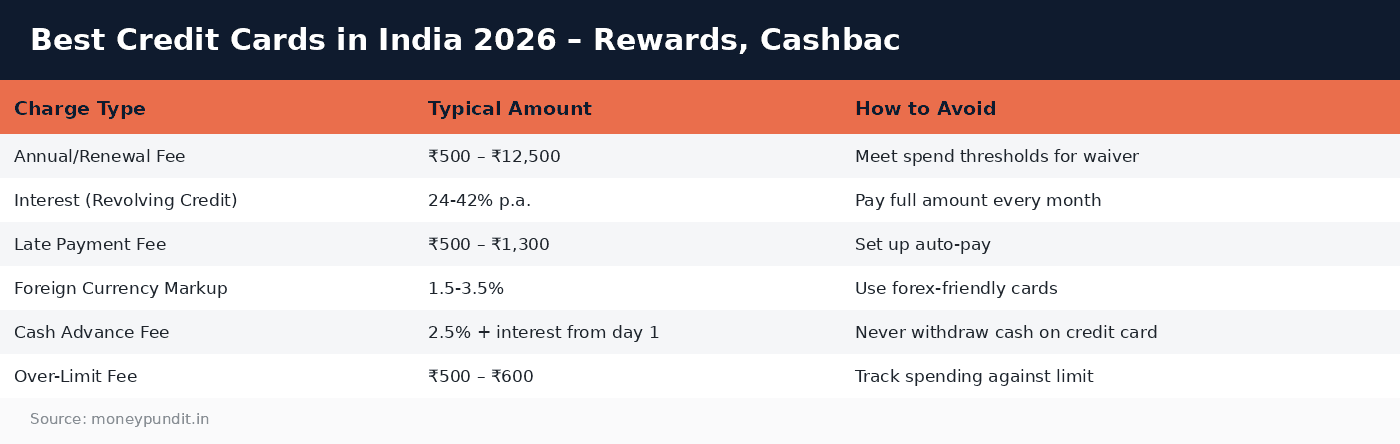
| Charge Type | Typical Amount | How to Avoid |
|---|---|---|
| Annual/Renewal Fee | ₹500 – ₹12,500 | Meet spend thresholds for waiver |
| Interest (Revolving Credit) | 24-42% p.a. | Pay full amount every month |
| Late Payment Fee | ₹500 – ₹1,300 | Set up auto-pay |
| Foreign Currency Markup | 1.5-3.5% | Use forex-friendly cards |
| Cash Advance Fee | 2.5% + interest from day 1 | Never withdraw cash on credit card |
| Over-Limit Fee | ₹500 – ₹600 | Track spending against limit |
How Credit Cards Affect Your CIBIL Score
Credit cards have a significant impact on your credit score. Positive factors include consistent full payments by due date, low credit utilisation (below 30% of your limit), and long credit history. Negative factors include missed or late payments, high utilisation (using more than 70% of limit), and applying for multiple cards in a short period. A healthy credit card usage pattern can boost your CIBIL score above 800, which qualifies you for the best loan rates. Since your CIBIL score directly affects the interest rate lenders offer, it is worth checking our Home Loan Eligibility Calculator to see how a stronger credit profile could improve your borrowing power.
Frequently Asked Questions
How many credit cards should I have?
Two to three credit cards from different networks (Visa, Mastercard, RuPay) provide good coverage. One primary rewards card for daily spending, one travel card for trips and lounge access, and one no-fee card as backup. Having too many cards becomes difficult to manage and can lead to overspending.
Should I close unused credit cards?
Generally no, unless the card has an annual fee you cannot get waived. Closing a card reduces your total available credit limit, which increases your credit utilisation ratio and can lower your CIBIL score. If the card has no annual fee, keep it active with a small recurring charge to maintain the credit history.
Is it safe to use credit cards online?
Yes, credit cards are actually safer than debit cards for online transactions. Credit card purchases are protected by the bank’s fraud liability policies. If your card is compromised, you can dispute the charges and are not liable for unauthorised transactions. Debit cards directly access your savings, making fraud recovery more difficult. Always enable transaction alerts, use virtual card numbers for online shopping where available, and never share your CVV or OTP with anyone.
What is the minimum CIBIL score for a credit card?
Most banks require a minimum CIBIL score of 700-750 for premium credit cards. For entry-level cards, scores of 650-700 may be acceptable. If your score is below 650, consider starting with a secured credit card (backed by an FD) or a card specifically designed for building credit, which has lower limits but easier approval criteria.
References: Rbi.org.in
Compare: credit card charges India 2026: interest rates and late fees by bank before choosing a card.
Compare: forex markup India 2026: credit card and forex card charges compared for zero forex markup options.
Best credit cards in india 2026: Key Takeaways
Key points on best credit cards in india 2026:
- Picking from the best credit cards in India 2026 comes down to matching a card’s reward structure to how you actually spend, not just chasing the highest headline reward rate.
- Credit card interest rates range from 24-42% per annum: the highest among all lending products.
- Credit cards have a significant impact on your credit score.
Verify the latest best credit cards in india 2026 figures with RBI before you act.