
Use credit cards without paying interest in brief: Stories of people trapped in revolving debt at 40% annual interest are real, but they’re also entirely avoidable.
Credit card companies profit heavily from cardholders who carry a balance, pay only the statement in full, every single cycle, and you can use a credit card purely for its rewards and grace period with zero interest cost, ever. Here’s the one rule that makes that possible.
Credit cards have a reputation problem in India. Stories of people trapped in revolving debt at 40% annual interest are real, but they’re also entirely avoidable. Used correctly, a credit card costs you nothing in interest, gives you 30–50 days of free credit, and earns you rewards on top. Here’s exactly how to do it.
Understand the Billing Cycle
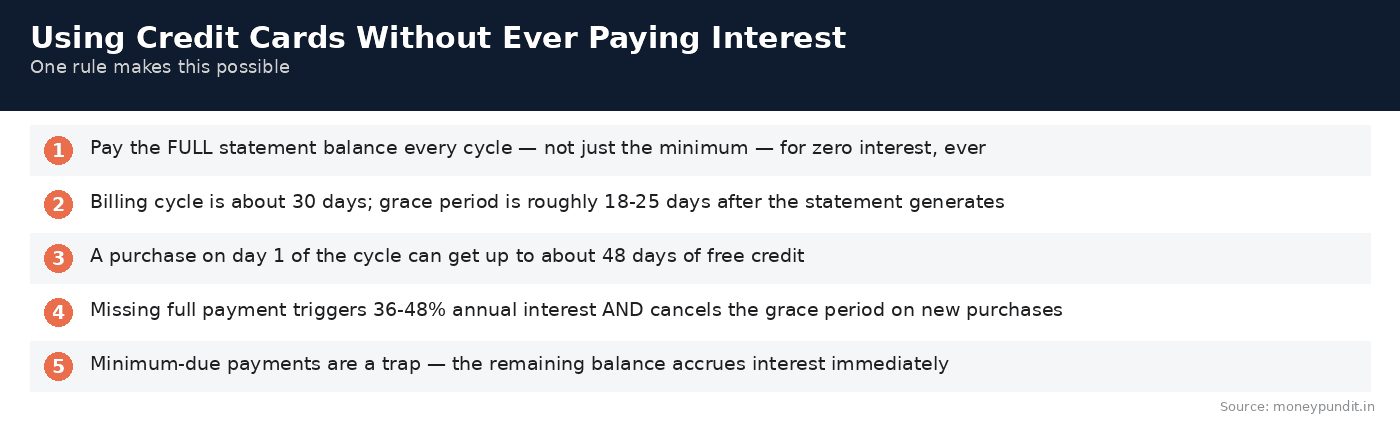
Every credit card has a billing cycle: typically 30 days. At the end of the cycle, your statement is generated. You then have a grace period (usually 18–25 days) to pay the full amount. If you pay the entire statement balance before the due date, you pay zero interest. The credit was completely free.
Example: Your billing cycle runs from the 1st to 30th of each month. Statement generates on the 30th. Due date is 18 days later on the 18th of next month. Any purchase made on the 1st gets almost 48 days of free credit.
The One Rule That Prevents Debt
Pay the full statement balance, not just the minimum due. Banks make minimum payments seem generous, “just pay ₹500 and you’re fine.” You’re not fine. The remaining balance immediately starts accruing interest at 36–48% per annum, and crucially, you lose the interest-free period on all new purchases until you clear the full balance.
Set up an auto-debit for the full outstanding amount. This removes the human error element entirely.
Never Spend More Than You Can Pay
This sounds obvious but is where most people go wrong. A credit card temporarily increases your purchasing power, don’t let it permanently reduce your savings. The mental model: treat your credit card like a debit card. Only spend what’s already in your bank account.
Track Your Spending
Credit cards make overspending easy because the pain of payment is delayed. Use your bank’s app or a budgeting app to track category-wise spending weekly. If you’re regularly surprised by your credit card bill, you need more visibility, not a lower credit limit.
When You Must Revolve a Balance
If you’re ever unable to pay the full balance, pay as much as possible, not just the minimum. Convert large outstanding amounts to EMI at the bank’s EMI interest rate (typically 12–18% per annum), which is significantly lower than the revolving credit rate of 36–48%. Use no-cost EMI offers for large planned purchases.
Understanding the Interest-Free Period
Every credit card comes with an interest-free period of 20-50 days (depending on the card and billing cycle). If you pay your full statement balance by the due date, you pay zero interest. The bank essentially gives you a free loan for up to 50 days. The key is understanding your billing cycle: if your statement date is the 5th and due date is the 25th, a purchase made on the 6th gets the longest interest-free period (nearly 50 days), while one made on the 4th gets the shortest (about 21 days).
The moment you miss paying the full balance, the interest-free period vanishes, not just on the unpaid amount, but on all new purchases from the transaction date until the balance is fully cleared. Credit card interest rates of 36-42% annually (3-3.5% monthly) are among the highest borrowing costs available. Even a partial payment only avoids the late payment fee; interest is still charged on the entire outstanding amount.
The Golden Rules of Interest-Free Credit Card Use
Rule 1: Always pay the full statement balance. Not the minimum due, not 90%: the full amount. Set up an auto-debit from your salary account for the full statement amount. This is the single most important rule for using credit cards profitably.
Rule 2: Never use credit cards for cash advances. Cash withdrawals from credit cards attract immediate interest (no grace period), typically at 36-42% annualised plus a transaction fee of 2.5-3%. Even if you repay the next day, you’ll pay interest from the withdrawal date.
Rule 3: Track spending against your budget. The biggest risk with credit cards is psychological: the ease of swiping leads to overspending. Set a personal spending limit (ideally 30-40% of your credit limit) and track it through your card’s app. If your monthly budget allows ₹40,000 in card spending, stop using the card once you approach that number.
Maximising Rewards While Paying Zero Interest
When you never pay interest, credit cards become free money-back machines. Route all your regular expenses through the right cards: fuel purchases on fuel-reward cards (1-5% savings), groceries on cashback cards (1-5% back), online shopping on co-branded cards (up to 10% on partner platforms), and utility bills on reward-point cards. A well-optimised credit card strategy can earn ₹15,000-30,000/year in cashback and rewards for a household spending ₹5-8 lakh annually through cards, all while paying zero interest.
The saved cashback and rewards can be redirected into a monthly SIP: ₹2,000/month in rewards invested at 12% CAGR for 20 years grows to approximately ₹20 lakh. That’s the power of using credit cards as a financial tool rather than a debt trap.
What to Do If You’re Already in Credit Card Debt
If you have an outstanding credit card balance, your first priority should be eliminating it before investing in anything else. Consider a balance transfer to a card offering 0% or low interest for 6-12 months, giving you breathing room to pay down the principal. Alternatively, take a personal loan at 10-14% to pay off credit card debt at 36-42%: the interest savings are immediate and significant. Once clear, implement the auto-debit-full-payment system and never carry a balance again.
References: Sebi.gov.in
Source: sebi.gov.in
Frequently Asked Questions
How can I avoid paying credit card interest?
Pay the total amount due, not just the minimum, by the due date every month. Interest-free credit applies only when the full statement balance is cleared.
What happens if I pay only the minimum due?
Interest is charged on the outstanding balance, usually at a high annual rate, and the interest-free period on new purchases is lost.
Does using a credit card affect my credit score?
Yes. Paying on time and keeping utilisation low, ideally below 30% of the limit, helps your score, while late payments hurt it.
Use credit cards without paying interest: Key Takeaways
To use credit cards without paying interest, pay the total amount due, not the minimum, by the due date every month. Using credit cards without paying interest works only while the interest-free period applies.
Key points on use credit cards:
- You then have a grace period (usually 18–25 days) to pay the full amount.
- Banks make minimum payments seem generous, “just pay ₹500 and you’re fine.” You’re not fine.
- A credit card temporarily increases your purchasing power, don’t let it permanently reduce your savings.
Related tools for use credit cards without paying interest: SIP calculator, tax calculator and FD calculator.
Verify the latest use credit cards figures with RBI before you act.