

Super top up health in brief: By layering a super top-up over your existing base policy or employer insurance, you can get ₹50 lakh to ₹1 crore in additional coverage for just ₹3,000-8,000 per year.
A super top-up policy can add ₹50 lakh to ₹1 crore of additional health cover for a fraction of what a base policy of that size would cost, but only if a single claim in the year crosses the deductible threshold, a detail that changes how you should actually use it. Here’s how super top-up works.
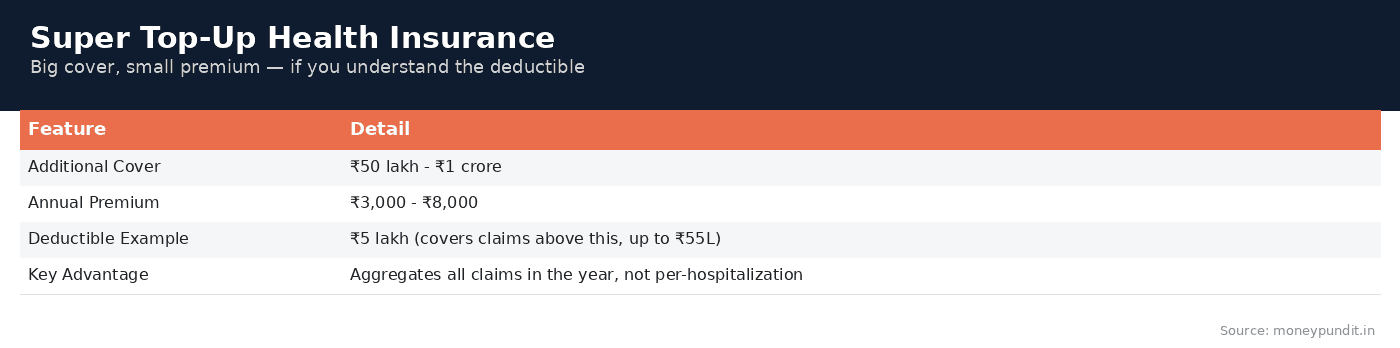
Super top-up health insurance is one of the smartest and most cost-effective ways to increase your health coverage without paying high premiums. By layering a super top-up over your existing base policy or employer insurance, you can get ₹50 lakh to ₹1 crore in additional coverage for just ₹3,000-8,000 per year.
How Super Top-Up Works
A super top-up policy activates when your medical expenses exceed a specified threshold called the deductible. For example, if you have a super top-up with ₹50 lakh cover and ₹5 lakh deductible, the policy covers expenses above ₹5 lakh up to ₹55 lakh per claim or per policy year (depending on the plan). The deductible can be covered by your base health insurance or even paid out of pocket. You only pay the low super top-up premium because the insurer is protected by the deductible for routine claims.
Super Top-Up vs Top-Up: Key Difference
A regular top-up applies the deductible per hospitalization: each hospital visit must individually exceed the deductible before the top-up pays. A super top-up aggregates all claims during the policy year, once your cumulative claims cross the deductible threshold (even across multiple hospitalizations), the super top-up kicks in. This aggregate feature makes super top-ups far more useful in practice and is the reason they are recommended over regular top-ups.
Ideal Super Top-Up Strategy
If you have employer health insurance of ₹5 lakh, buy a super top-up with ₹5 lakh deductible and ₹50 lakh-₹1 crore cover. Your employer insurance handles the first ₹5 lakh, and the super top-up covers expenses beyond that. Total effective coverage: ₹55 lakh to ₹1.05 crore. If you have a personal base policy of ₹10 lakh, buy a super top-up with ₹10 lakh deductible. This gives you ₹60 lakh to ₹1.1 crore total coverage. The beauty is the super top-up for a 30-year-old with ₹5 lakh deductible costs only ₹3,000-5,000 annually.
Top Super Top-Up Plans
HDFC ERGO Optima Super Top-Up offers coverage up to ₹1 crore with flexible deductible options. ICICI Lombard Health Shield Top-Up provides comprehensive coverage with no room rent restrictions. Star Health Super Surplus is popular for its straightforward terms and wide network. New India Assurance Super Top-Up is a public sector option with competitive premiums for senior citizens. Care Health Super Top-Up offers plans with built-in critical illness cover.
Important Considerations
Match your super top-up deductible to your base policy sum insured for seamless coverage. Ensure the super top-up insurer and base policy insurer have overlapping network hospitals. The super top-up should not have room rent limits lower than your base policy. Buy a super top-up even if your employer coverage seems sufficient. Job changes or layoffs can leave you without base cover, and the deductible can be paid out of pocket in such scenarios.
Can I use employer insurance as the deductible for a super top-up from a different insurer?
Yes: the super top-up only requires that your medical expenses exceed the deductible amount, regardless of how that amount was paid. You can use employer insurance, another personal policy, or even out-of-pocket payment to satisfy the deductible.
How Super Top-Up Insurance Actually Works
Super top-up activates only when your total medical expenses in a policy year cross the chosen deductible (threshold). Unlike a regular top-up (which applies the deductible per hospitalization), a super top-up aggregates all claims during the year. Example: with a ₹5 lakh deductible and ₹50 lakh sum insured, if you have three hospitalizations costing ₹2 lakh, ₹2 lakh, and ₹3 lakh in one year, the total ₹7 lakh crosses your ₹5 lakh deductible, and the super top-up pays the ₹2 lakh excess. This makes super top-up significantly more valuable than regular top-up plans.
Set your deductible equal to your base health insurance sum insured. If your company provides ₹5 lakh group cover, buy a super top-up with ₹5 lakh deductible and ₹50 lakh or ₹1 crore sum insured. The premium is surprisingly affordable. A 30-year-old can get ₹1 crore super top-up cover for roughly ₹5,000-8,000 per year, because the insurer knows most claims will be absorbed by your base policy.
Key Features to Compare When Buying Super Top-Up
Look for unlimited room rent (no sub-limits on ICU or single room charges), no disease-specific caps, and restoration benefit (sum insured gets restored after a claim). Check the waiting period for pre-existing diseases. Most plans have 2-4 years. Some insurers offer a “floater” super top-up covering the entire family under one policy, which is more cost-effective than individual plans.
Ensure your super top-up insurer accepts claims from any base policy, some restrict it to their own base plans. The claim process: exhaust your base policy first, then file with the super top-up insurer with discharge summary, bills, and a letter from the base insurer confirming claim settlement. Premium paid is tax-deductible under Section 80D, up to ₹25,000 (₹50,000 for senior citizens). Review your coverage annually as medical inflation runs at 10-14%, a ₹50 lakh cover today may feel inadequate in 10 years. Use our Tax Calculator to factor in Section 80D deductions when computing your net insurance cost.
A modest base health policy plus a large super top-up is usually the most cost-efficient way to get serious coverage. Just make sure you understand the deductible structure before you actually need to make a claim, not after.
References: Irdai.gov.in
Source: irdai.gov.in
Frequently Asked Questions About Super top up health
How does a super top-up health insurance policy work?
It activates only when your total medical expenses in a policy year cross the deductible you chose, and then covers the excess up to its sum insured.
What is the difference between a top-up and a super top-up plan?
A regular top-up applies the deductible to each hospitalisation separately, so each hospital visit must individually exceed it. A super top-up adds up all claims in the policy year against the deductible.
What is an ideal super top-up strategy?
If your employer health cover is ₹5 lakh, buy a super top-up with a ₹5 lakh deductible and a much larger sum insured, such as ₹50 lakh, on top of it.
How do I choose the deductible for a super top-up?
Match the deductible to the sum insured of your base policy so that cover continues without a gap once the base policy is exhausted.
Super top up health: Key Takeaways
Key points on super top up health:
- A super top-up policy activates when your medical expenses exceed a specified threshold called the deductible.
- A regular top-up applies the deductible per hospitalization: each hospital visit must individually exceed the deductible before the top-up pays.
- If you have employer health insurance of ₹5 lakh, buy a super top-up with ₹5 lakh deductible and ₹50 lakh-₹1 crore cover.
Verify the latest super top up health figures with IRDAI before you act.
Related guides: Insurance Guide, Family Floater vs Individual Health Insurance, Income Tax Calculator FY 2026.