
Insurance claim settlement ratio in brief: If an insurer received 1,000 claims and settled 970, their CSR is 97%.
A 99% claim settlement ratio sounds reassuring, but it’s an aggregate number that doesn’t tell you whether YOUR specific type of claim, say, a pre-existing condition or a large sum, gets settled at anywhere close to that rate. Here’s what CSR actually measures and its real limitations.
Claim settlement ratio (CSR) is the most widely quoted metric for evaluating insurance companies, but it is frequently misunderstood. A high CSR does not automatically mean an insurer is good, and a lower CSR does not necessarily mean they are bad. Understanding what CSR actually represents helps you make better insurance decisions.
What is Claim Settlement Ratio
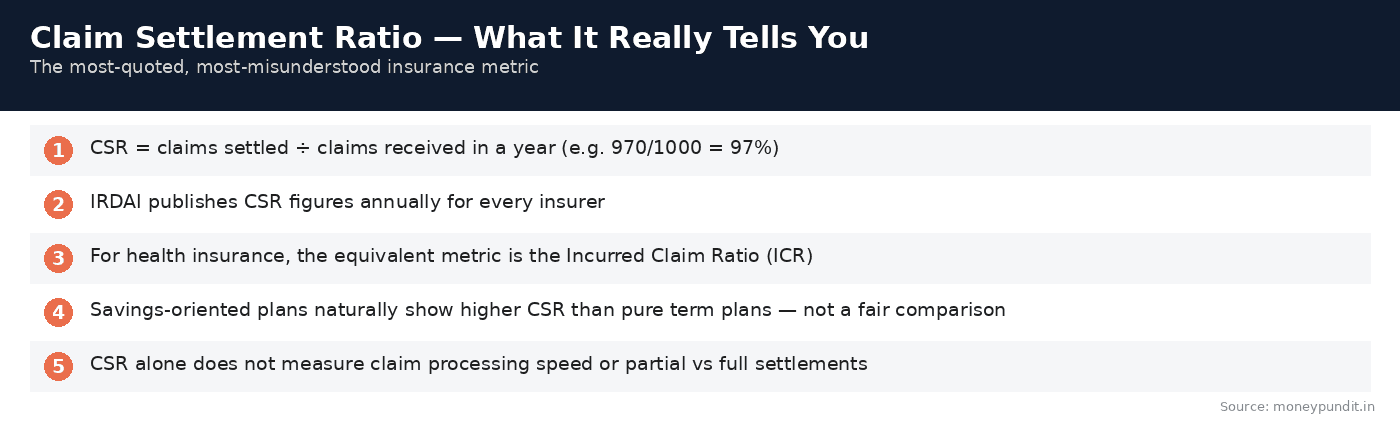
CSR is the percentage of claims settled by an insurer out of total claims received during a financial year. If an insurer received 1,000 claims and settled 970, their CSR is 97%. IRDAI publishes these figures annually in its annual report. For life insurance, CSR applies to death claims. For health insurance, the equivalent metric is the incurred claim ratio (ICR). The percentage of premium collected that is paid out in claims.
Why CSR Alone is Misleading
A company selling mostly savings-oriented plans (endowments, money-back) will naturally have fewer death claims and a higher CSR compared to one selling primarily term insurance. Similarly, CSR does not distinguish between individual and group claims. A company with a large group insurance book will process more straightforward employer-verified claims, inflating their ratio. The ratio also does not tell you about claim processing speed, partial settlements versus full settlements, or the customer experience during the claim process.
What to Look For Instead
Consider multiple metrics together: CSR should be above 95% for life insurers and above 90% for health insurers. Check the average claim processing time. IRDAI publishes this data. Look at the percentage of claims rejected versus pending, a high pending rate suggests operational issues. Read customer reviews and complaints registered with IRDAI’s Integrated Grievance Management System (IGMS). Check the company’s financial stability through their solvency ratio. IRDAI mandates a minimum of 150%, and companies with 200%+ have stronger financial cushions.
Top Insurers by Claim Settlement Track Record
For life insurance: LIC (98.7%), Max Life (99.5%), HDFC Life (99.1%), SBI Life (97.8%), and ICICI Prudential (97.9%) consistently rank high. For health insurance: Star Health, Niva Bupa, HDFC ERGO, and ICICI Lombard have strong claim processing reputations. Note that newer insurers may have limited data. Always check the latest IRDAI annual report for updated figures rather than relying on insurer marketing materials.
Does a 99% CSR mean my claim will definitely be paid?
No: CSR is a company-level aggregate. Your individual claim depends on policy terms, accurate disclosure, and meeting claim conditions. A policy purchased with non-disclosed pre-existing conditions will be rejected regardless of the insurer’s CSR.
Why do some insurers have lower CSR?
Lower CSR often correlates with higher term insurance sales (more death claims relative to total policies), stricter underwriting for misrepresented applications, and better fraud detection. A well-run company that rejects fraudulent claims may have a slightly lower CSR but is actually protecting honest policyholders.
What Claim Settlement Ratio Actually Means
The Claim Settlement Ratio (CSR) is the percentage of claims an insurance company pays out versus the total claims received in a financial year. IRDAI publishes these numbers annually. A CSR of 98% means the insurer settled 98 out of every 100 claims received. For life insurance, the industry average CSR is around 97-98%, with top performers like LIC (98.7%), HDFC Life (99.1%), and Max Life (99.5%) leading the pack.
However, CSR alone doesn’t tell the complete story. A company with 95% CSR that processes claims in 15 days provides a better experience than one with 98% CSR that takes 90 days. Look at the claim settlement ratio alongside the average claim processing time, the incurred claim ratio (total amount paid vs total premiums collected), and the complaint ratio (number of complaints per 10,000 policies).
Why Claims Get Rejected
Understanding rejection reasons helps you avoid them. The most common reasons for claim rejection are: non-disclosure of pre-existing conditions (the #1 reason, if you hide a medical condition while buying health or life insurance and it later affects the claim, the insurer can reject it), policy lapse due to non-payment of premiums, claims during the waiting period (health insurance has 2-4 year waiting periods for specific diseases), exclusion clauses (suicide within 1 year for life insurance, cosmetic procedures for health insurance), and incorrect or incomplete documentation.
The Insurance Act mandates that if a life insurance policy has been in force for 3+ years, the insurer cannot challenge it on grounds of non-disclosure. This is the “contestability period.” After 3 years, your claim is essentially non-rejectable (except in cases of proven fraud). For health insurance, the contestability period is 8 years. These timelines make it even more important to be completely transparent during the application process, honest disclosure protects your family’s claims in the future.
How to Ensure Your Claim Is Never Rejected
Full disclosure at the time of purchase is the single most important step. Declare every medical condition, hospitalisation, medication, and family medical history, even conditions that seem minor or resolved. Insurers can access your medical records through the Medical Information Bureau, and undisclosed conditions discovered during claim investigation lead to automatic rejection.
Keep your policy active by setting up auto-debit for premium payments. Maintain copies of all medical records, prescriptions, and hospital bills systematically, a digital folder works best. For health insurance claims, always inform your insurer before planned hospitalisation (for cashless claims) or within 24-48 hours of emergency admission. Nominate beneficiaries clearly and keep the nomination updated after life events like marriage or the birth of children. Review your insurance coverage annually and supplement with additional cover as your income and responsibilities grow, use our Retirement Calculator to factor insurance adequacy into your overall financial plan.
References: Sebi.gov.in
Source: sebi.gov.in
Insurance claim settlement ratio: Key Takeaways
Key points on insurance claim settlement ratio:
- CSR is the percentage of claims settled by an insurer out of total claims received during a financial year.
- A company selling mostly savings-oriented plans (endowments, money-back) will naturally have fewer death claims and a higher CSR compared to one selling primarily term insurance.
- Look at the percentage of claims rejected versus pending, a high pending rate suggests operational issues.
Verify the latest insurance claim settlement ratio figures with IRDAI before you act.
Related guides: Insurance Guide, Family Floater vs Individual Health Insurance, Income Tax Calculator FY 2026.