

How to invest mutual funds in brief: Direct plans through apps like Groww, Zerodha Coin, or Kuvera charge zero commission and have lower expense ratios, saving you 0.5-1% annually.
Most first-time mutual fund investors spend more time picking the ‘#1 best fund’ from a listicle than they do figuring out their own goal and time horizon, which is backwards, since the goal should decide the fund category, not the other way around. Here’s a complete beginner’s process.
Getting Started with Mutual Fund Investing
If you are new to investing, mutual funds are arguably the best starting point. They offer professional fund management, diversification across dozens or hundreds of stocks and bonds, and accessibility with investments starting from just Rs 500 per month. This comprehensive guide walks you through everything you need to know to start your mutual fund journey in India.
Step 1: Complete Your KYC
Before investing in any mutual fund, you need to complete the Know Your Customer (KYC) process. This is a one-time requirement mandated by SEBI. You can complete eKYC online in minutes through any mutual fund platform using your Aadhaar number and PAN card. Once your KYC is verified, you can invest in any mutual fund from any fund house across India.
Step 2: Choose the Right Platform
You can invest in mutual funds through multiple channels. Direct plans through apps like Groww, Zerodha Coin, or Kuvera charge zero commission and have lower expense ratios, saving you 0.5-1% annually. Regular plans through distributors or banks come with higher expense ratios due to embedded commissions. For long-term wealth creation, always choose the direct plan.
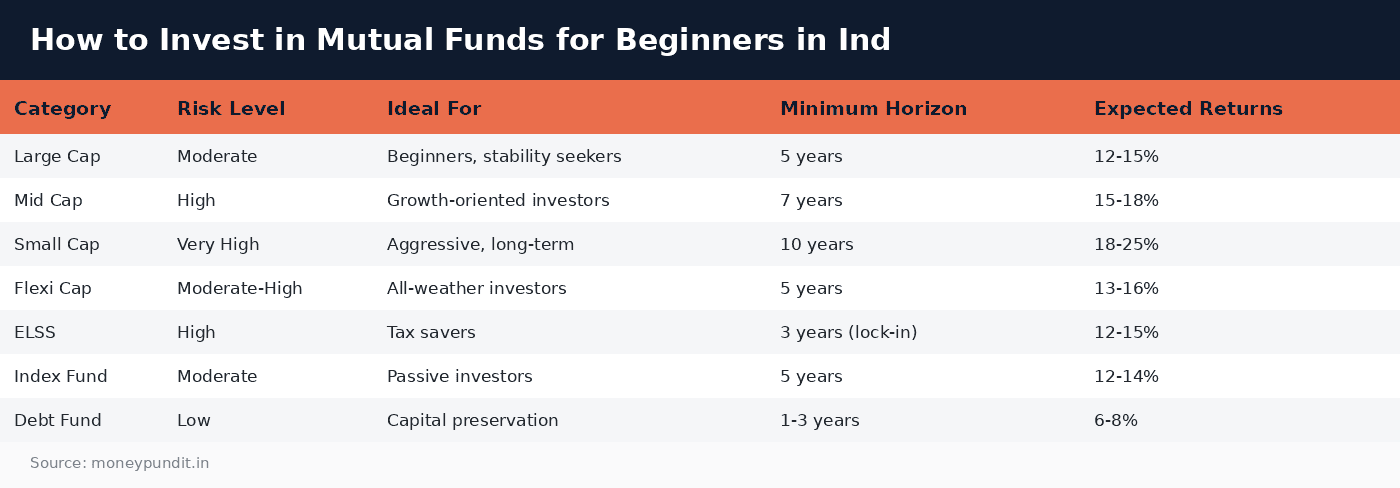
Step 3: Understand Fund Categories
| Category | Risk Level | Ideal For | Minimum Horizon | Expected Returns |
|---|---|---|---|---|
| Large Cap | Moderate | Beginners, stability seekers | 5 years | 12-15% |
| Mid Cap | High | Growth-oriented investors | 7 years | 15-18% |
| Small Cap | Very High | Aggressive, long-term | 10 years | 18-25% |
| Flexi Cap | Moderate-High | All-weather investors | 5 years | 13-16% |
| ELSS | High | Tax savers | 3 years (lock-in) | 12-15% |
| Index Fund | Moderate | Passive investors | 5 years | 12-14% |
| Debt Fund | Low | Capital preservation | 1-3 years | 6-8% |
Step 4: Start Your First SIP
For beginners, we recommend starting with a SIP (Systematic Investment Plan) rather than a lumpsum investment. Here is a simple starter portfolio for someone investing Rs 5,000 per month:
Option A (Simple): Rs 5,000 in a single Flexi Cap Fund like Parag Parikh Flexi Cap
Option B (Diversified): Rs 2,500 in a Large Cap Fund + Rs 2,500 in a Flexi Cap Fund
As your income grows and you gain confidence, you can increase your SIP amount and add mid cap or small cap exposure.
Step 5: Monitor and Rebalance
Do not check your mutual fund portfolio daily: this leads to emotional decision-making. Review your portfolio once every quarter. Compare your fund performance against its benchmark and category average over rolling 3-year and 5-year periods. Switch funds only if a fund consistently underperforms its benchmark for 4-6 consecutive quarters, not based on short-term dips.
Common Beginner Mistakes
Investing Without Goals: Every SIP should be linked to a specific financial goal with a target amount and timeline. Without goals, you are more likely to redeem during market dips.
Chasing NFOs: New Fund Offers (NFOs) are marketed heavily but rarely offer any advantage over existing proven funds. Stick to funds with at least a 5-year track record.
Ignoring Emergency Fund: Build an emergency fund covering 6 months of expenses in a liquid fund or savings account before starting equity SIPs. Without this buffer, you may be forced to redeem your equity investments at the worst time.
Frequently Asked Questions
How much money do I need to start?
You can start investing in mutual funds with as little as Rs 100-500 per month through SIP. There is no minimum requirement for most platforms.
Are mutual funds safe?
Mutual funds are regulated by SEBI and managed by professional fund managers. However, equity mutual funds carry market risk and can give negative returns in the short term. Debt mutual funds carry lower risk but are not completely risk-free.
Can I lose all my money in mutual funds?
Losing your entire investment is virtually impossible in a diversified mutual fund because the fund invests across 40-60 different stocks. Even in the worst market crash of 2008, diversified funds recovered within 2-3 years.
SIP vs Lump Sum: Which Approach Works Better
SIP (Systematic Investment Plan) invests a fixed amount monthly, automatically buying more units when markets are low and fewer when markets are high. This rupee-cost averaging reduces the risk of investing at market peaks. Lump sum works better when you have a large amount and markets are at reasonable valuations (not at all-time highs). Research shows: over 10+ year periods, lump sum investing slightly outperforms SIP because markets tend to rise over time. But SIP is psychologically easier, enforces discipline, and matches salaried income patterns. Use our SIP Calculator to project returns at different monthly amounts.
For beginners, SIP is the clear winner: start with ₹500-5,000/month in 2-3 funds, increase by 10-15% annually (step-up SIP), and let compounding work over 10-20 years. A ₹5,000/month SIP growing at 12% annually becomes ₹50 lakh in 15 years and ₹1 crore in 20 years, the power of compounding accelerates dramatically in later years.
Building Your First Mutual Fund Portfolio
A simple 3-fund portfolio covers most needs: one large-cap index fund (Nifty 50 or Sensex, 50% allocation) for stability and market-matching returns, one flexi-cap/mid-cap fund (30%) for growth, and one debt/hybrid fund (20%) for stability and rebalancing. This provides diversification across company sizes, sectors, and asset classes without overcomplicating your portfolio.
Always choose direct plans over regular plans: the 0.5-1% expense ratio savings compounds into lakhs over time. Invest through AMC websites or commission-free platforms like MF Utilities, Kuvera, or Groww. Complete your KYC once (it’s valid across all AMCs) through KRA agencies like CAMS or KFintech. Avoid these common mistakes: don’t invest in more than 5-6 funds (overlap kills diversification benefits), don’t stop SIPs during market crashes (that’s when you get the cheapest units), don’t chase last year’s top performers, and don’t redeem within 3 years unless absolutely necessary. Review your portfolio annually: rebalance if any fund’s allocation drifts more than 10% from your target.
Start with one fund that matches a clear goal, automate the investment through a SIP, and resist the urge to add a new fund every time you read about a top performer, a focused, boring portfolio beats a scattered, exciting one almost every time.
References: Amfiindia.com
How to invest mutual funds: Key Takeaways
Key points on how to invest mutual funds:
- If you are new to investing, mutual funds are arguably the best starting point.
- Before investing in any mutual fund, you need to complete the Know Your Customer (KYC) process.
- Regular plans through distributors or banks come with higher expense ratios due to embedded commissions.
Verify the latest how to invest mutual funds figures with AMFI before you act.