
Large cap mutual funds put at least 80% of their money in the 100 biggest listed companies by market value, so they own household names such as HDFC Bank, Reliance and TCS. The table below lists every large cap scheme tracked in AMFI data, ranked by 1-year return, with 3-year and 5-year CAGR alongside.
Large cap funds exist specifically to reduce the single-stock and single-manager risk of picking individual blue-chip shares, the tradeoff is that most of them, by definition, can’t dramatically outperform the index they’re built around. Here’s what to look for and current top picks.
What Are Large Cap Mutual Funds?
Large cap mutual funds invest a minimum of 80% of their assets in the top 100 companies by market capitalisation on Indian stock exchanges. These are the biggest and most established companies in India. Think Reliance, TCS, HDFC Bank, Infosys, and ITC. Large cap funds offer the most stable returns among equity fund categories with lower volatility compared to mid cap and small cap funds.
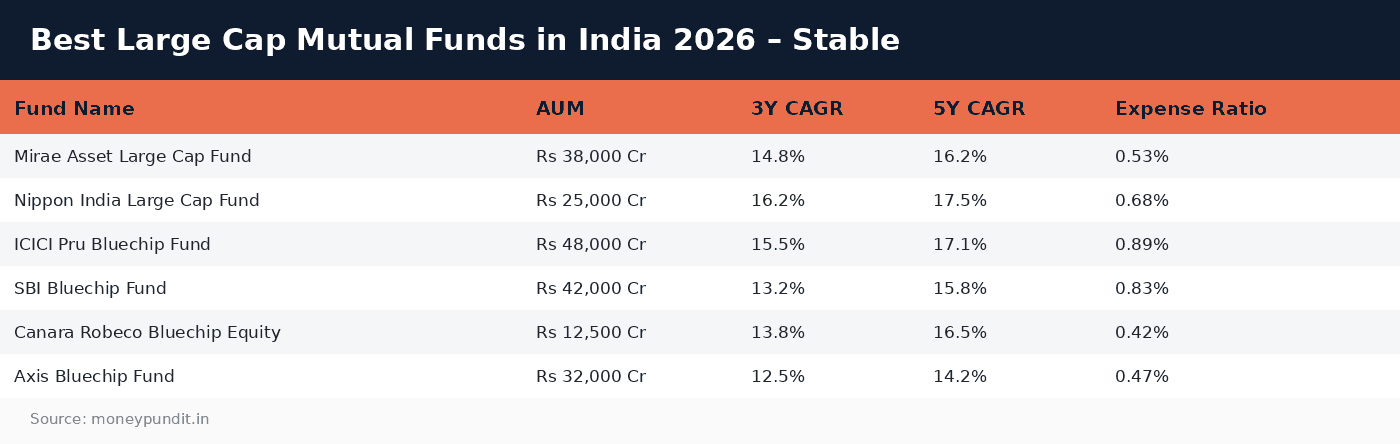
Top Large Cap Funds for 2026
| # | Fund Name | NAV (₹) | 1Y Return ▼ | 3Y CAGR | 5Y CAGR |
|---|---|---|---|---|---|
| 1 | Taurus Large Cap Fund | 178.55 | +7.67% | +13.73% | +10.06% |
| 2 | quant Large Cap Fund | 16.21 | +3.79% | +13.35% | — |
| 3 | BANK OF INDIA LARGE CAP FUND | 17.11 | +2.35% | +11.90% | +8.86% |
| 4 | Invesco India Large Cap Fund | 83.40 | -0.68% | +13.25% | +10.20% |
| 5 | BAJAJ FINSERV LARGE CAP FUND | 9.84 | -1.82% | — | — |
| 6 | BARODA BNP PARIBAS LARGE CAP FUND | 246.16 | -1.93% | +10.68% | — |
| 7 | HSBC Large Cap Fund | 512.36 | -2.01% | +10.03% | +8.26% |
| 8 | BANDHAN LARGE CAP FUND | 86.58 | -2.03% | +12.13% | +9.68% |
| 9 | ITI Large Cap Fund | 18.77 | -2.55% | +9.76% | +7.73% |
| 10 | SBI Large Cap Fund | 98.82 | -2.58% | +8.46% | +8.29% |
| 11 | WhiteOak Capital Large Cap Fund | 15.07 | -3.12% | +12.33% | — |
| 12 | JM Large Cap Fund | 169.36 | -3.27% | +9.56% | +9.49% |
| 13 | Edelweiss Large Cap Fund | 92.90 | -3.71% | +9.44% | +9.24% |
| 14 | Groww Large Cap Fund | 49.21 | -4.13% | +9.37% | +8.34% |
| 15 | Tata Large Cap Fund | 554.58 | -4.20% | +9.37% | +8.60% |
| 16 | Sundaram Large Cap Fund | 21.58 | -4.40% | +6.88% | +7.12% |
| 17 | Axis Large Cap Fund | 66.11 | -4.75% | +7.80% | +4.92% |
| 18 | Mirae Asset Large Cap Fund | 120.62 | -4.99% | +7.84% | +6.84% |
| 19 | HDFC Large Cap Fund | 1,152.58 | -5.50% | +8.05% | +9.51% |
| 20 | Kotak Large Cap Fund | 620.62 | -5.65% | +9.36% | +8.27% |
| 21 | Franklin India Large Cap Fund | 1,067.34 | -5.67% | +9.05% | +6.93% |
| 22 | Aditya Birla Sun Life Large Cap Fund | 548.58 | -5.72% | +8.73% | +8.12% |
| 23 | PGIM India Large Cap Fund - Direct Plan | 381.10 | -5.77% | +6.97% | +5.99% |
| 24 | Union Largecap Fund | 23.44 | -6.02% | +6.93% | +6.28% |
| 25 | Canara Robeco Large Cap Fund | 68.21 | -6.38% | +9.32% | +7.89% |
| 26 | Nippon India Large Cap Fund | 95.68 | -6.47% | +9.98% | +11.77% |
| 27 | LIC MF Large Cap Fund | 58.55 | -6.70% | +7.49% | +5.52% |
| 28 | Mahindra Manulife Large Cap Fund | 23.88 | -6.79% | +7.84% | +7.71% |
| 29 | ICICI Prudential Large Cap Fund | 112.77 | -7.16% | +9.89% | +10.15% |
| 30 | UTI - Large Cap Fund | 279.17 | -7.20% | +6.51% | +6.00% |
| 31 | DSP Large Cap Fund | 477.19 | -7.28% | +10.20% | +8.47% |
| 32 | Samco Large Cap Fund | 8.73 | -8.13% | — | — |
| 33 | Parag Parikh Large Cap Fund | 9.09 | — | — | — |
| 34 | JioBlackRock Large Cap Fund | 9.44 | — | — | — |
Data sourced from AMFI & mfapi.in. Returns are annualised CAGR. Past performance doesn't guarantee future results. Last updated: 15 Oct 2026
Large Cap vs Index Funds
One of the biggest debates in Indian investing is whether active large cap funds justify their higher expense ratios compared to passive index funds like Nifty 50 or Sensex index funds. Data shows that over the last 5 years, only about 30-40% of active large cap funds have consistently beaten the Nifty 50 index after accounting for expenses.
For cost-conscious investors, a Nifty 50 index fund with a 0.10-0.20% expense ratio can be a better choice than an active large cap fund charging 0.50-1.00%. However, select active funds with proven alpha generation capability (like Mirae Asset and Nippon India) continue to justify their fees.
Role of Large Caps in Your Portfolio
Large cap funds should form the foundation of every equity portfolio. They provide stability during market corrections, while small caps may fall 40-50% in a bear market, large caps typically fall only 20-30%. This lower drawdown means you are less likely to panic-sell during downturns.
A recommended core-satellite approach: 50-60% of equity allocation in large cap or flexi cap funds (core), and 40-50% in mid cap and small cap funds (satellite) for alpha generation.
When to Invest in Large Caps
Large cap funds are suitable as your first equity mutual fund investment. They are ideal for investors who want equity exposure but cannot tolerate high volatility, are investing for medium-term goals (5-7 years), or want a stable foundation before adding mid and small cap exposure. SIP in large cap funds has historically delivered 12-15% CAGR over 10+ year periods with considerably less stomach-churning volatility than other equity categories.
Frequently Asked Questions
Are large cap funds safe? No equity investment is completely safe. However, large cap funds are the least risky among equity fund categories due to their investment in well-established companies with strong balance sheets, governance, and market position.
Large cap fund or Nifty 50 ETF? For investors who want simplicity and low cost, a Nifty 50 ETF or index fund is excellent. For those willing to pay slightly higher expenses for the possibility of beating the index, select proven active large cap funds.
How many large cap funds should I own? One or two large cap funds are sufficient. Since all large cap funds invest in the same universe of top 100 stocks, owning more than two leads to significant portfolio overlap without diversification benefit.
What Makes a Large Cap Fund the Best Choice for Stability?
Large cap mutual funds invest at least 80% of their assets in the top 100 companies by market capitalisation on Indian stock exchanges. These include household names like Reliance Industries, TCS, HDFC Bank, Infosys, ITC, and Bharti Airtel, companies with decades of operating history, strong balance sheets, consistent earnings, and high liquidity. For investors seeking equity market participation without extreme volatility, large cap funds offer the most stable entry point.
Over the past 10-15 years, the Nifty 50 (India’s primary large cap benchmark) has delivered approximately 12-14% CAGR, outperforming bank fixed deposits (6-7.5%) and PPF (7.1%) by a significant margin. While mid cap and small cap funds may deliver higher absolute returns, large caps achieve this with 30-40% lower drawdowns during market corrections.
Large Cap vs Mid Cap vs Small Cap: Performance Comparison
Understanding how different market cap segments perform helps you allocate wisely. Over 10-year periods, large caps have delivered 12-14% CAGR, mid caps 14-17%, and small caps 15-18%. However, during the 2020 COVID crash, large caps fell about 25%, mid caps 35%, and small caps 45-50%. Recovery timelines also differ, large caps recovered within 6 months while many small caps took 12-18 months.
For most investors, a combination works best: 40-50% in large caps for stability, 20-30% in mid caps for growth, and 10-20% in small caps for high-growth potential. Use our SIP calculator to plan your monthly investment across these categories.
Active Large Cap Funds vs Index Funds
One of the most debated topics in Indian investing is whether active large cap funds justify their higher fees. SEBI data shows that only 30-40% of actively managed large cap funds beat the Nifty 50 index over 5-year periods. This has led to a surge in Nifty 50 index fund popularity, with expense ratios as low as 0.1-0.2% compared to 1-1.8% for active funds.
A practical approach: split your large cap allocation between a low-cost index fund (for guaranteed market-matching returns) and one carefully selected active fund (for potential alpha). This “core-satellite” strategy gives you cost efficiency plus the chance to outperform.
How to Select the Best Large Cap Fund for Your Portfolio
Look beyond 1-year returns. Evaluate on: 5-year and 10-year rolling returns: consistency across different periods matters more than any single year’s performance. Downside capture ratio: how much of market falls the fund absorbs (lower is better). Expense ratio: direct plans save 0.5-1% annually. Fund manager tenure: prefer managers with 5+ years at the helm. Start a monthly SIP and use our MF returns calculator to track your actual XIRR against the benchmark.
Tax Implications of Large Cap Fund Investments
Large cap fund gains follow equity taxation rules. Short-term capital gains (held less than 12 months) are taxed at 20%. Long-term capital gains (held 12+ months) above ₹1.25 lakh per year are taxed at 12.5%. For tax-efficient investing, consider ELSS funds which provide Section 80C tax deduction on the invested amount while delivering comparable returns to large cap funds. Use our capital gains tax calculator to estimate your tax liability before redeeming.
Large caps are the right foundation for most portfolios precisely because they’re less exciting, they won’t double overnight, but they also won’t wipe out a decade of savings in one bad quarter.
References: Amfiindia.com
Large cap mutual funds suit core portfolios. Many investors hold large cap mutual funds alongside a mid cap or flexi cap fund, so check overlap in the top holdings before you add another scheme.
When you compare large cap mutual funds, look at the 5-year CAGR, the expense ratio and how closely the fund tracks the Nifty 100. The best large cap mutual funds rarely win every year, so consistency matters more than one strong year.
Large Cap Funds: Key Takeaways
Large cap funds suit investors who want equity growth without the sharp swings of mid and small caps, usually over 5 years or more. Most large cap funds find it hard to beat the Nifty 100 after costs, so compare expense ratios and look at index funds too. Gains are taxed under equity rules: 20% on units sold within 12 months and 12.5% on gains above Rs 1.25 lakh a year after that. Compare other categories on the mutual fund categories hub, see flexi cap funds for more flexibility, estimate returns with the SIP calculator and read scheme documents on AMFI and SEBI before you invest. Mutual fund investments are subject to market risks.
Large Cap Funds: Questions Answered
What is a large cap mutual fund?
A large cap mutual fund invests at least 80% of its assets in the top 100 listed companies by market value, as SEBI requires. These are the most established businesses in India.
Are large cap funds safe?
They are less volatile than mid and small cap funds, but they are still linked to the market and can fall sharply in a crash, as they did in March 2020. A horizon of 5 years or more is sensible.
Should I choose a large cap fund or an index fund?
Many active large cap funds have trailed the index after costs in recent years. An index fund tracking the Nifty 50 or Nifty 100 charges less, while a good active fund may add value in the long run. Compare 5-year returns and expense ratios in the table above.