

How to choose right mutual fund in brief: With over 1,500 mutual fund schemes available in India, choosing the right fund can feel overwhelming.
Fund selection tools and star ratings measure past performance, but the more important question, does this fund match your specific goal and risk tolerance, requires a framework, not a ranking. Here’s a step-by-step process for choosing the right mutual fund.
With over 1,500 mutual fund schemes available in India, choosing the right fund can feel overwhelming. This guide provides a systematic framework to select mutual funds that align with your financial goals, risk tolerance, and investment horizon.
Step 1: Define Your Financial Goal
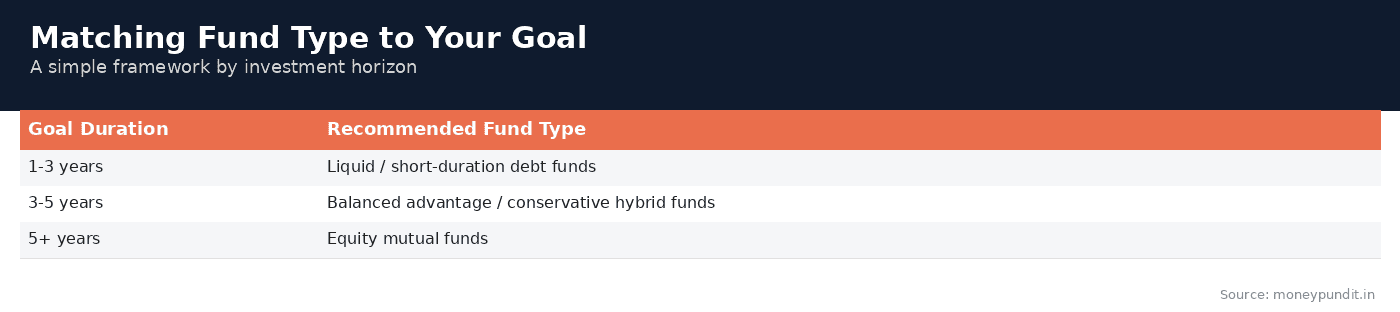
Every investment should be tied to a specific goal. Short-term goals (1-3 years) like building an emergency fund or saving for a vacation are best served by liquid or short-duration debt funds. Medium-term goals (3-5 years) like a car purchase or wedding expenses suit balanced advantage or conservative hybrid funds. Long-term goals (5+ years) like retirement planning, children’s education, or wealth creation align well with equity mutual funds.
Step 2: Assess Your Risk Tolerance
Be honest about how much loss you can stomach. If a 20% portfolio drop would cause you to panic-sell, pure equity funds are not for you. Conservative investors should lean toward debt and hybrid funds. Moderate investors can go with large-cap or flexi-cap equity funds. Aggressive investors can explore mid-cap, small-cap, and sectoral funds. Your risk tolerance often correlates with your investment experience and age.
Step 3: Choose the Right Fund Category
For equity allocation, start with flexi-cap or large-cap funds as your core holding (60-70% of equity). Add mid-cap funds for growth (20-30%). Consider small-cap funds only if you have a 7+ year horizon and high risk appetite (10-20%). For debt allocation, use short-duration or corporate bond funds for 1-3 year needs and liquid funds for emergency reserves.
Step 4: Evaluate Fund Performance
Look at rolling returns over 3, 5, and 10 years rather than point-to-point returns. Compare against the benchmark index and category average. Check if the fund consistently delivers top-quartile performance across market cycles. A fund that is sometimes first and sometimes third quartile but never fourth is more reliable than one that swings between first and fourth.
Step 5: Check Expense Ratio and Fund Size
Choose direct plans to save 0.5-1% in annual expense ratio. For large-cap funds, higher AUM is fine. For mid and small-cap funds, very high AUM (above ₹30,000 crore) can constrain the manager. Ideal AUM range for mid-cap funds is ₹5,000-₹20,000 crore and for small-cap funds is ₹3,000-₹15,000 crore.
Step 6: Review Fund Manager Track Record
Check the fund manager’s experience and track record across market cycles. See how the fund performed during major downturns like March 2020 or the 2022 correction. Consistency in management is important. Frequent fund manager changes can disrupt performance continuity.
How many mutual funds should I hold?
A well-diversified portfolio needs 4-6 funds across categories. Holding more than 8-10 funds leads to over-diversification where your portfolio essentially mimics an index but with higher costs.
Should I invest in NFOs?
Most NFOs do not offer anything new compared to existing funds and lack a track record. Unless the NFO targets a genuinely new segment or strategy not available in existing funds, it is better to invest in proven schemes with established performance histories.
Step 1: Define Your Goal and Time Horizon
The right mutual fund depends entirely on what you’re investing for and when you need the money. Short-term goals (1-3 years) like a vacation or emergency fund → liquid or ultra-short duration debt funds. Medium-term goals (3-5 years) like a car down payment → hybrid or balanced advantage funds. Long-term goals (5-10+ years) like retirement or children’s education → equity funds (large-cap, mid-cap, flexi-cap). Tax saving → ELSS funds with 3-year lock-in.
This goal-first approach eliminates 80% of the confusion. Once you know you need an equity fund for a 15-year goal, your selection universe narrows from 1,500+ mutual fund schemes to about 200. Further narrowing by category (say, flexi-cap for broad market exposure) brings it down to 30-40 schemes. Now the selection becomes manageable.
Step 2: Evaluate Fund Performance and Consistency
Don’t choose funds based solely on 1-year returns: any fund can have a great year. Instead, evaluate performance across multiple time periods: 3-year, 5-year, 7-year, and 10-year rolling returns. A fund that consistently ranks in the top 25% (first quartile) across most periods is more reliable than one that was #1 last year but mediocre in prior years. Use our MF Returns Calculator to compare historical performance across funds.
Check how the fund performed during market downturns (2018, 2020, 2022), a fund that falls less during corrections and recovers faster demonstrates quality fund management. The maximum drawdown (largest peak-to-trough fall) indicates the worst-case scenario you should be prepared for. If a fund’s maximum drawdown is -35%, ask yourself: “Can I stay invested through a 35% decline without panic selling?” If not, choose a less volatile option.
Step 3: Check Costs, Fund Manager, and Fund House
Expense ratio directly reduces your returns: a 1% difference in expense ratio compounds to 15-20% less corpus over 20 years on the same gross returns. Always prefer direct plans (available through AMC websites, MF Utility, Groww, Kuvera) over regular plans, direct plans have 0.5-1% lower expense ratios since they eliminate distributor commissions. For index funds, expense ratio should be below 0.2%; for active equity funds, below 0.8% (direct plan).
Fund manager experience matters for actively managed funds: prefer managers with 5+ years on the specific scheme and a track record of navigating different market cycles. A star fund manager’s departure is a genuine concern; monitor manager changes. Finally, stick with established fund houses (top 15 AMCs by AUM), they have stronger research teams, better risk management frameworks, and more regulatory oversight. Start with one or two funds through SIPs rather than spreading money across 8-10 funds: simplicity usually beats complexity in investing.
The right fund is less about chasing last year’s topper and more about matching the fund’s category, cost, and risk profile to your own timeline. That discipline compounds better than any single hot pick.
References: Amfiindia.com
Source: amfiindia.com
How to choose right mutual fund: Key Takeaways
Key points on how to choose right mutual fund:
- Short-term goals (1-3 years) like building an emergency fund or saving for a vacation are best served by liquid or short-duration debt funds.
- If a 20% portfolio drop would cause you to panic-sell, pure equity funds are not for you.
- For equity allocation, start with flexi-cap or large-cap funds as your core holding (60-70% of equity).
Verify the latest how to choose right mutual fund figures with AMFI before you act.