

Child education planning in brief: A general engineering degree in India today can cost ₹15-25 lakh by the time a child born now is ready for college, and that number keeps climbing faster than most parents’ savings.
A general engineering degree in India today can cost ₹15-25 lakh by the time a child born now is ready for college, and that number keeps climbing faster than most parents’ savings. Here’s how to size that goal correctly and build a monthly investment plan that actually gets you there.
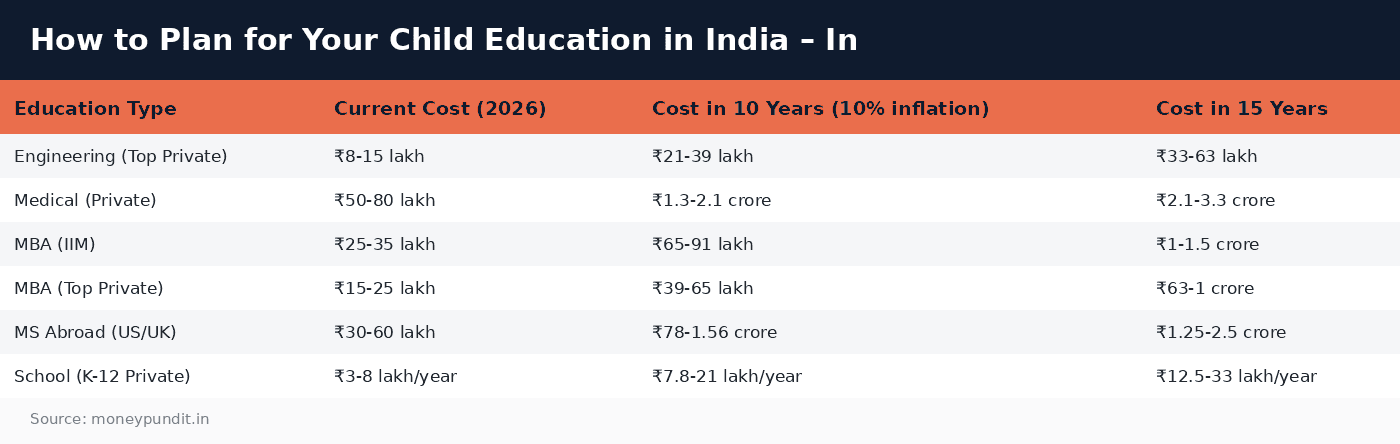
Education costs in India are rising at 8-12% annually: significantly faster than general inflation. An engineering degree that costs ₹8 lakh today could cost ₹20-25 lakh by the time your newborn turns 18. Medical education, IIM programs, and overseas studies cost even more. Without a dedicated education fund started early, parents face the painful choice between compromising on education quality or taking expensive education loans. This guide helps you plan and invest strategically for your child’s education.
Current and Projected Education Costs
| Education Type | Current Cost (2026) | Cost in 10 Years (10% inflation) | Cost in 15 Years |
|---|---|---|---|
| Engineering (Top Private) | ₹8-15 lakh | ₹21-39 lakh | ₹33-63 lakh |
| Medical (Private) | ₹50-80 lakh | ₹1.3-2.1 crore | ₹2.1-3.3 crore |
| MBA (IIM) | ₹25-35 lakh | ₹65-91 lakh | ₹1-1.5 crore |
| MBA (Top Private) | ₹15-25 lakh | ₹39-65 lakh | ₹63-1 crore |
| MS Abroad (US/UK) | ₹30-60 lakh | ₹78-1.56 crore | ₹1.25-2.5 crore |
| School (K-12 Private) | ₹3-8 lakh/year | ₹7.8-21 lakh/year | ₹12.5-33 lakh/year |
Costs include tuition, hostel, books, and living expenses. Education inflation assumed at 10% per annum.
How Much to Save Monthly: SIP Calculator
| Target Amount | Child Age 0 (18 yrs) | Child Age 5 (13 yrs) | Child Age 10 (8 yrs) |
|---|---|---|---|
| ₹25 lakh | ₹3,500/month | ₹6,500/month | ₹15,000/month |
| ₹50 lakh | ₹7,000/month | ₹13,000/month | ₹30,000/month |
| ₹1 crore | ₹14,000/month | ₹26,000/month | ₹60,000/month |
| ₹2 crore | ₹28,000/month | ₹52,000/month | ₹1,20,000/month |
Assumes 12% CAGR from equity mutual funds with annual 10% step-up in SIP amount.
Investment Strategy by Child’s Age
Newborn to Age 5 (15-18 years to goal)
With the longest runway, invest aggressively: 80% in equity (flexi cap funds, mid cap funds, small cap funds) and 20% in SSY (Sukanya Samriddhi for daughters) or PPF. Start SIPs immediately, even ₹5,000/month started at birth grows to approximately ₹40 lakh at 12% CAGR by age 18. This is the most powerful phase due to maximum compounding time.
Age 5-10 (8-13 years to goal)
Maintain 70% equity and 30% debt allocation. If you have not started yet, begin with higher SIP amounts and commit to 10-15% annual step-ups. Review the target corpus annually as education costs and your child’s interests become clearer. This is also the time to explore Sukanya Samriddhi (if not opened earlier and daughter is under 10).
Age 10-14 (4-8 years to goal)
Begin shifting towards a 50-50 equity-debt allocation. Move existing equity gains into balanced advantage funds or debt funds to protect accumulated wealth from market volatility. Continue fresh SIPs in equity for the growth component. By age 12-13, you should have a clear picture of the target amount based on your child’s academic trajectory and career interests.
Age 14-18 (0-4 years to goal)
Shift to 20-30% equity and 70-80% debt. The priority is capital preservation. You cannot afford a 30-40% market crash when the money is needed in 1-2 years. Move funds into short-duration debt funds, FDs, or liquid funds. By age 16-17, the entire corpus should be in safe, liquid instruments ready for deployment.
Best Investment Options for Education Fund
| Instrument | Best For | Expected Returns | Risk |
|---|---|---|---|
| Equity Mutual Funds (SIP) | Long-term growth (8+ years) | 12-15% | High (short-term) |
| Sukanya Samriddhi Yojana | Girl child (guaranteed, tax-free) | 8.2% | Zero |
| PPF | Guaranteed component | 7.1% | Zero |
| Child-Specific MF Plans | Lock-in until child turns 18 | 10-14% | Moderate to High |
| Balanced Advantage Funds | Medium-term (3-7 years) | 8-10% | Moderate |
| Debt Funds / FDs | Short-term (1-3 years to goal) | 6-8% | Low |
Avoid These Education Planning Mistakes
Buying Child Insurance Plans
Insurance companies aggressively sell “child plans” that combine life insurance with investment. These plans typically deliver 5-7% returns, barely beating inflation. A term insurance plan (₹8,000-₹12,000/year) plus equity SIPs with the remaining amount will create a significantly larger education fund. Keep insurance and investment separate.
Starting Too Late
Every year of delay dramatically increases the required monthly investment. Starting at birth with ₹7,000/month can achieve ₹50 lakh by age 18. Starting at age 10 requires ₹30,000/month for the same target. The cost of delay is not linear. It is exponential due to lost compounding.
Not Accounting for Education Inflation
Using general inflation (5-6%) instead of education inflation (8-12%) leads to severe underestimation. An IIM MBA costing ₹25 lakh today will cost ₹65+ lakh in 10 years at 10% education inflation. Build your target corpus using 10% inflation for education costs, not the general CPI number.
Education Loan as Supplement
Even with an education fund, you might consider a partial education loan for several reasons. The Section 80E tax deduction on education loan interest (no upper limit, available for 8 years) provides significant tax savings. A child repaying their own education loan develops financial responsibility. And the education fund can continue earning returns while the loan is being repaid at a lower interest cost. A balanced approach: fund 60-70% from savings and 30-40% from an education loan.
Frequently Asked Questions
Should I save for education or retirement first?
Prioritise retirement savings, then education. Your child can take an education loan with Section 80E tax benefits, but there is no “retirement loan.” Fund your retirement adequately first, then allocate surplus to the education fund. If both compete for limited resources, ensure at least your EPF + PPF contributions continue for retirement while starting a modest education SIP.
Is Sukanya Samriddhi enough for my daughter’s education?
SSY at ₹1.5 lakh/year for 15 years at 8.2% creates approximately ₹46 lakh at maturity, insufficient for premium education by the time she turns 18-21. Use SSY as the guaranteed base (₹46 lakh) and supplement with equity mutual fund SIPs (target ₹30-50 lakh additional) for a comprehensive education corpus.
What if my child gets a scholarship or chooses a less expensive path?
An over-funded education corpus is never a problem: it becomes a head start for your child’s investment portfolio, home down payment fund, or addition to your own retirement savings. The flexibility of mutual funds means you can redirect the corpus to any goal. Under-funding is the real risk.
References: Amfiindia.com
Child education planning: Key Takeaways
Key points on child education planning:
- Assumes 12% CAGR from equity mutual funds with annual 10% step-up in SIP amount.
- With the longest runway, invest aggressively: 80% in equity (flexi cap funds, mid cap funds, small cap funds) and 20% in SSY (Sukanya Samriddhi for daughters) or PPF.
- Insurance companies aggressively sell “child plans” that combine life insurance with investment.
Verify the latest child education planning figures with RBI before you act.