
The nsc interest rate 2026 in brief: Frequently Asked Questions About NSC Interest Rate 2026 Can I buy NSC for my minor child?
You can verify the current NSC interest rate anytime on our live small savings interest rate tracker, which also tracks PPF, EPF, KVP, SCSS, and SBI FD rates in one place.
NSC Interest Rate 2026 & Key Features
| Feature | Details |
|---|---|
| Interest Rate | 7.7% per annum (compounded annually) |
| Maturity Period | 5 years |
| Minimum Investment | ₹1,000 |
| Maximum Investment | No upper limit |
| Tax Benefit | Section 80C deduction (no cap on investment, but 80C limit is ₹1.5L) |
| Interest Taxation | Taxable at slab rate (but re-invested interest qualifies for 80C in years 1-4) |
| Premature Withdrawal | Only in exceptional circumstances (death, court order) |
| Loan Collateral | Accepted by banks as collateral for secured loans |
How NSC Interest Rate Works in 2026
NSC interest is compounded annually but not paid out: it is reinvested automatically and paid along with the principal at maturity. A ₹1,00,000 NSC investment grows as follows: Year 1 end: ₹1,07,700, Year 2 end: ₹1,15,993, Year 3 end: ₹1,24,924, Year 4 end: ₹1,34,543, Year 5 (maturity): ₹1,44,903. Your total interest earned is ₹44,903 on a ₹1 lakh investment over 5 years.
This means the effective annual yield at the current NSC interest rate 2026 of 7.7% works out to approximately 44.9% total return over the 5-year tenure. Unlike bank fixed deposits where interest can be withdrawn periodically, NSC enforces complete reinvestment, ensuring the full power of compounding works in your favour. The interest rate is fixed at the time of purchase and remains unchanged for the entire 5-year period, regardless of any future rate revisions by the government.
NSC Tax Treatment: The Unique Advantage
NSC has a clever tax advantage that many investors overlook. The annual interest is deemed to be reinvested in NSC, and this reinvested interest qualifies for Section 80C deduction in years 1 through 4. In year 5, the interest is paid out at maturity and is taxable. This means for the first 4 years, the interest effectively earns you a tax deduction even though you cannot access it.
For example, on a ₹1.5 lakh NSC investment: Year 1 interest of ₹11,550 qualifies for 80C deduction, Year 2 interest of ₹12,440 qualifies for 80C, and so on. If your other 80C investments do not exhaust the ₹1.5 lakh limit, the NSC interest reinvestment automatically fills the gap without any additional action from you.
NSC Interest Rate 2026 vs Other Fixed-Return Investments
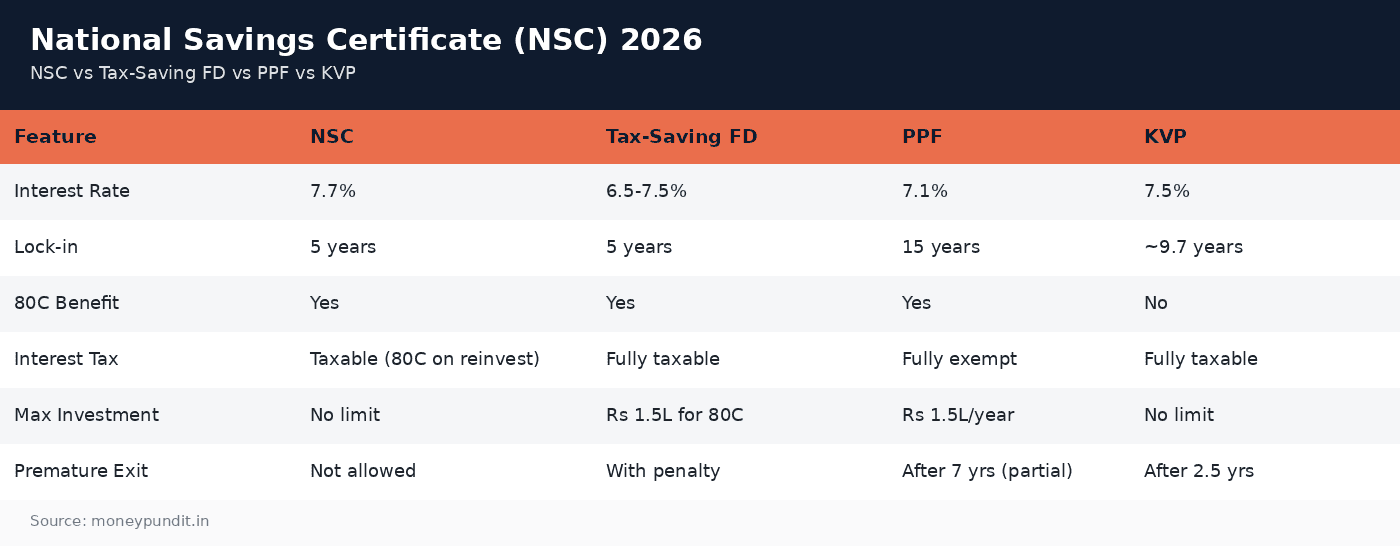
Use our FD Calculator to compare returns side by side. Here is how NSC stacks up against other popular fixed-return options:
| Feature | NSC | Tax-Saving FD | PPF | KVP |
|---|---|---|---|---|
| Interest Rate | 7.7% | 6.5-7.5% | 7.1% | 7.5% |
| Lock-in | 5 years | 5 years | 15 years | ~9.7 years (doubles) |
| 80C Benefit | Yes | Yes | Yes | No |
| Interest Tax | Taxable (but 80C on reinvest) | Fully taxable | Fully exempt | Fully taxable |
| Max Investment | No limit | ₹1.5L for 80C | ₹1.5L/year | No limit |
| Premature Exit | Not allowed | With penalty | After 7 years (partial) | After 2.5 years |
As the table shows, the NSC interest rate 2026 of 7.7% is the highest among all comparable government-backed instruments. While PPF offers tax-free returns at 7.1%, the 15-year lock-in makes it far less liquid than NSC. Tax-saving FDs from banks offer rates between 6.5% and 7.5%, but the interest is fully taxable with no reinvestment benefit. For investors who want a balance of competitive returns, tax efficiency, and a reasonable 5-year lock-in, NSC stands out as the clear winner in 2026.
Who Should Invest in NSC at the Current Interest Rate?
Conservative Investors
If you want guaranteed returns with sovereign safety and a defined 5-year horizon, NSC delivers better returns than most bank FDs. The guaranteed 7.7% is locked for 5 years regardless of future interest rate changes, providing certainty in an uncertain rate environment.
Tax Planners Needing Extra 80C Capacity
If your EPF contribution, life insurance premium, and children’s tuition fees do not exhaust the ₹1.5 lakh 80C limit, NSC is a convenient way to fill the gap. You can invest any amount, and the reinvested interest provides additional 80C benefit in subsequent years.
Senior Citizens
While SCSS (Senior Citizens Savings Scheme) is typically better for seniors due to quarterly interest payouts, NSC serves as a useful complement if the SCSS ₹30 lakh limit is reached and additional safe investment avenues are needed.
How to Buy NSC in 2026
NSC can be purchased at any post office across India. You need to fill Form NC-1, provide identity proof (Aadhaar/PAN), address proof, and a passport-sized photograph. Payment can be made by cash, cheque, or demand draft. Some post offices also offer online NSC purchase through the DOP (Department of Posts) internet banking platform. NSC is issued in electronic form linked to your post office savings account.
The minimum investment in NSC is just ₹1,000 (in multiples of ₹100), and there is no maximum limit, making it accessible for small savers and large investors alike. You can purchase NSC online through the India Post official website using internet banking. Joint accounts (up to 3 adults) and minor accounts through guardians are also available. To lock in the current NSC interest rate 2026 of 7.7%, it is advisable to invest before the next quarterly rate review by the Ministry of Finance.
NSC as Loan Collateral
One practical advantage of NSC is its acceptance as collateral security for bank loans. If you need a loan but do not want to break your NSC investment, you can pledge the certificates with a bank to avail a secured loan at lower interest rates than unsecured personal loans. The bank holds the NSC certificates until the loan is repaid, and you continue earning the 7.7% interest on your NSC during this period.
According to Reserve Bank of India (RBI) guidelines, most nationalised banks and scheduled commercial banks accept NSC as security for loans. The loan amount is typically up to 80-90% of the NSC face value plus accrued interest. This makes NSC a dual-purpose instrument. It earns you guaranteed returns at the NSC interest rate 2026 while simultaneously serving as a ready source of emergency credit without breaking your investment.
Related Articles & Tools
- FD Calculator: Calculate your fixed deposit maturity amount and interest earned
- PPF Calculator: Compare PPF returns with NSC over the same period
- Best FD Rates in India 2026: Compare interest rates across all major banks
- PPF vs ELSS: Which tax-saving investment is right for you?
- Tax Planning Guide: Complete guide to saving tax in India
- NPS Guide: Another government-backed investment with tax benefits
NSC Interest Rate History: How Rates Have Changed
The NSC interest rate is revised quarterly by the Ministry of Finance as part of the Small Savings Scheme review. Here is how rates have moved in recent years:
- 2019-2020: 7.9%: The highest in recent years
- 2020-2021: 6.8%: Reduced during the pandemic period
- 2021-2022: 6.8%: Unchanged through the fiscal year
- 2022-2023: 7.0%: Gradual recovery began
- 2023-2024: 7.7%: Significant rate increase
- 2024-2026: 7.7%: NSC interest rate 2026 remains stable at this level
The current NSC interest rate 2026 of 7.7% has been unchanged since Q1 2023-24, reflecting the government’s commitment to making small savings attractive for retail investors. While rate cuts are always possible in future quarters, investors who buy NSC now will lock in 7.7% for the full 5-year tenure regardless of future changes.
How the NSC Interest Rate Is Decided
NSC rates aren’t set arbitrarily. Along with PPF, SSY, and other small savings instruments, the NSC rate is reviewed every quarter by the Ministry of Finance using a formula recommended by the Shyamala Gopinath Committee (2011): the rate is benchmarked to the yield on government securities (G-Secs) of comparable maturity, plus a small spread. This is why NSC, PPF, and other small savings rates tend to move together and broadly track the direction of interest rates in the wider economy, even though each is announced separately.
In practice, the government has kept most small savings rates unchanged for extended stretches even when G-Sec yields drift slightly, to avoid disrupting saver expectations, which is part of why the 7.7% NSC rate has held steady since mid-2023 despite RBI’s repo rate moving in both directions over the same period.
What Rate Changes Mean for Your NSC Investment
Because NSC has a fixed 5-year tenure with interest compounded annually but paid out only at maturity, the rate you lock in on the day you invest determines your entire return. Here’s how a Rs 1,00,000 investment grows at three different rates from the history above:
| Rate (locked at purchase) | Maturity Value (5 years) | Total Interest Earned |
|---|---|---|
| 6.8% (2020-2022 rate) | ~Rs 1,39,000 | ~Rs 39,000 |
| 7.0% (2022-2023 rate) | ~Rs 1,40,000 | ~Rs 40,000 |
| 7.7% (current, since 2023) | ~Rs 1,45,000 | ~Rs 45,000 |
Unlike a bank FD, you can’t renegotiate or break an NSC early to chase a better rate elsewhere without losing the tax benefits already claimed, so the rate at purchase is effectively locked in for the full term.
NSC Rate vs Inflation: Is 7.7% Still Worth It?
NSC interest is fully taxable at your income slab rate (unlike PPF, which is tax-free on maturity). For an investor in the 30% tax bracket, a 7.7% NSC rate works out to roughly 5.4% post-tax. If retail inflation runs at 4-5%, that leaves a modest but positive real return. Better than a comparable bank FD in most years, but not by a wide margin.
The real appeal of NSC for most investors isn’t the headline rate; it’s the combination of a government guarantee, Section 80C deduction on the amount invested (up to Rs 1.5 lakh), and a fixed 5-year lock that removes the temptation to churn the investment. Investors purely chasing the highest post-tax yield should compare NSC against tax-saving FDs and the Senior Citizen Savings Scheme, both of which sometimes edge out NSC depending on the rate cycle.
Frequently Asked Questions About NSC Interest Rate 2026
Can I buy NSC for my minor child?
Yes, NSC can be purchased in the name of a minor child by the parent or guardian. The investment qualifies for 80C deduction in the parent’s tax return. Upon maturity, the amount is paid to the minor (or guardian if the child is still a minor).
What happens if I lose my NSC certificate?
Since NSC is now issued in electronic (passbook) form linked to your post office account, physical loss is not a concern. For older paper certificates, you can apply for duplicate certificates at the issuing post office with an indemnity bond and identity proof.
Is NSC interest compounded monthly or annually?
NSC interest is compounded annually, not monthly or quarterly. This means interest earned in year 1 earns additional interest from year 2 onwards. While annual compounding is less frequent than the monthly compounding of some bank FDs, the higher base rate of 7.7% compensates for this difference.
Can NRIs invest in NSC?
NRIs cannot purchase new NSC certificates. However, if an Indian resident who holds NSC becomes an NRI, the existing certificates continue until maturity and can be encashed normally. The maturity proceeds are subject to TDS provisions applicable to NRIs.
Is NSC interest rate 2026 likely to change soon?
The NSC interest rate 2026 of 7.7% has been stable since April 2023. While the government reviews small savings rates every quarter, the current rate is expected to remain unchanged for at least the near term given India’s strong retail savings inflow. However, if the RBI cuts the repo rate significantly, a future reduction is possible, which is why locking in the current 7.7% rate now can be a smart move.
References: Rbi.org.in