
Kvp interest rate in brief: The current KVP interest rate is 7.5% per annum, which doubles your investment in exactly 115 months (9 years 7 months).
Kisan Vikas Patra (KVP) has one of the simplest value propositions of any government savings scheme: put money in, and it doubles, guaranteed, with a fixed and known timeline. The current KVP interest rate is 7.5% per annum, which doubles your investment in exactly 115 months (9 years 7 months).

Current KVP Interest Rate 2026
The Kisan Vikas Patra interest rate is 7.5% per annum, compounded annually, reviewed quarterly by the Ministry of Finance alongside PPF, NSC, SCSS, and the other small savings schemes. The rate has been held unchanged since October 2023, eight consecutive quarters, making it one of the more stable rates in the small savings family even as bank FD and RD rates have started drifting down with the RBI’s ongoing rate-cutting cycle.
At 7.5%, a KVP investment takes exactly 115 months (9 years 7 months) to double. This “doubling period” is KVP’s headline feature and is recalculated by the Finance Ministry each time the rate changes, a higher rate shortens it, a lower rate extends it.
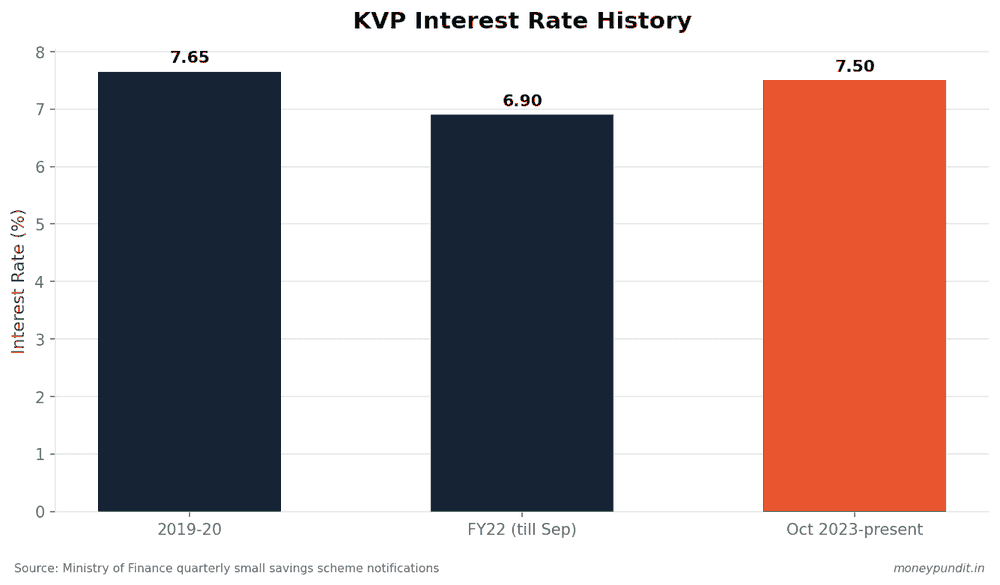
KVP Interest Rate History
| Period | KVP Rate | Doubling Period |
|---|---|---|
| 2019-20 | 7.6% – 7.7% | ~113 months |
| FY 2022 (till Sep) | 6.9% | ~124 months |
| Oct 2023 – present | 7.5% | 115 months (current) |
Source: Ministry of Finance quarterly small savings scheme notifications.
KVP Rules: Lock-in, Denominations & Limits
- Lock-in period: 30 months (2 years 6 months). Premature encashment isn’t allowed before this except in case of the holder’s death, a court order, or forfeiture by a pledgee.
- Minimum investment: Rs 1,000, in multiples of Rs 100 thereafter. There is no maximum investment limit.
- Available denominations: Rs 1,000, Rs 5,000, Rs 10,000, and Rs 50,000 certificates.
- Where to buy: Any post office, and select public sector bank branches. Can be held individually, jointly, or on behalf of a minor.
- Guarantee: Both the principal and the doubling are backed by a sovereign (Government of India) guarantee, zero market risk, unlike mutual funds or stocks.
KVP Tax Treatment
Unlike PPF or NSC, KVP offers no Section 80C deduction on the amount invested. The interest earned is fully taxable at your income tax slab rate each year on an accrual basis, even though it’s only paid out at maturity. Similar to how bank FD interest is taxed. There’s no TDS deducted by the post office at the time of maturity payout, so you’re responsible for declaring and paying tax on the accrued interest yourself. This makes KVP most tax-efficient for investors in lower tax brackets, or for parking funds where the guarantee matters more than the post-tax return.
How Much Will Your KVP Be Worth? Examples at 7.5%
At 7.5% compounded annually, a KVP doubles in 115 months (9 years 7 months). The table shows approximate values for a Rs 1,00,000 investment if you hold the certificate for different periods. Actual encashment values follow the Post Office schedule, so confirm the figure at your branch before you plan around it.
| 2.5 years (lock-in ends) | Rs 1,19,800 | Rs 19,800 |
| 5 years | Rs 1,43,600 | Rs 43,600 |
| 7 years | Rs 1,65,900 | Rs 65,900 |
| 115 months (maturity) | Rs 2,00,000 | Rs 1,00,000 |
The money roughly doubles only if you hold to maturity. Selling earlier still earns the compounded rate, but you give up the last stretch of growth, where compounding does most of its work.
KVP vs PPF vs NSC vs Bank FD
KVP suits people who want a guaranteed, government-backed doubling with no tax saving. If you want a tax deduction or a longer horizon, other small savings schemes may fit better.
| Rate (Oct-Dec 2026) | 7.5% | 7.7% | 7.1% |
| Tenure | 115 months | 5 years | 15 years |
| Section 80C deduction | No | Yes | Yes |
| Interest taxable | Yes, on accrual | Yes, on accrual | No (EEE) |
| Premature exit | After 2.5 years | Very limited | Partial, after 5 years |
Bank FD rates vary by bank and tenure. Compare current offers on our best FD rates page or run your own numbers in the FD calculator. For tax-free growth, PPF wins. For a fixed, short doubling period without market risk, KVP is simple.
Who Should Invest in KVP?
KVP works well for conservative investors who want a known maturity date and amount, who do not need a tax deduction, and who can leave the money untouched for at least 30 months. It is less suited if you are in the 30% tax bracket, since the accrued interest is taxed at your slab rate every year, or if you want regular income, since KVP pays nothing until maturity.
Related Guides & Tools
- Post Office Savings Schemes 2026: Complete Guide
- NSC Interest Rate 2026 vs FD, PPF & KVP
- RD Interest Rates 2026: Bank Comparison & History
- PPF Interest Rate History (1986-2026)
Frequently Asked Questions
What is the current KVP interest rate?
The current Kisan Vikas Patra interest rate is 7.5% per annum, compounded annually, unchanged since October 2023. At this rate, an investment doubles in 115 months (9 years 7 months).
How long does it take for KVP to double my money?
At the current 7.5% rate, KVP doubles your investment in exactly 115 months, 9 years and 7 months. This doubling period is fixed by the Finance Ministry each quarter based on the prevailing interest rate; it was as short as ~113 months when rates were higher (7.6-7.7% in 2019-20) and as long as ~124 months when the rate dipped to 6.9% in 2022.
Can I withdraw my KVP investment before maturity?
KVP has a 30-month (2.5-year) lock-in period during which premature encashment is generally not permitted, except in the case of the certificate holder’s death, an order by a court, or forfeiture by a pledgee (such as a bank the certificate was pledged to). After 30 months, premature encashment is allowed.
Is KVP interest taxable?
Yes. KVP offers no Section 80C deduction on investment, and the interest earned is fully taxable at your income tax slab, accrued annually even though paid only at maturity. No TDS is deducted by the post office. You must declare and pay the tax yourself.
Is Kisan Vikas Patra only for farmers?
No. Despite the name (which translates to “Farmer’s Development Certificate”), any resident Indian individual can invest in KVP. It isn’t restricted to farmers. The scheme is open to individuals, joint holders, and can be purchased on behalf of a minor.
Disclaimer: Interest rates are reviewed quarterly by the Ministry of Finance and subject to change. Figures above are indicative, verify the current rate and doubling period at your nearest post office before investing.
Reviewed by: MoneyPundit Team | Last updated: September 9, 2026
Data source: Ministry of Finance quarterly small savings scheme interest rate notifications; India Post KVP scheme rules.
Methodology: Doubling period reflects the officially notified figure for each rate period, as published alongside the quarterly small savings rate revision.
Is KVP better than a bank FD?
It depends on the current FD rate for your tenure and your tax slab. KVP is government-backed and its rate is fixed for the certificate, but interest is taxed on accrual like an FD, so the deciding factor is usually the rate gap and how long you can lock the money in.
Can a KVP certificate be transferred?
Yes. A KVP can be transferred from one person to another and from one post office to another, subject to the Post Office rules and the forms they require.
Can I buy KVP online?
KVP is mainly issued at post office counters, so check with your nearest branch for the current process.
Kvp interest rate: Key Takeaways
Key points on kvp interest rate:
- The Kisan Vikas Patra interest rate is 7.5% per annum, compounded annually , reviewed quarterly by the Ministry of Finance alongside PPF, NSC, SCSS, and the other small savings schemes.
- Source: Ministry of Finance quarterly small savings scheme notifications.
- Unlike PPF or NSC, KVP offers no Section 80C deduction on the amount invested.
Verify the latest kvp interest rate figures with RBI before you act.