

Use this SSY calculator to project your daughter’s Sukanya Samriddhi Yojana maturity value at the current 8.2% interest rate, and compare it with our PPF calculator for another tax-free option.
What is Sukanya Samriddhi Yojana (SSY)?
Sukanya Samriddhi Yojana is a government-backed savings scheme launched in 2015 under the Beti Bachao Beti Padhao campaign, designed specifically for the girl child. It offers one of the highest interest rates among government small savings schemes (currently 8.2% p.a. for Oct-Dec 2026) with EEE (Exempt-Exempt-Exempt) tax status, making it arguably the best risk-free investment for a girl child’s education and marriage.
An SSY account can be opened by a parent or legal guardian for a girl child below 10 years of age. A maximum of two accounts can be opened, one for each daughter (three in case of twins/triplets as the second birth). The account matures 21 years from the date of opening or upon the girl’s marriage after age 18.
SSY Interest Rate History
| Period | Interest Rate |
|---|---|
| April 2014 – March 2015 | 9.1% |
| April 2015 – March 2016 | 9.2% |
| April 2016 – Sept 2016 | 8.6% |
| Oct 2016 – March 2018 | 8.4% |
| April 2018 – June 2019 | 8.1% |
| July 2019 – March 2023 | 7.6% |
| April 2023 – Present | 8.2% |
SSY Investment Rules
Minimum annual deposit: ₹250 (reduced from ₹1,000 in 2019). Maximum annual deposit: ₹1,50,000. Deposits must be made for 15 years from account opening, after which the account continues to earn interest until maturity at 21 years. Missing the minimum deposit attracts a penalty of ₹50 plus the shortfall amount to reactivate.
Maturity Projections
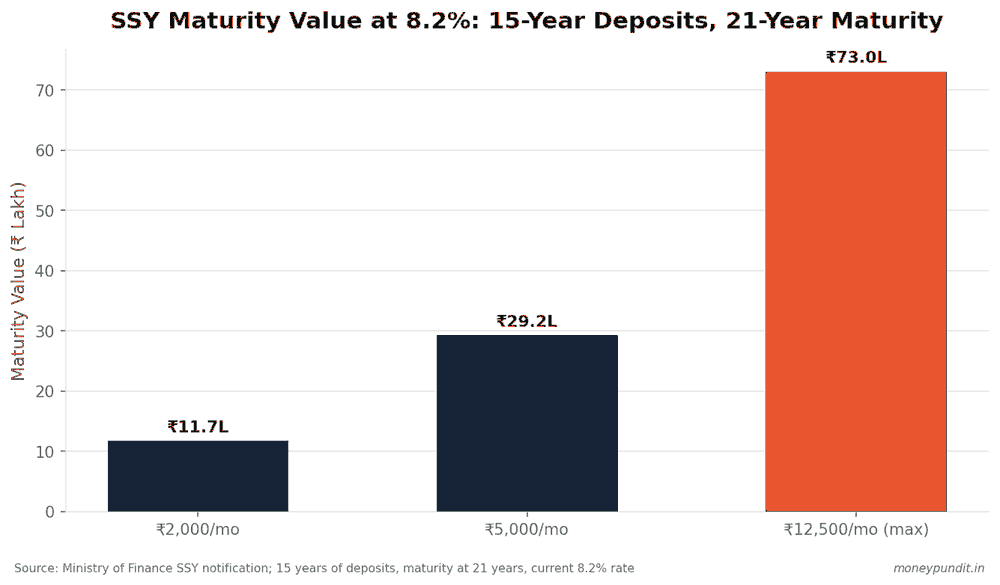
| Annual Investment | Total Invested (15 yrs) | Maturity Value (21 yrs) @8.2% | Interest Earned |
|---|---|---|---|
| ₹12,500/month | ₹22,50,000 | ~₹73,00,000 | ~₹50,50,000 |
| ₹5,000/month | ₹9,00,000 | ~₹29,20,000 | ~₹20,20,000 |
| ₹2,000/month | ₹3,60,000 | ~₹11,70,000 | ~₹8,10,000 |
| ₹250 (minimum) | ₹3,750 | ~₹12,200 | ~₹8,450 |
Partial Withdrawal and Premature Closure
Partial withdrawal of up to 50% of the balance is allowed after the girl turns 18, for higher education purposes. The account can be prematurely closed after 5 years in specific circumstances: death of account holder, extreme compassionate grounds (life-threatening illness), or change in residency status of the guardian. Premature closure attracts interest at 1.5% less than the scheme rate.
SSY vs PPF vs FD: Which is Better for Your Daughter?
Run the numbers in the SSY calculator above for a direct comparison. SSY offers the highest interest rate (8.2%) among EEE instruments. PPF gives 7.1% with EEE status but has a 15-year lock-in without gender restriction. FDs offer 6.5-7.5% but interest is fully taxable. For a girl child’s long-term goals, SSY is clearly superior due to higher returns and complete tax exemption on the corpus.
SSY Maturity Example: ₹1.5 Lakh a Year
If you deposit the maximum ₹1,50,000 early each year for 15 years at 8.2%, you invest ₹22,50,000 in total. The account matures 21 years after opening, and the balance is roughly ₹71.8 lakh, most of it interest. Deposits stop after year 15 but interest keeps compounding until year 21.
Approximate figures. The SSY rate is reset every quarter by the government, and the exact result depends on when in the year you deposit.
Can NRIs open or continue SSY accounts?
As per current rules, NRIs cannot open new SSY accounts. However, accounts opened before the guardian became NRI can continue till maturity. If the girl child becomes a non-resident, the account earns only the savings bank rate (4%) from the date of NRI status until closure. It’s advisable to close the account upon change of residency status.
What if I miss a year’s deposit in SSY?
If you fail to deposit the minimum ₹250 in any year, the account becomes inactive (default). To reactivate, you must pay the penalty of ₹50 per default year plus the minimum deposit of ₹250 for each default year. The account continues to earn interest even during the default period, but reactivation is mandatory to make future deposits.
Can I open SSY in a different state from where I live?
Yes, SSY accounts can be opened at any post office or authorized bank across India, regardless of your domicile. The account is also freely transferable between post offices and banks anywhere in the country at no cost. This makes it convenient if you relocate for work.
How to Use the SSY Calculator
Our Sukanya Samriddhi Yojana calculator helps you estimate the maturity value of your SSY investment. Enter the annual deposit amount (minimum ₹250, maximum ₹1,50,000), your daughter’s current age, and the current interest rate. The calculator projects the year-by-year growth, total deposits, interest earned, and the maturity amount when your daughter turns 21.
SSY Interest Rate History and Current Rate
The Sukanya Samriddhi Yojana interest rate is reviewed quarterly by the government. As of 2026, the SSY interest rate stands at 8.2% per annum, compounded annually: making it one of the highest-yielding government-backed savings schemes in India. This rate has remained attractive compared to other small savings instruments:
Historically, SSY rates have ranged from 7.6% to 9.2% since the scheme’s launch in January 2015. Even at its lowest, SSY has consistently offered better returns than PPF (currently 7.1%), NSC (7.7%), and bank fixed deposits (6-7.5%). The government keeps SSY rates higher as a policy measure to promote the financial security of girl children across India.
Sukanya Samriddhi Yojana Rules and Benefits
The SSY scheme is specifically designed for the girl child and comes with several unique features. The account can be opened by a parent or legal guardian for a girl child below 10 years of age. Each family can open a maximum of two SSY accounts (one per daughter), with an exception for twins/triplets born in the second delivery. Deposits can be made for the first 15 years from the date of account opening, and the account matures 21 years from the date of opening.
SSY enjoys the EEE (Exempt-Exempt-Exempt) tax status: deposits up to ₹1,50,000 qualify for deduction under Section 80C, the interest earned is completely tax-free, and the maturity amount is also exempt from income tax. This triple tax benefit, combined with the high interest rate, makes SSY one of the most tax-efficient investment options for parents of daughters.
Partial Withdrawal and Premature Closure
The scheme allows partial withdrawal of up to 50% of the balance at the end of the preceding financial year once the girl child turns 18 or has passed 10th standard (whichever is later). This provision is designed to help cover higher education expenses. The remaining balance continues to earn interest until maturity.
Premature closure is permitted under specific circumstances: if the girl child passes away (unfortunate but necessary provision), if the guardian faces a life-threatening medical condition, or if the girl marries after turning 18. In case of premature closure, the balance earns the applicable SSY rate, not the lower post office savings rate. Transfer of the account between banks and post offices is freely allowed and can be done without any charges.
SSY vs Other Investment Options for Your Daughter
When planning for your daughter’s future, compare SSY with other long-term options. While SSY offers guaranteed 8.2% returns with tax benefits, ELSS mutual funds have historically delivered 12-15% CAGR over 15+ year periods, though with market risk. A balanced approach often works best, invest ₹1,50,000 in SSY for the guaranteed, tax-free base, and additional amounts through SIP in equity mutual funds for potentially higher growth.
For example, investing ₹1,50,000 annually in SSY at 8.2% for 15 years (with maturity at 21 years) would yield approximately ₹69 lakh. A parallel SIP of ₹5,000 per month in a flexi-cap fund earning 12% CAGR over 21 years would add approximately ₹56 lakh. Together, your daughter would have a corpus of over ₹1.25 crore by age 21. A powerful combination of safety and growth.
Reviewed by: MoneyPundit Team | Last updated: July 2, 2026
Data source: Ministry of Finance quarterly Small Savings Schemes notification (indiapost.gov.in), current Sukanya Samriddhi Yojana rate.
Methodology: Annual compounding applied to the current government-notified SSY rate, per scheme rules (deposits allowed until the girl child turns 15, maturity at 21).