
The steps in brief: For floating-rate loans to individuals for non-business purposes, the RBI directions effective 1 Jan 2026 bar prepayment and foreclosure charges.

How to close a loan account in India: step by step
Step 1: Request the foreclosure statement
Ask your lender for a foreclosure or pre-closure statement with a validity date. It shows principal outstanding, accrued interest up to that date, and any charges. Do the calculation yourself too, using our EMI and loan tools, so you can spot mistakes. If you hold a home loan, our home loan interest rates comparison will also tell you whether a balance transfer is cheaper than closing.
Step 2: Check whether a prepayment charge applies
For floating-rate loans to individuals for non-business purposes, the RBI directions effective 1 Jan 2026 bar prepayment and foreclosure charges. Fixed-rate loans can still carry a charge, which an aggregator reports at roughly 2 percent to 6 percent depending on the lender and product. Read the sanction letter for the clause and note that business loans are outside the no-charge rule.
Step 3: Pay the exact amount and keep proof
Pay by net banking or demand draft to the loan account, never to an individual. Keep the receipt and the bank’s confirmation. Pay only up to the validity date on the statement, otherwise interest for extra days is added.
Step 4: Collect the no-dues certificate and closure letter
Ask for a no-dues certificate (NOC) and a loan closure letter showing zero balance. Check that the loan account number, your name and the closure date are correct.
Step 5: Get original documents back and the charge released
For secured loans, the lender holds original property papers, a vehicle registration with hypothecation, or pledged gold. The RBI directions as reported require the lender to return the original documents and remove its charge, including the CERSAI entry for property loans, within 30 days of closure. For vehicle loans, you also need the hypothecation removed from the registration certificate at the transport office, using the paperwork the lender provides.
Step 6: Verify the credit report
After about 30 days, check that the loan shows as closed with zero balance on your credit report. Our credit score guide explains how to read it and dispute errors.
Prepayment and foreclosure charge rules
| Loan type | Prepayment or foreclosure charge | Source and date |
|---|---|---|
| Floating-rate loan to an individual, non-business purpose | No charge | RBI directions effective 1 Jan 2026 (RBI prepayment charges directions effective 1 Jan 2026, as summarised by an aggregator, accessed 7 Oct 2026) |
| Fixed-rate loan to an individual | May carry a charge, reported at about 2 percent to 6 percent | Aggregator summary, accessed 7 Oct 2026 |
| Business loans | Not covered by the no-charge rule for non-business loans | As reported, accessed 7 Oct 2026 |
| Gold loan | Not verified from a dated source in this review | Check the lender’s terms |
Return of original documents: the 30 day rule
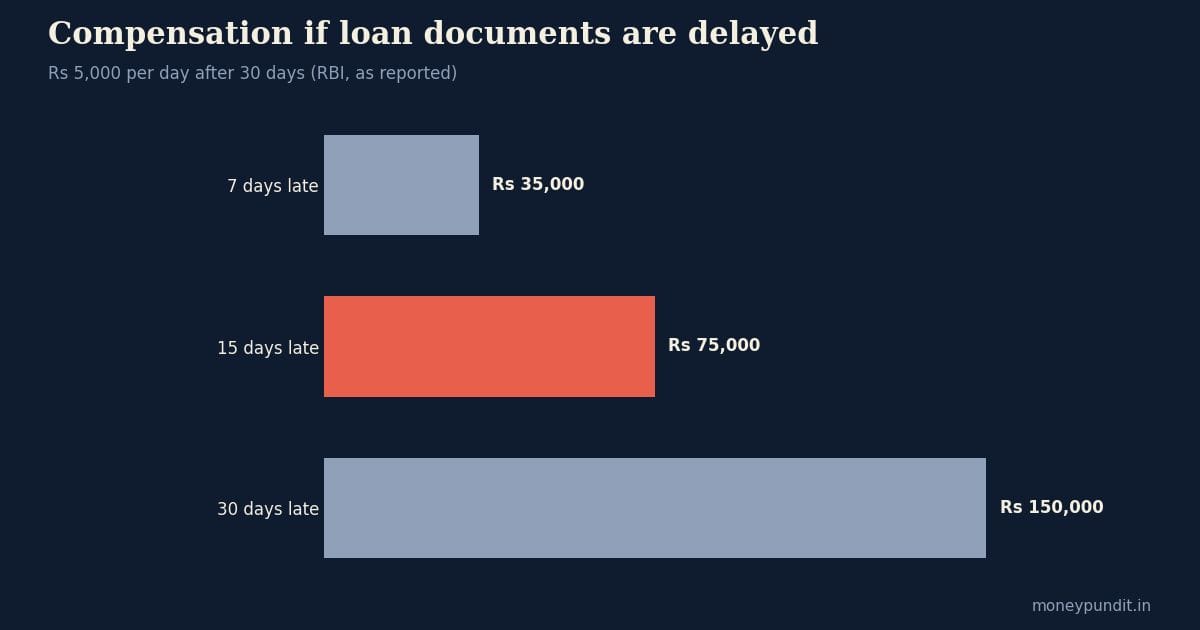
As reported, if the lender does not return the original property documents and release the charge within 30 days of closure, it owes you Rs 5,000 for every day of delay. The chart shows what that adds up to.
| Delay beyond 30 days | Compensation at Rs 5,000 per day |
|---|---|
| 7 days | Rs 35,000 |
| 15 days | Rs 75,000 |
| 30 days | Rs 150,000 |
The totals are our own arithmetic on the Rs 5,000 per day figure and assume the rule applies to your loan as described. Confirm the exact scope of the rule with the lender or the RBI before you claim.
Documents to collect, by loan type
| Loan type | Documents to collect on closure | Related guide |
|---|---|---|
| Home loan | No-dues certificate, original property papers, CERSAI charge removal, closure letter | Home loan rates |
| Personal loan | No-dues certificate, closure letter, cancelled NACH mandate | Personal loan rates |
| Car loan | No-dues certificate, hypothecation removal paperwork for the RC, closure letter | Car loan rates |
| Education loan | No-dues certificate, closure letter, return of any collateral papers | Education loan rates |
| Gold loan | Return of pledged ornaments, closure letter | Gold loan rates |
Lender-specific closure processes: what we could and could not verify
| Lender group | Verified closure steps or charges | Status |
|---|---|---|
| SBI, HDFC Bank, ICICI Bank, Axis Bank, Kotak Mahindra Bank | No dated lender source reviewed for closure steps | Not verified, rely on the RBI rules above |
| PNB, Bank of Baroda, Canara, Union Bank, Indian Bank | No dated lender source reviewed | Not verified |
| NBFCs and housing finance companies | Rules may differ by regulator and product | Not verified, read the sanction letter |
We found aggregator summaries of the RBI rules but no dated lender pages for closure steps, so we mark each group as unverified instead of guessing. The RBI directions apply to regulated lenders, but how a lender applies them to older loans and which products it treats as floating-rate should be confirmed in writing.
If the lender delays or overcharges
Complain to the lender’s grievance officer first and keep the acknowledgement. If you are not satisfied, escalate to the RBI Integrated Ombudsman. The Reserve Bank of India publishes its directions in full.
Should you close early or keep paying?
Compare your loan rate with what a safe deposit earns before you pour savings into a prepayment. Our credit card closure guide and bank account closure guide cover the other accounts you may tidy up after a loan is cleared, and our home loan rates page helps you check if a lower-rate transfer beats foreclosure.
Common mistakes
- Paying after the validity date on the foreclosure statement.
- Not collecting the no-dues certificate and original documents the same day.
- Skipping the CERSAI or hypothecation release, which blocks a future sale or loan.
- Leaving the NACH mandate active so an extra EMI debits after closure.
Closing checklist
- Get the foreclosure statement and check any charge.
- Pay the exact amount by traceable mode.
- Collect the no-dues certificate and closure letter.
- Get original documents back and the charge released within 30 days.
- Cancel the NACH mandate.
- Verify the credit report after about 30 days.
Frequently asked questions
Can a bank charge a prepayment penalty on my loan in 2026?
Not on floating-rate loans to individuals for non-business purposes, under RBI directions effective 1 Jan 2026. Fixed-rate loans may still carry a charge reported at about 2 percent to 6 percent.
How long does the lender have to return my original documents?
As reported, 30 days from closure, with compensation of Rs 5,000 per day for delay.
What is a no-dues certificate for a loan?
It is a lender-issued letter that says you owe nothing on the loan. Keep it permanently, because it proves closure if the credit report is wrong.
Does closing a loan early improve my credit score?
A closed loan with a clean history is a positive record, but the score effect varies. Check the report after about 30 days.
What if the lender will not release my property documents?
Write to the grievance officer, cite the RBI directions, and escalate to the RBI Integrated Ombudsman if there is no response.
Do I need to close the NACH mandate after the last EMI?
Yes. Ask the lender and your bank to cancel the mandate so that no further debit happens.
Information only, not financial or legal advice. Rules are as reported and may be amended; verify with your lender. Last reviewed 7 Oct 2026.