

Knowing how to close a bank account in India properly saves you from surprise charges, missed EMIs and a messy credit trail. Closing is simple in principle: clear every linked instruction, move the balance, submit a closure request at your home branch, and keep written proof. The details that trip people up are the closure charge in the first year, forgotten auto-debits, and not confirming the closure in writing. This guide walks through the steps, the one bank charge we could verify from a dated source (SBI), and exactly where the public data runs out. Accessed 7 Oct 2026.

How to close a bank account in India: step by step
The sequence below works for savings and current accounts at most banks. Do the steps in order, because skipping the first two is the most common reason a closure request is rejected or a payment bounces after closure.
Step 1: List and move every linked instruction
Open your last 12 months of statements and note every recurring debit and credit: loan EMIs, mutual fund SIPs, insurance premiums, subscriptions, rent, and any salary or dividend that lands in the account. Move each to your new account before you close the old one. A SIP or EMI that fails after closure can attract a bounce charge and a negative mark that you then need to fix. If the account is your registered account for demat dividends, tax refunds or a provident fund, update those records too. See our guide on the billing cycle if card auto-pay is also linked to this account.
Step 2: Clear dues and keep the balance sensible
Pay any outstanding charges, overdraft or minimum-balance penalty first. Banks usually pay out the remaining balance by transfer to another account in your name, by demand draft, or in cash up to branch limits. Choosing a transfer to your own account leaves a clean record. Our debit card and zero-balance account charges comparison shows which charges can quietly drain a dormant account before you close it.
Step 3: Surrender cheque book, passbook and debit card
Return unused cheque leaves, the passbook and the debit card at the branch. Cut and destroy the card only if the branch asks you to. Surrendering them is part of the closure form at most banks, and it protects you from misuse. If you lost any of them, tell the branch in writing so that it is on record, and read how fraud protection rules work in case of an unauthorised transaction.
Step 4: Submit the closure request
Fill in the bank’s account closure form at your home branch and attach a self-attested ID proof. Some banks also accept the request through net banking or a registered email; the options differ by bank and we have not verified each bank’s online process from a dated source, so confirm the route with your branch. Ask for a stamped acknowledgement or a service request number. For joint accounts, all holders usually need to sign unless the operating instruction says otherwise.
Step 5: Collect written confirmation and check the trail
Ask for a closure confirmation letter or an email. Two weeks later, check that no new debit has posted and that the account shows as closed in your net banking. Keep the letter and your last statement for at least a few years. Closure of a savings account does not by itself change your credit score, but unpaid dues on a linked loan or card would, so read our credit score guide if you carry any credit.
Bank account closure charges: what the data shows
There is no single rule from the RBI that fixes a closure fee, so each bank sets its own schedule of charges. The only bank where we found a dated, specific closure schedule is the State Bank of India. The table and chart below use that source and nothing else.
SBI account closure charge by account age
| Account age at closure | Charge (before GST) | Source and date |
|---|---|---|
| Within 14 days of opening | Rs 0 | BankBazaar blog, modified Jul 2025, accessed 7 Oct 2026 |
| 15 days to 1 year | Rs 500 plus GST | BankBazaar blog, modified Jul 2025, accessed 7 Oct 2026 |
| After 1 year | Rs 0 | BankBazaar blog, modified Jul 2025, accessed 7 Oct 2026 |
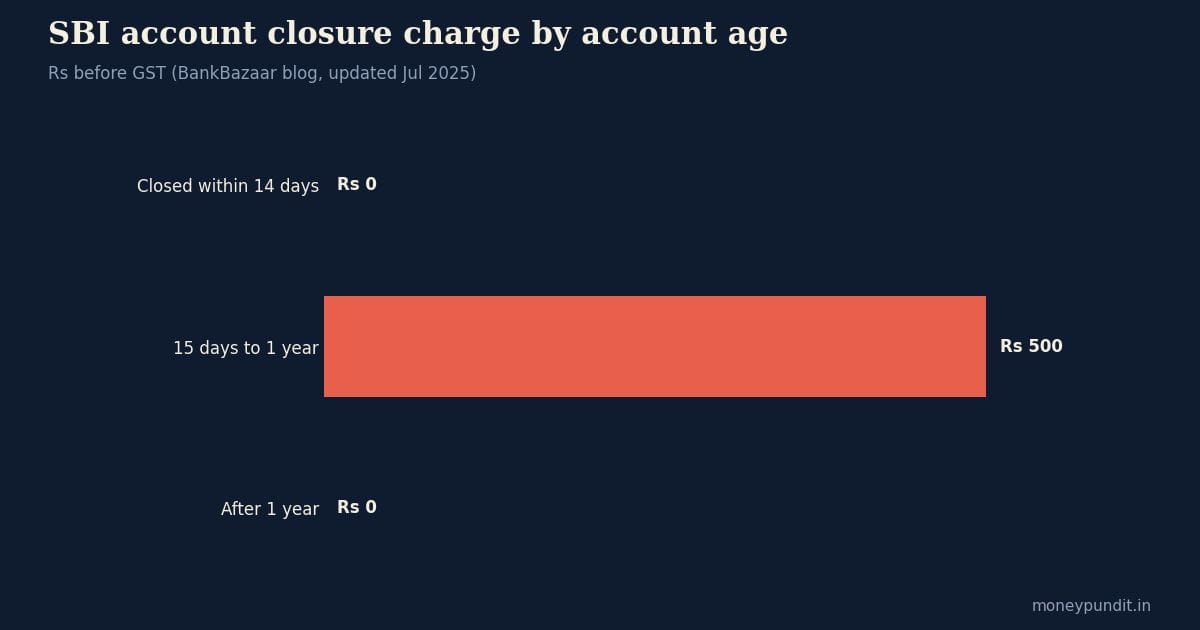
The blog was first published in 2017 and was last modified in July 2025, so treat the figures as a guide, not a guarantee. The SBI branch will quote the current number before it closes the account, and you can ask for it in writing.
Closure charges at other major banks
| Bank group | Closure charge status | What to do |
|---|---|---|
| SBI | Rs 0 within 14 days, Rs 500 plus GST from 15 days to 1 year, Rs 0 after 1 year (dated source above) | Confirm current figure at branch |
| HDFC Bank, ICICI Bank, Axis Bank, Kotak Mahindra Bank | Not verified from a dated source in this review | Check the bank’s published schedule of charges before applying |
| PNB, Bank of Baroda, Canara Bank, Union Bank of India | Not verified from a dated source in this review | Check the bank’s published schedule of charges before applying |
| Small finance banks and other private banks | Not verified from a dated source in this review | Check the bank’s published schedule of charges before applying |
Why the gap: bank websites publish closure charges in long schedule-of-charges PDFs that change often, and aggregator pages disagree with each other. Rather than print an unverified number for every bank, we mark each as unverified. As we confirm a bank’s current schedule from its own published document, we will add it here with a date.
Documents and rules you should know
- ID and address proof: usually a self-attested copy of the same KYC you gave when opening the account, or the bank’s own closure form.
- Joint accounts: all holders typically sign unless the mandate says “either or survivor”.
- Dormant or inoperative accounts: a dormant account may need reactivation or extra KYC before it can be closed. Ask the branch about this before you travel there.
- Salary and zero-balance accounts: if your employer has the account on record, tell the payroll team first, otherwise the next salary will bounce.
- Fixed or recurring deposits: linked deposits are usually paid out or moved before closing the savings account. See the savings account interest rates comparison if you are choosing the next home for your money.
What to do if the bank delays your closure
Start with a written complaint to the branch manager and keep your acknowledgement number. If the bank does not resolve it, escalate to the bank’s nodal officer, and then to the RBI Integrated Ombudsman portal. The RBI sets the broader banking customer-service framework on the Reserve Bank of India website. Keep copies of every form, email and reference number, because the ombudsman asks for them.
Before you close: should you really close the account?
If the only reason is a minimum-balance penalty, compare options first. A zero-balance or basic savings account may be cheaper than closing and reopening elsewhere, and a long-standing account helps your banking history. If you are moving money because of a better rate, compare the post office option in our post office schemes vs bank deposits guide. If the reason is a lost card or fraud, close or block the card first and read about annual fee waiver tactics only if you are keeping a card.
Common mistakes when closing a bank account
- Closing before moving SIPs, EMIs and insurance debits, which causes bounce charges.
- Not collecting written confirmation, which leaves you with no proof if a charge appears later.
- Ignoring the first-year closure charge, which at SBI is Rs 500 plus GST for accounts closed between 15 days and 1 year.
- Leaving a small balance and forgetting the account, so penalties build up and the account turns dormant.
Closing checklist
- Move all SIPs, EMIs, subscriptions and salary credit to a new account.
- Pay any dues and check the closure charge in writing.
- Return cheque book, passbook and debit card.
- Submit the closure form and keep the acknowledgement.
- Collect the closure confirmation and check the statement after two weeks.
Frequently asked questions
Is there a fee to close a bank account in India?
It depends on the bank and the age of the account. At SBI, a dated source shows Rs 0 within 14 days, Rs 500 plus GST from 15 days to 1 year, and Rs 0 after 1 year. For other banks, check the schedule of charges, because we could not verify them from a dated source.
Can I close a bank account online?
Some banks accept closure requests through net banking or a registered email, but the process differs by bank and we have not verified each one. Confirm with your branch, and ask for an acknowledgement either way.
Does closing a savings account affect my credit score?
Closing a savings account does not directly change your credit score. Unpaid dues on a linked loan, card or overdraft can, so clear those first.
How long does it take to close a bank account?
Branches commonly process closure within a few working days, but we found no single dated rule from the RBI that fixes the timeline for savings accounts. Ask for a service request number and follow up in writing if there is a delay.
What happens to the money left in my account?
The bank pays out the balance by transfer to another account in your name, by demand draft, or in cash up to branch limits. Choose a transfer for a clean paper trail.
Can I close a joint bank account alone?
Usually all holders need to sign, unless the operating instruction on the account says either holder can act alone. Ask the branch to confirm your mandate.
Information only, not financial advice. Charges and processes change; verify with your bank before you act. Last reviewed 7 Oct 2026.