
Forex markup India cardholders pay is one of the least visible costs of foreign travel and overseas online shopping. Every time an Indian credit card, debit card or forex card is used in a foreign currency, the bank can add a percentage fee on top of the exchange rate, plus 18% GST. This page compares forex markup India issuers charge in 2026 across credit cards, debit cards and prepaid forex cards, with a dated source for every table. Fees change often, so confirm the figure for your exact card with the bank and read the Reserve Bank of India guidance on foreign exchange transactions before you travel.
Forex Markup India 2026: The Short Version
Standard credit and debit cards typically charge up to 3.5% as a foreign currency markup, and 18% GST applies on that fee. A growing set of credit cards charge nothing, IDFC FIRST Bank announced zero forex markup across its credit cards on 10 Sep 2026, and prepaid forex cards can avoid the markup if you spend in the currency you loaded. The cheapest option depends on your spending, so the tables below show the card fee next to the markup.
What Forex Markup India Banks Charge on Credit Cards
Credit cards with zero or low forex markup, October 2026
| Credit card | Forex markup | Joining and annual fee (before GST) |
|---|---|---|
| Federal Bank Scapia | Nil | Rs 0 |
| ixigo AU | Nil | Rs 0 |
| IDFC FIRST WOW (FD-backed) | Nil | Rs 0 |
| IDFC FIRST Wealth | Nil | Rs 0 |
| RBL World Safari | Nil | Rs 3,000 |
| IDFC FIRST Mayura (metal) | Nil | Rs 5,999 |
| Axis Burgundy Private | Nil | Rs 50,000 |
| AU Zenith+ | 0.99% | Rs 4,999 |
| HDFC Regalia | 2% (preferential) | Rs 2,500 |
Source: Paisabazaar foreign transaction fee guide and BankBazaar zero forex markup guide, accessed 7 Oct 2026. Most other cards charge the standard markup of up to 3.5%. Standard markup per issuer (SBI, ICICI, Kotak and others) is not covered here because no single dated source listed every bank.
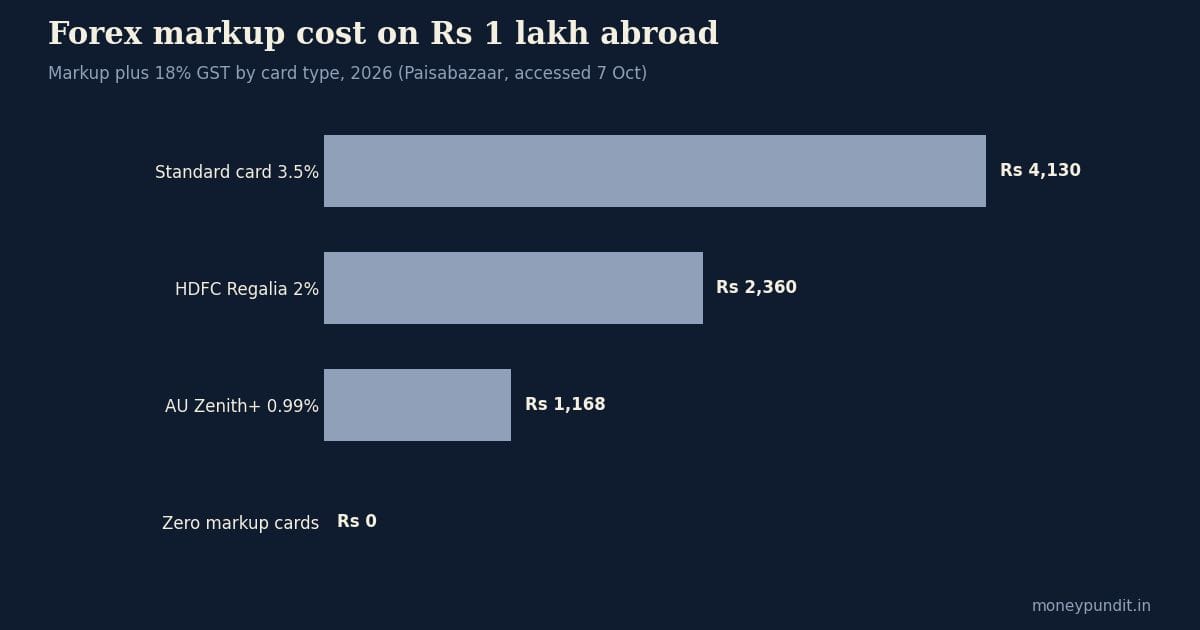
How much does the markup cost on a Rs 1 lakh trip?
| Card type | Markup | Fee on Rs 1,00,000 | GST at 18% | Total cost |
|---|---|---|---|---|
| Standard card | 3.5% | Rs 3,500 | Rs 630 | Rs 4,130 |
| HDFC Regalia | 2% | Rs 2,000 | Rs 360 | Rs 2,360 |
| AU Zenith+ | 0.99% | Rs 990 | Rs 178 | Rs 1,168 |
| Zero markup cards | Nil | Rs 0 | Rs 0 | Rs 0 |
Calculated from the percentages above. A zero markup card saves Rs 4,130 on every Rs 1 lakh spent abroad compared with a standard card, though it may carry a higher annual fee.
Debit Card Forex Markup India Customers Pay
Debit cards are usually the most expensive way to spend abroad. Axis Bank, for example, applies a cross-currency markup of 3.5% on all international purchases and cash withdrawals, a Dynamic Currency Conversion fee of 3.5% plus GST, and Rs 125 per international ATM withdrawal beyond the free limit, according to its fee schedule effective 1 Sep 2026. Burgundy Private debit card holders are exempt from the DCC fee. Check the full list of debit card charges in India before you carry a debit card overseas.
Prepaid Forex Card Charges in India
A prepaid forex card lets you load currency at a locked exchange rate. Spending in the loaded currency avoids a cross-currency markup at some issuers, but there is usually an issuance fee, and the rate at which the bank sells you the currency can include a spread above the mid-market rate. Paisabazaar lists the main multi-currency options below.
Forex cards by issuer, October 2026
| Forex card | Issuance fee (before GST) | Currencies | Notes |
|---|---|---|---|
| HDFC Multicurrency Platinum ForexPlus | Rs 500 | Up to 22 | Zero cross-currency markup if paid in pre-loaded currencies; load limit USD 250,000 a year |
| ICICI Multi-Currency Forex Prepaid | Nil | Up to 15 | Cover up to Rs 5,00,000 on card loss |
| IndusInd Multi-Currency Forex Prepaid | Rs 300 | Up to 14 | Zero currency conversion charges, 2 free ATM withdrawals a month |
| Axis Multi-Currency Forex | Rs 300 | Up to 16 | Fee waived for Priority and Burgundy customers |
| SBI Multicurrency Visa Foreign Travel Card | Rs 100 | Up to 9 (multi-currency) | Not usable in India, Nepal and Bhutan |
| Tata Neu IndusInd Forex | Rs 300 | Up to 14 | Digital card management |
| Axis World Traveller Forex | Rs 500 | Multi-currency | Travel rewards |
| Niyo Global | Nil | 180+ countries | No forex markup advertised |
Source: Paisabazaar best forex cards guide, accessed 7 Oct 2026. Reload fees, ATM fees and the exchange rate spread are not listed there and differ by bank.
Forex Card vs Credit Card: Which Forex Markup India Option Costs Less?
A forex card gives you a fixed budget, a locked rate and no credit risk, but you pay an issuance fee, may lose money on unused balance conversion and have no reward points. A zero markup credit card gives rewards and protection, and converts each purchase at the rate on the day it is processed, so you carry the exchange rate risk. For one short trip with moderate spending, a no-fee zero markup credit card is usually the cheapest. For long stays or students who withdraw cash often, compare ATM fees on a forex card against credit card cash advance charges, which start accruing interest on day one, as shown in our credit card charges India guide.
How forex markup India issuers apply the fee
When you pay in US dollars, the card converts the amount to rupees and then adds the markup. For any other currency, the amount is first converted to US dollars, then to rupees, and the markup is added at that stage. GST at 18% is charged on the markup, not on the purchase value. Foreign transaction fees apply to retail purchases abroad, online payments in foreign currency, overseas ATM withdrawals, and even purchases at duty-free shops in India that are billed overseas.
How to Cut Forex Markup India Travellers Pay
Pay in the local currency of the country you are in, and decline any terminal offer to charge you in rupees, because dynamic currency conversion adds its own markup. Use a zero markup credit card for purchases and a no-fee forex or debit card only for ATM cash. Check that the annual fee does not cancel the saving: a card with Rs 5,999 annual fee needs about Rs 1.45 lakh of foreign spending a year to recover the fee against the 4.13% cost of a standard card. Read our credit card annual fee waiver tips and the best credit cards in India before applying.
Hidden Costs Beyond Forex Markup India Travellers Should Check
The headline markup is only one layer of cost. Overseas ATM withdrawals on a credit card usually carry a cash advance fee with a minimum of Rs 100 to Rs 300, interest from the day of withdrawal, and the markup itself. A forex card avoids interest but can still charge an ATM fee, a reload fee and an inactivity or encashment charge when you convert unused balance back to rupees. Dynamic currency conversion at shop terminals, where you are offered to pay in rupees, usually adds a worse exchange rate than paying in the local currency.
Exchange rate spread on forex card loading and forex markup India buyers miss
Banks quote their own rate when you buy foreign currency for a prepaid card. That rate can sit above the mid-market rate even when the card advertises no markup on spending, so the real cost sits in the loading step. Compare the rate offered by two issuers on the same day and note the difference before you load a large amount.
Checklist before you travel
Confirm the forex markup India banks apply on every card you will carry, switch on international usage, set a spending limit, and keep one backup card from a different network. Pay card bills in full so the interest-free period applies, and avoid cash advances. If you plan to study or live abroad, compare the fee on a forex card with regular remittance options before moving large sums.
What This Comparison Does Not Cover
This page is not exhaustive. Credit card markup is listed for nine cards and not for every issuer; standard markup for SBI Card, ICICI, Kotak, Yes Bank, HSBC, Standard Chartered and public sector issuers is not tabulated because no dated primary source was available. Forex card reload fees, ATM fees and exchange rate spreads are not covered. Third party sites report a spread of roughly 0.5% to 3% above the mid-market rate on forex card loading, which we could not verify from bank documents. Always read the bank’s schedule of charges for your card.
FAQs on Forex Markup India
What is forex markup India banks charge on credit cards?
Most standard cards charge a forex markup of up to 3.5% on foreign currency transactions, plus 18% GST on that fee. Some cards charge 2%, 0.99% or nothing.
Which credit cards have zero forex markup in India?
Examples include Federal Bank Scapia, ixigo AU, IDFC FIRST WOW, Wealth and Mayura, RBL World Safari and Axis Burgundy Private, according to Paisabazaar and BankBazaar in October 2026.
Is a forex card cheaper than a credit card abroad?
Not always. A zero markup credit card has no conversion fee and earns rewards, while a forex card has an issuance fee but locks your rate. Compare the total cost for your own spend.
Does GST apply to forex markup?
Yes. 18% GST is added to the markup fee, so a 3.5% markup effectively costs 4.13% of the transaction value.
Do debit cards charge forex markup abroad?
Yes. Axis Bank charges a 3.5% cross-currency markup on international debit card purchases and withdrawals, plus fixed ATM fees, per its fee schedule effective 1 Sep 2026.
Related Resources
See also the credit card fraud protection tips for safe foreign spending and credit card vs debit card to decide which card to carry.