

Post office vs bank FD rates in October 2026: the 5-year post office time deposit pays 7.50%, while SBI pays 6.05% and HDFC Bank 6.40% for the same tenure. Only small finance banks beat it, at the cost of lower insurance protection. Below is the full comparison, scheme by scheme.
NRI? See NRE, NRO and FCNR deposit rates.
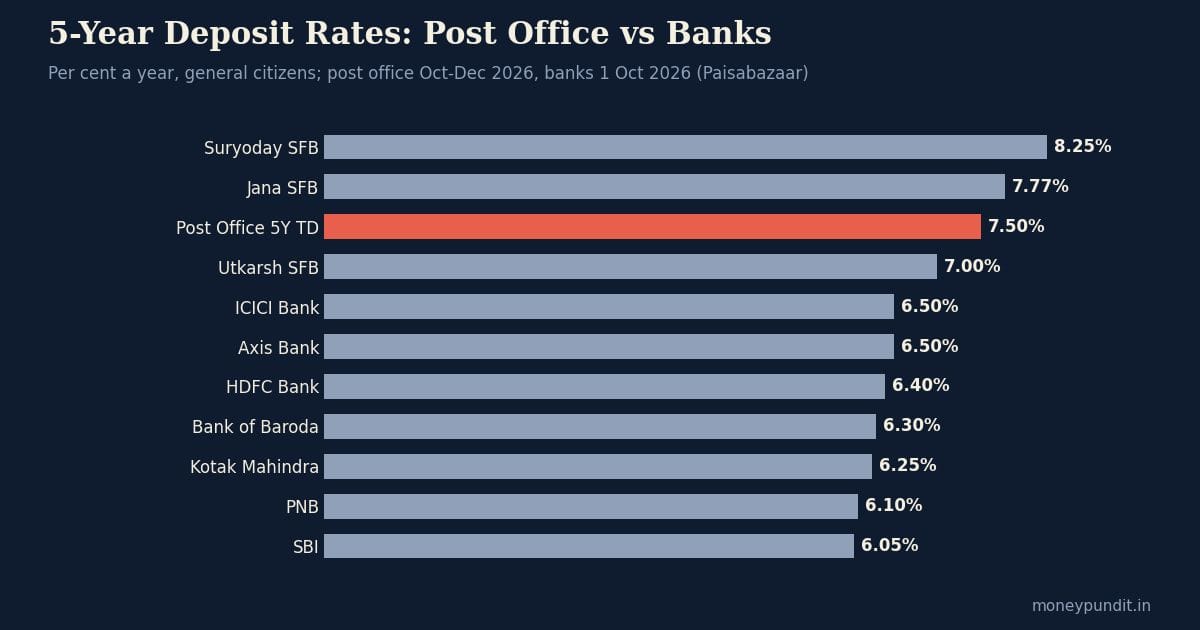
Post Office vs Bank FD Rates: Time Deposit Comparison
The post office time deposit (TD) is the closest match to a bank fixed deposit. Rates below are for general citizens and deposits under Rs 3 crore. Post office rates are for October to December 2026; bank rates are as of 1 October 2026, before the RBI hike was passed on.
| Provider | 1 year | 3 years | 5 years |
|---|---|---|---|
| Post Office Time Deposit | 6.90% | 7.10% | 7.50% |
| State Bank of India | 6.25% | 6.30% | 6.05% |
| Punjab National Bank | 6.25% | 6.35% | 6.10% |
| Bank of Baroda | 6.25% | 6.25% | 6.30% |
| Canara Bank | 6.25% | 6.25% | 6.25% |
| Union Bank of India | 6.20% | 6.10% | 6.00% |
| Bank of India | 6.50% | 6.70% | 6.00% |
| HDFC Bank | 6.25% | 6.45% | 6.40% |
| ICICI Bank | 6.25% | 6.45% | 6.50% |
| Axis Bank | 6.25% | 6.50% | 6.50% |
| Kotak Mahindra Bank | 6.50% | 6.40% | 6.25% |
| Suryoday Small Finance Bank | 7.25% | 7.25% | 8.25% |
| Jana Small Finance Bank | 7.00% | 8.00% | 7.77% |
| Equitas Small Finance Bank | 7.10% | 7.10% | 7.00% |
| Utkarsh Small Finance Bank | 6.00% | 7.50% | 7.00% |
| Ujjivan Small Finance Bank | 7.25% | 7.25% | 7.20% |
| Unity Small Finance Bank | 7.50% | 6.75% | 6.75% |
| AU Small Finance Bank | 6.35% | 7.40% | 6.75% |
Sources: India Post and Ministry of Finance small savings notification for Oct to Dec 2026 as reported by Angel One and Outlook Money; bank rates from Paisabazaar FD rate tables, 1 October 2026. For all 48 banks see our best FD rates in India 2026 page.
Post Office Savings Schemes vs Bank Products: Rates Side by Side
| Product | Post office rate (Oct to Dec 2026) | Bank comparison |
|---|---|---|
| Savings account | 4.00% | SBI 2.50%; large private banks 2.50% to 3.00% |
| 1-year deposit | 6.90% | Large banks 6.25% to 6.50% |
| 2-year deposit | 7.00% | Not offered separately by most banks |
| 3-year deposit | 7.10% | Large banks 6.10% to 6.70% |
| 5-year deposit | 7.50% | Large banks 6.00% to 6.50% |
| 5-year recurring deposit | 6.70% | Compare on our RD rates by bank page |
| Senior Citizens Savings Scheme | 8.20% | Best senior FD in our senior citizen FD rates list |
| Monthly Income Scheme | 7.40% | No direct bank product |
| National Savings Certificate | 7.70% | No direct bank product |
| Kisan Vikas Patra | 7.50% | No direct bank product |
| Public Provident Fund | 7.10% | No direct bank product |
Source: Government of India small savings rates for the October to December 2026 quarter, announced 30 September 2026. Savings account rate for SBI from sbi.bank.in. Details of each scheme sit in our post office savings schemes guide and the live small savings rate tracker.
Safety: Government Guarantee vs DICGC Insurance
Post office deposits carry the sovereign backing of the Government of India, with no upper limit on protection. A bank deposit is insured by DICGC up to Rs 5 lakh per depositor per bank, covering principal and interest together. For most households with less than Rs 5 lakh in one bank, both are very safe. Above that, spreading deposits across banks or using post office schemes keeps the full amount protected. See the DICGC website for the official cover rules.
Post Office TD vs Bank FD: Features Compared
| Feature | Post office time deposit | Bank fixed deposit |
|---|---|---|
| Who sets the rate | Government, reviewed every quarter | Each bank, can change any time |
| Senior citizen bonus | None, same rate for all | Usually +0.25% to +0.50% |
| Tenures | 1, 2, 3 and 5 years | 7 days to 10 years |
| Tax saving | 5-year TD qualifies under Section 80C (old regime) | 5-year tax saver FD qualifies under Section 80C (old regime) |
| Premature withdrawal | Not allowed in the first 6 months | Allowed with a penalty, terms vary by bank |
| Deposit protection | Government of India | DICGC up to Rs 5 lakh per bank |
Interest on both is taxable at your slab rate. Choose the 5-year tenure only if you need the 80C deduction; otherwise shorter tenures keep money flexible. Run your own numbers with the FD calculator.
Which Is Better for You?
Pick the post office time deposit if you want the highest rate with sovereign safety and no bank above 6.6% for your tenure. Pick a bank FD if you want flexibility, a senior citizen premium, tenures under one year, or a small finance bank paying above 7.5% on an amount within DICGC cover. Senior citizens should look at SCSS at 8.2% first. Monthly income seekers can model the Post Office MIS calculator against an FD with monthly payout.
What the RBI Rate Hike Changes
The RBI raised the repo rate by 25 basis points to 5.50% on 7 October 2026. Banks tend to lift deposit rates within weeks, which narrows the post office advantage on 1-year and 3-year deposits. Post office rates only change at the next quarterly review. Our RBI MPC explainer covers the effect on FDs and EMIs. Related: KVP rules and PPF rate history.
Frequently Asked Questions
Is post office FD better than bank FD?
On 1 October 2026 rates, the 5-year post office time deposit at 7.50% beats every public sector and large private bank in our table (SBI 6.05%, HDFC Bank 6.40%, ICICI Bank 6.50%). Some small finance banks pay more, up to 8.25%, but deposits above Rs 5 lakh in a bank are not covered by DICGC insurance.
Is a post office time deposit safe?
Post office schemes are backed by the Government of India. Bank deposits are insured by DICGC up to Rs 5 lakh per depositor per bank, covering principal and interest together.
Are post office interest rates fixed?
The government reviews small savings rates every quarter. Rates for October to December 2026 were left unchanged. A deposit made now keeps the rate prevailing on the date of deposit for time deposits, so check the scheme rules.
Do banks give senior citizens extra interest but post office does not?
Yes. Most banks add 0.25% to 0.50% for senior citizens on FDs, while the post office time deposit pays the same rate to everyone. Senior citizens get a better deal from the Senior Citizens Savings Scheme at 8.2%.
Will bank FD rates rise after the RBI hike?
The RBI raised the repo rate to 5.50% on 7 October 2026. Banks usually reprice deposits over the following weeks, so bank FD rates in the table may move up. Post office rates only change at the quarterly review.