

Direct vs regular mutual fund: which one should you choose? This is one of the most common questions every mutual fund investor faces in India. The difference between direct and regular plans may seem small at first glance, but over 10-20 years, it can cost you lakhs of rupees in lost returns. In this comprehensive guide, we break down everything you need to know about direct plan vs regular plan mutual funds to help you make an informed decision in 2026.

What is a Direct Mutual Fund Plan?
A direct mutual fund plan is one where you invest directly with the Asset Management Company (AMC) without involving any intermediary like a broker, distributor, or financial advisor. Since there is no middleman, the AMC does not pay any distribution commission, which results in a lower expense ratio. You can invest in direct plans through the AMC’s website, apps like Groww, Zerodha Coin, Kuvera, or platforms like MFCentral and CAMS.
SEBI mandated the introduction of direct plans starting January 1, 2013, ensuring that every open-ended mutual fund scheme offers both a direct and a regular variant. The portfolio, fund manager, investment objective, and risk profile remain identical, the only difference is the expense ratio charged to investors.
What is a Regular Mutual Fund Plan?
A regular mutual fund plan is purchased through an intermediary such as a bank, financial advisor, distributor, or brokerage platform. The AMC pays a commission to these intermediaries for distributing the fund, and this commission is built into the expense ratio of the regular plan. As a result, the Total Expense Ratio (TER) of a regular plan is always higher than its direct plan counterpart.
Regular plans are suitable for investors who need hand-holding, personalised advice, and help with paperwork. However, it is important to understand how much this advisory service costs you in the long run through higher expense ratios.
Key Differences Between Direct and Regular Mutual Funds
Understanding the direct vs regular mutual fund difference is crucial for maximising your investment returns. Here is a detailed direct vs regular mutual fund comparison:
| Parameter | Direct Plan | Regular Plan |
|---|---|---|
| Intermediary | None: invest directly with AMC | Through broker, distributor, or advisor |
| Expense Ratio | Lower (no commission) | Higher (includes distributor commission) |
| NAV | Higher NAV | Lower NAV |
| Returns | Higher by 0.5%-1.5% annually | Lower due to higher TER |
| Advisory Support | Self-directed: no personal advice | Guidance from distributor or advisor |
| Portfolio & Fund Manager | Same as regular plan | Same as direct plan |
| Investment Objective | Identical | Identical |
| Availability | AMC website, direct platforms | Banks, brokers, distributors |
Expense Ratio: The Real Cost in Direct vs Regular Mutual Fund
The expense ratio is the annual fee charged by the AMC to manage your mutual fund investment. Under SEBI regulations, the Total Expense Ratio (TER) includes fund management fees, administrative costs, and in the case of regular plans, distributor commissions. The difference in expense ratio between direct and regular plans typically ranges from 0.5% to 1.5% per year.
For example, if an equity mutual fund’s regular plan has an expense ratio of 1.8%, the direct plan of the same fund might have an expense ratio of just 0.9%. A difference of 0.9% annually. While 0.9% may sound small, the impact on your returns over long periods is dramatic due to the power of compounding.
Long-Term Impact: A Real Calculation
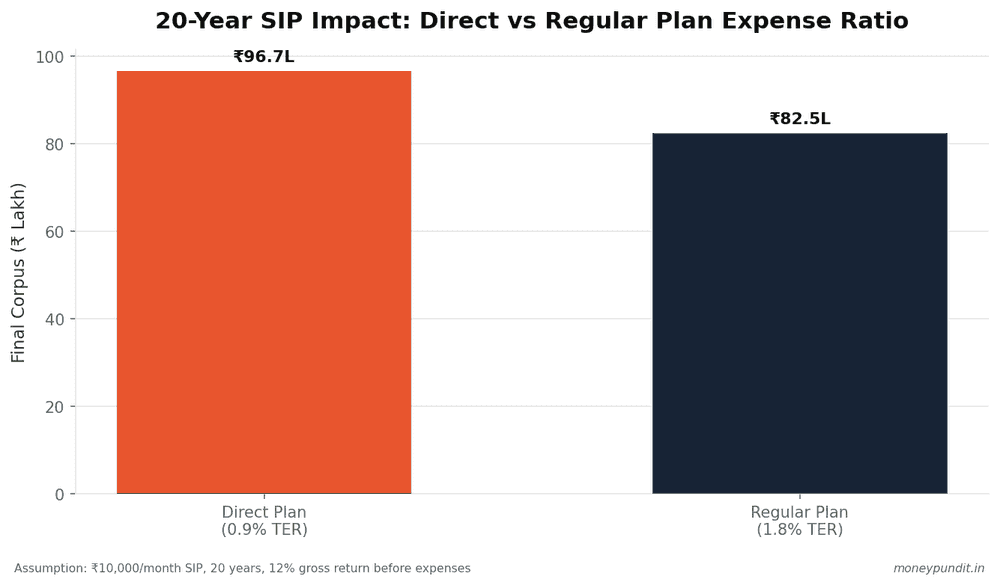
Let us calculate the difference with a practical example. Assume you invest Rs 10,000 per month via SIP for 20 years. The fund generates 12% annual returns before expenses.
Direct Plan (expense ratio 0.9%): Net return = 11.1% → Final corpus = Rs 96.7 lakh
Regular Plan (expense ratio 1.8%): Net return = 10.2% → Final corpus = Rs 82.5 lakh
The difference is Rs 14.2 lakh: all because of the 0.9% higher expense ratio in the regular plan. You can calculate the exact impact for your investments using our SIP Calculator.
How NAV Differs in Direct vs Regular Mutual Fund
Since direct plans have a lower expense ratio, more of your money stays invested and compounds over time. This means the Net Asset Value (NAV) of a direct plan is always higher than the NAV of the corresponding regular plan. On the day both plans launch, the NAV is the same. But over time, the direct plan’s NAV grows faster because less money is deducted as expenses.
A higher NAV does not mean the fund is expensive: it simply reflects better returns due to lower costs. Always compare the same fund’s direct and regular NAVs to see the compounding advantage of direct plans.
How to Invest in Direct Mutual Funds in 2026
Investing in direct mutual fund plans has become extremely easy in 2026. Here are the most popular methods:
1. AMC Website or App: Visit the mutual fund company’s official website (e.g., HDFC MF, ICICI Prudential, SBI MF) and invest directly. You will need to complete KYC through CAMS or KFintech.
2. Direct Mutual Fund Platforms: Apps like Groww, Zerodha Coin, Kuvera, ET Money, and Paytm Money offer commission-free direct mutual fund investments. These platforms provide portfolio tracking, SIP management, and goal-based investing tools.
3. MFCentral: An official platform by AMFI (Association of Mutual Funds in India) that allows you to manage all your mutual fund investments across AMCs in one place.
4. Registrar Portals: CAMS and KFintech portals allow direct transactions for all mutual fund schemes registered with them.
How to Switch from Regular to Direct Mutual Fund Plan
If you currently hold regular plan mutual funds and want to switch to direct plans, here is the process:
Step 1: Log in to the AMC’s website, CAMS, KFintech, or a direct platform like Groww or Kuvera.
Step 2: Navigate to your existing investment and select the “Switch” option.
Step 3: Choose the direct plan variant of the same scheme as the target fund.
Step 4: Enter the amount or number of units you want to switch and confirm.
Step 5: The switch typically takes 1-3 working days to reflect in your portfolio.
Important: A switch from regular to direct is treated as a redemption from the regular plan and a fresh purchase in the direct plan. This means capital gains tax will apply based on the holding period and fund type. Use our Income Tax Calculator to estimate the tax impact before switching. Also note that ELSS funds cannot be switched before the 3-year lock-in period ends.
When Should You Choose a Regular Plan?
While direct plans offer better returns, regular plans are not entirely without merit. Consider a regular plan if:
You are a complete beginner who needs personal guidance on fund selection, asset allocation, and rebalancing. A good financial advisor can add value that exceeds the commission cost.
You lack time or interest to research and monitor your mutual fund investments. A distributor can handle portfolio reviews and suggest changes.
You need comprehensive financial planning that goes beyond mutual funds, including insurance, estate planning, and tax optimisation. A fee-based advisor who uses regular plans as part of a holistic service may be worth the cost.
However, if you are comfortable making your own investment decisions and have basic knowledge of mutual funds, direct plans are almost always the better choice. The cost savings compound significantly over time, as we showed in the calculation above.
Direct vs Regular Mutual Fund: Which is Better for SIP?
For SIP (Systematic Investment Plan) investors, direct plans offer an even bigger advantage because of the long-term nature of SIP investments. When you invest via SIP in a direct plan, every monthly instalment benefits from the lower expense ratio. Over 15-25 years, the compounding effect of the expense ratio difference becomes massive.
Most direct mutual fund platforms like Groww, Kuvera, and Zerodha Coin make it equally easy to set up SIPs in direct plans. The process is no different from setting up a SIP in a regular plan. You just save more money. Check our SIP Calculator to see how much extra wealth you can create by choosing direct plans for your SIPs.
SEBI Regulations on Direct and Regular Plans
SEBI has been actively working to make mutual fund investing more transparent and cost-effective for retail investors. Key regulatory developments include:
January 2013: SEBI mandated that all mutual fund schemes must offer a direct plan option alongside the regular plan.
TER Slabs: SEBI has set maximum limits on Total Expense Ratios based on fund size (AUM). Larger funds must charge lower TERs, benefiting investors in both direct and regular plans.
2026 TER Regulations: Under the latest SEBI (Mutual Funds) Regulations, the expense structure is now split into a Base Expense Ratio (BER) covering fund management and operational costs, with brokerage, transaction costs, and statutory levies disclosed separately. This improves transparency for investors comparing direct and regular plan costs.
You can verify the latest regulations and investor guidelines on the official SEBI Investor Education portal.
Understanding the direct vs regular mutual fund difference is essential for maximising your investment returns. Choose wisely based on your knowledge, comfort level, and investment horizon.
Frequently Asked Questions
What is the main difference between direct and regular mutual funds?
The main difference is the expense ratio. Direct plans do not include distributor commissions, resulting in a lower TER (typically 0.5-1.5% less than regular plans). Both plans have the same portfolio, fund manager, and investment objective.
Are direct mutual funds better than regular mutual funds?
For most investors who can make their own investment decisions, direct mutual funds are better because they offer higher returns due to lower expense ratios. The cost savings compound significantly over long periods, potentially saving lakhs of rupees.
Can I switch from regular to direct mutual fund without selling?
No. A switch from regular to direct is technically a redemption and repurchase. Capital gains tax will apply based on your holding period. However, the long-term savings from lower expense ratios usually outweigh the one-time tax cost.
How much more returns do direct plans give compared to regular plans?
Direct plans typically give 0.5% to 1.5% higher annual returns compared to regular plans of the same scheme. Over 20 years, this difference can translate to 10-20% more total wealth due to compounding.
Which platforms offer direct mutual fund plans in India?
Popular platforms for direct mutual fund investment in India include Groww, Zerodha Coin, Kuvera, ET Money, Paytm Money, and MFCentral. You can also invest directly through AMC websites and registrar portals (CAMS, KFintech).
Is there any risk difference between direct and regular plans?
No. Both direct and regular plans of the same scheme invest in the exact same portfolio of securities with the same fund manager. The risk profile is identical, only the expense ratio and resulting returns differ.
Related reading: What is an AMC? · SIP vs Mutual Fund