

Mid cap mutual funds invest at least 65% of their assets in companies ranked 101 to 250 by market value, firms established enough to be stable and small enough to grow fast. The live table below ranks every mid cap scheme by 1-year return with 3-year and 5-year CAGR.
Mid cap funds have historically delivered higher returns than large caps over long periods, but they also fall harder and faster in a downturn, the extra return isn’t free, it’s compensation for volatility most investors underestimate until they live through it. Here’s how to evaluate mid cap funds properly.
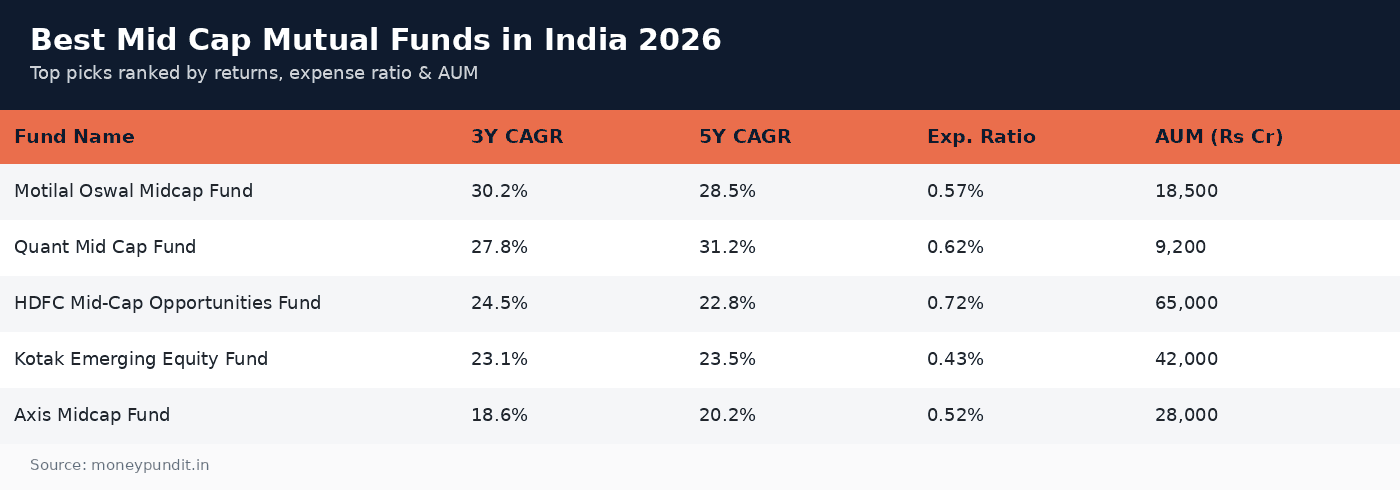
Mid cap mutual funds invest in companies ranked 101-250 by market capitalisation on Indian stock exchanges. These funds offer a compelling balance between the explosive growth potential of small caps and the relative stability of large caps, making them a favourite among investors seeking wealth creation over 5-7 years or more.
What Are Mid Cap Mutual Funds?
As per SEBI classification, mid cap funds must invest at least 65% of their total assets in equity and equity-related instruments of mid cap companies. These companies typically have market capitalisation between ₹5,000 crore and ₹20,000 crore, though this range shifts as markets evolve. Mid cap companies are often in their growth phase. They have survived the startup stage but still have significant room to expand their market share, revenues, and profitability.
The mid cap segment has historically delivered superior returns compared to large caps over longer holding periods, though with higher volatility. Many of today’s large cap leaders, such as Bajaj Finance, Avenue Supermarts, and Trent, were once mid cap stocks that rewarded early investors handsomely.
Top Mid Cap Mutual Funds for 2026
| # | Fund Name | NAV (₹) | 1Y Return ▼ | 3Y CAGR | 5Y CAGR |
|---|---|---|---|---|---|
| 1 | HSBC Midcap Fund | 519.57 | +15.50% | +23.01% | — |
| 2 | WhiteOak Capital Mid Cap Fund | 22.57 | +10.89% | +21.14% | — |
| 3 | ICICI Prudential Mid Cap Fund | 366.09 | +10.44% | +20.15% | +15.75% |
| 4 | Helios Mid Cap Fund | 13.62 | +8.70% | — | — |
| 5 | JM Mid Cap Fund | 21.78 | +7.71% | +18.58% | — |
| 6 | BANDHAN MID CAP FUND | 19.82 | +7.55% | +17.51% | — |
| 7 | ITI Mid Cap Fund | 24.58 | +6.82% | +18.80% | +15.13% |
| 8 | Invesco India Mid Cap Fund | 227.87 | +6.40% | +22.67% | +18.05% |
| 9 | Taurus Mid Cap Fund | 133.94 | +6.05% | +10.38% | +11.17% |
| 10 | Baroda BNP Paribas Mid Cap Fund | 128.26 | +5.87% | +15.64% | — |
| 11 | Union Midcap Fund | 54.93 | +5.68% | +16.11% | +13.91% |
| 12 | Aditya Birla Sun Life Midcap Fund | 915.28 | +5.17% | +14.07% | +12.52% |
| 13 | Nippon India Growth Mid Cap Fund | 4,772.29 | +4.99% | +17.45% | +16.51% |
| 14 | Mahindra Manulife Mid Cap Fund | 39.00 | +4.77% | +16.07% | +15.72% |
| 15 | Mirae Asset Midcap Fund | 41.46 | +4.76% | +14.73% | +13.80% |
| 16 | LIC MF Mid Cap Fund | 33.29 | +4.45% | +15.44% | — |
| 17 | Axis Midcap Fund | 138.32 | +4.44% | +15.90% | +12.06% |
| 18 | Canara Robeco Mid Cap Fund | 18.72 | +4.08% | +16.59% | — |
| 19 | Quant Mid Cap Fund | 242.11 | +4.00% | +10.86% | +14.24% |
| 20 | Edelweiss Mid Cap Fund | 122.65 | +3.99% | +19.84% | +16.94% |
| 21 | BANK OF INDIA MID CAP FUND | 10.37 | +3.07% | — | — |
| 22 | Tata Mid Cap Fund | 503.81 | +3.06% | +13.94% | +13.43% |
| 23 | SBI MIDCAP FUND | 261.77 | +3.05% | +10.19% | +12.20% |
| 24 | HDFC Mid Cap Fund | 220.90 | +2.81% | +15.76% | +17.28% |
| 25 | Sundaram Mid Cap Fund | 1,550.76 | +2.43% | +17.05% | +15.29% |
| 26 | UTI - Mid Cap Fund | 338.10 | +0.69% | +10.93% | +10.75% |
| 27 | Kotak Mid Cap Fund | 160.77 | +0.50% | +16.36% | +14.86% |
| 28 | DSP Midcap Fund | 164.05 | +0.23% | +12.92% | +10.24% |
| 29 | Franklin India Mid Cap Fund | 3,031.79 | -0.71% | +14.35% | +12.05% |
| 30 | PGIM India Midcap Fund - Direct Plan | 74.26 | -1.08% | +11.18% | +9.38% |
| 31 | TRUSTMF MID CAP FUND | 11.78 | — | — | — |
| 32 | Samco Mid Cap Fund | 9.72 | — | — | — |
| 33 | The Wealth Company Mid Cap Fund | 9.36 | — | — | — |
Data sourced from AMFI & mfapi.in. Returns are annualised CAGR. Past performance doesn't guarantee future results. Last updated: 15 Oct 2026
Returns as of April 2026. Past performance does not guarantee future results.
Why Invest in Mid Cap Funds?
Mid cap funds sit in a sweet spot of the market capitalisation spectrum. These companies are large enough to have established business models, professional management, and proven products or services. Yet they are small enough to grow at rates that large caps simply cannot sustain. When a large cap company with ₹5 lakh crore market cap needs to grow revenues by 25%, the absolute numbers are staggering. A mid cap company at ₹10,000 crore can achieve this more realistically.
Additionally, mid caps tend to be less tracked by institutional analysts compared to large caps. This information asymmetry creates opportunities for skilled fund managers to identify hidden gems before the broader market catches on. Active fund management adds genuine value in this segment, which is why many mid cap funds have outperformed their benchmark indices.
Key Factors to Consider Before Investing
Investment Horizon
Mid cap funds require patience. A minimum investment horizon of 5-7 years is recommended to ride out market cycles. During bear markets, mid caps can fall 40-60% from their peaks, significantly more than large caps. However, they also recover sharply during bull phases, often delivering multibagger returns.
Risk Tolerance
These funds carry higher risk than large cap or flexi cap funds. The underlying companies may face challenges like limited access to capital, governance issues, or business model disruptions. Investors should be comfortable with interim portfolio drawdowns of 30-50% without panicking.
Fund Manager Track Record
In the mid cap space, the fund manager’s stock-picking ability matters enormously. Look for managers who have navigated multiple market cycles successfully, maintained consistent performance across different market conditions, and demonstrated discipline in portfolio construction.
Expense Ratio
While mid cap funds generally have higher expense ratios than large cap or index funds, the difference in direct vs regular plan costs can be substantial, often 0.8% to 1.2% annually. Over a 10-year SIP, this difference can translate to lakhs of rupees in additional returns through direct plans.
SIP vs Lumpsum in Mid Cap Funds
For most investors, a systematic investment plan (SIP) is the preferred route for mid cap investing. SIPs help average out the higher volatility inherent in mid caps through rupee cost averaging. When markets fall, your SIP buys more units at lower NAVs, which amplifies returns when markets eventually recover.
Lumpsum investments can work well during market corrections when mid cap valuations become attractive. However, timing the market consistently is extremely difficult, making SIPs the more practical approach for building long-term wealth through mid cap funds.
Tax Implications
Mid cap equity mutual funds are taxed as equity-oriented funds. Short-term capital gains (holding period less than 12 months) are taxed at 20%. Long-term capital gains exceeding ₹1.25 lakh in a financial year are taxed at 12.5%. Dividends received from these funds are added to your income and taxed at your applicable slab rate.
Frequently Asked Questions
Are mid cap funds suitable for beginners?
Mid cap funds can be part of a beginner’s portfolio, but they should not be the sole investment. New investors should start with a diversified approach, perhaps 50% in large cap or flexi cap funds and 30% in mid caps, with the remaining 20% in debt funds. As you gain experience and comfort with volatility, you can adjust allocations.
How many mid cap funds should I hold?
One or two well-chosen mid cap funds are sufficient for most portfolios. Holding more than two leads to significant portfolio overlap, as top fund managers often invest in many of the same mid cap companies. This overlap dilutes the diversification benefit without adding meaningful value.
Should I choose an index fund or active fund for mid caps?
Unlike in the large cap space where index funds have become increasingly popular, active mid cap funds still have a strong case. The mid cap segment offers more opportunities for alpha generation through active stock selection. Most top active mid cap funds have outperformed the Nifty Midcap 150 index over 5 and 10-year periods. However, mid cap index funds at lower costs are a viable alternative for investors who prefer passive investing.
What is the ideal allocation to mid cap funds?
For an aggressive investor in their 20s or 30s, a 25-35% allocation to mid cap funds within the equity portfolio is reasonable. For moderate risk profiles, 15-20% works well. Conservative investors or those near retirement should limit mid cap exposure to 10% or less.
Mid caps deserve a place in most long-term portfolios, but sized appropriately, treat them as a satellite allocation around a large-cap or index-fund core, not the foundation, unless you have both the time horizon and the temperament to ride out sharp drawdowns.
References: Amfiindia.com
Mid cap mutual funds work best as part of a diversified equity portfolio rather than the only holding. Check overlap with your large cap fund and keep mid cap mutual funds to a share you can stay invested in through a fall.
When you compare mid cap mutual funds, look beyond the 1-year return. The best mid cap mutual funds tend to hold up better in falling markets and keep a stable fund manager. Use the table to shortlist mid cap mutual funds, then read each factsheet before you invest.
Mid Cap Funds: Key Takeaways
Mid cap funds have rewarded patient investors but have fallen 30% or more in past downturns, so treat 7 years as the minimum horizon and invest through a monthly SIP rather than a lump sum. Check that the top holdings are genuinely mid cap names and compare the 5-year CAGR with the Nifty Midcap 150 index. Gains are taxed under equity rules: 20% on units sold within 12 months and 12.5% on gains above Rs 1.25 lakh a year after that. Compare other categories on the mutual fund categories hub, see small cap funds for higher risk, estimate returns with the SIP calculator and read scheme documents on AMFI and SEBI before you invest. Mutual fund investments are subject to market risks.