
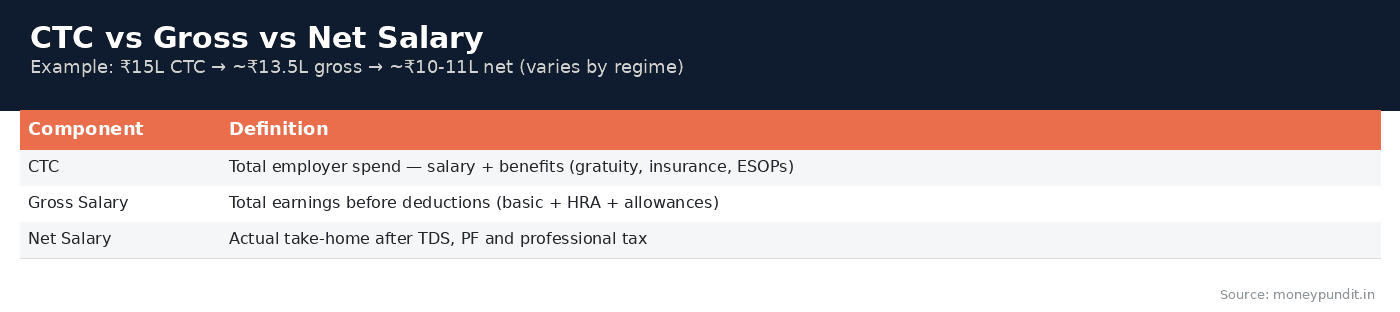
Salary structure ctc gross in brief: A CTC of ₹15 lakh might result in a gross salary of ₹13.5 lakh and a net salary of ₹10-11 lakh depending on tax regime and deductions.
CTC is the number recruiters quote during hiring, but it’s rarely close to what actually lands in your bank account, the gap between CTC, gross, and net pay trips up even experienced professionals negotiating a new offer. Here’s how to break down a salary structure and optimize your take-home.
Understanding your salary structure is the first step toward effective tax planning and financial optimization. Most salaried Indians do not fully understand the difference between CTC, gross salary, and net take-home pay, or how to restructure components to maximize their in-hand income legally.
CTC vs Gross vs Net: The Breakdown
Cost to Company (CTC) is the total amount your employer spends on you, including direct payments and benefits like gratuity, insurance, ESOPs, and food coupons. Gross salary is your total earning before tax deductions, it includes basic salary, HRA, special allowances, and other allowances. Net salary or take-home pay is what you actually receive after deducting income tax (TDS), employee PF contribution, professional tax, and other statutory deductions. A CTC of ₹15 lakh might result in a gross salary of ₹13.5 lakh and a net salary of ₹10-11 lakh depending on tax regime and deductions.
Key Salary Components
Basic salary is the foundation: typically 40-50% of CTC. It determines HRA, PF contribution, and gratuity. Higher basic means higher PF and gratuity but also higher taxable income. HRA (House Rent Allowance) is typically 50% of basic for metros and 40% for non-metros. If you pay rent, HRA provides significant tax exemption. Special allowance is the balancing figure. Fully taxable with no exemptions, so minimizing this component is beneficial. LTA (Leave Travel Allowance) covers domestic travel expenses with tax exemption for two journeys in a 4-year block.
How to Optimize Your Salary Structure
Request your employer to restructure your salary for tax efficiency. Increase HRA to 50% of basic if you pay rent in a metro, the exemption directly reduces taxable income. Include meal coupons or food allowance (₹50 per meal, tax-free). Add telephone and internet reimbursement (actual bills are tax-free). Include vehicle maintenance and fuel reimbursement for business travel. NPS employer contribution up to 10% of basic is tax-free under Section 80CCD(2) and does not count toward the ₹1.5 lakh 80C limit. These restructurings are legal and can increase take-home pay by ₹50,000-₹1,50,000 annually.
Understanding Your Form 16
Form 16 is your annual tax certificate from the employer. Part A shows TDS deducted and deposited. Part B shows the detailed salary breakup, exemptions claimed, and tax calculation. Verify your Form 16 against your monthly payslips, errors in HRA exemption, 80C deductions, or income reporting are common and can result in excess tax payment or future notices from the tax department.
Should I opt for a higher basic salary?
Higher basic increases mandatory PF contribution (building retirement savings) and gratuity but also increases taxable income. For younger employees who want to maximize take-home, a lower basic with optimized allowances may be better. For those prioritizing retirement savings and long-term benefits, a higher basic with maximum PF is preferable.
What is the ideal salary structure for tax savings?
Basic: 40% of CTC. HRA: 50% of basic. NPS employer contribution: 10% of basic. Meal vouchers, LTA, telephone, and fuel reimbursements to cover remaining allowances. Special allowance should be minimized as it is fully taxable with no exemption.
Breaking Down CTC Components
CTC (Cost to Company) is NOT your take-home salary: it includes everything your employer spends on you: basic salary (typically 40-50% of CTC), HRA (usually 40-50% of basic), special allowance, employer’s PF contribution (12% of basic), gratuity provision (4.81% of basic), health insurance premium, and sometimes variable pay, ESOPs, or meal vouchers. Understanding each component helps you negotiate better and optimise your tax liability.
Your gross salary = CTC minus employer’s PF contribution, gratuity provision, and employer-paid insurance. Your net/take-home salary = gross salary minus employee’s PF contribution, professional tax, and income tax (TDS). For a ₹15 lakh CTC, take-home is typically ₹95,000-₹1,05,000/month depending on tax regime and deductions. Use our Take Home Salary Calculator to compute your exact monthly in-hand amount based on your CTC structure.
Optimising Your Salary Structure for Tax Efficiency
Many salary components are partially or fully tax-exempt. HRA exemption saves significant tax for those paying rent in metros: request higher HRA allocation if possible. LTA (Leave Travel Allowance) exempts domestic travel expenses twice in a block of 4 years. Meal vouchers/coupons up to ₹50 per meal are tax-free. NPS employer contribution up to 10% of basic is deductible under Section 80CCD(2) without any upper cap. This is over and above the ₹1.5 lakh Section 80C limit.
When negotiating a salary revision, ask HR to restructure rather than just increase, shifting allocation toward tax-efficient components like HRA, NPS employer contribution, and reimbursements (telephone, internet, books) can increase your take-home by ₹15,000-₹30,000 annually without any increase in CTC. Compare both tax regimes with your specific structure: the optimal salary composition differs under each regime.
Action Point: Review your salary slip monthly: ensure PF contributions, TDS deductions, and allowance breakdowns match your CTC offer letter. Any discrepancies should be raised with HR immediately. Use our Tax Calculator to verify that your employer is deducting the correct TDS based on your investment declarations.
Salary structure ctc gross: Key Takeaways
Key points on salary structure ctc gross:
- Cost to Company (CTC) is the total amount your employer spends on you, including direct payments and benefits like gratuity, insurance, ESOPs, and food coupons.
- Higher basic means higher PF and gratuity but also higher taxable income.
- Request your employer to restructure your salary for tax efficiency.
Verify the latest salary structure ctc gross figures with Income Tax Department before you act.