

SIP vs mutual fund is one of the most-searched investing questions in India: and also one of the most confused. It sounds like a straight fight between two options, but it isn’t one. A SIP (Systematic Investment Plan) is not a separate investment product that competes with a mutual fund. It’s simply a way of putting money into a mutual fund, a fixed amount, debited automatically from your bank account at regular intervals, instead of investing everything at once.
So when people ask “SIP vs mutual fund, which is better?”, the real question they usually mean is one of two things: SIP vs lumpsum (should I invest in installments or all at once?), or which mutual fund category to pick. This guide untangles both, with the actual 2026 numbers behind SIP investing in India, how much money is flowing through SIPs, how SIP and lumpsum returns compared over the last year, and how taxation actually works when you invest through a SIP.
What Is a Mutual Fund?
A mutual fund pools money from thousands of investors and is professionally managed by an Asset Management Company (AMC), which invests the pooled corpus in stocks, bonds, or a mix of both depending on the fund’s mandate. When you invest in a mutual fund, you receive units priced at the fund’s Net Asset Value (NAV), calculated once at the end of each trading day. As of June 2026, India’s mutual fund industry manages roughly ₹82.22 lakh crore in assets across equity, debt, hybrid and other categories, according to AMFI data.
You can invest in a mutual fund in exactly two ways: as a lumpsum (one payment, all at once) or as a SIP (spread across multiple smaller payments). Both routes buy units of the same underlying fund, the fund itself doesn’t change based on how you invest in it.
What Is a SIP?
A Systematic Investment Plan (SIP) is an instruction you set up with your mutual fund platform or AMC to auto-debit a fixed amount, as little as ₹100 to ₹500 a month on many platforms, from your bank account on a chosen date, and invest it automatically into the mutual fund scheme you’ve selected. Each installment buys units at that day’s NAV, so over months and years you end up owning units bought at many different prices, an effect known as rupee cost averaging.
SIP investing has become the default way most Indian retail investors enter mutual funds. As of May 2026, SIP assets under management stood at ₹17.12 lakh crore, nearly 21% of the entire mutual fund industry’s AUM, built up through 9.64 crore contributing SIP accounts, with monthly inflows holding above ₹30,000 crore for over a year (₹30,954 crore in May 2026 alone, up 16% year-on-year).
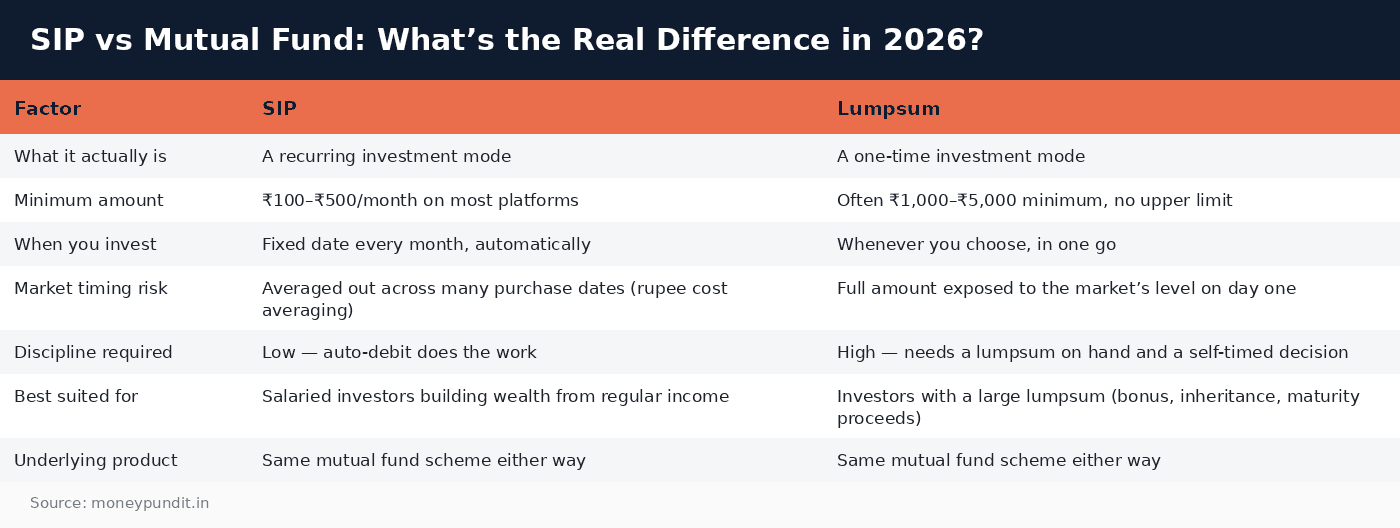
SIP vs Mutual Fund: Key Differences at a Glance
| Factor | SIP | Lumpsum |
|---|---|---|
| What it actually is | A recurring investment mode | A one-time investment mode |
| Minimum amount | ₹100–₹500/month on most platforms | Often ₹1,000–₹5,000 minimum, no upper limit |
| When you invest | Fixed date every month, automatically | Whenever you choose, in one go |
| Market timing risk | Averaged out across many purchase dates (rupee cost averaging) | Full amount exposed to the market’s level on day one |
| Discipline required | Low: auto-debit does the work | High: needs a lumpsum on hand and a self-timed decision |
| Best suited for | Salaried investors building wealth from regular income | Investors with a large lumpsum (bonus, inheritance, maturity proceeds) |
| Underlying product | Same mutual fund scheme either way | Same mutual fund scheme either way |
SIP vs Lumpsum: Which Delivers Better Returns?
Because both routes buy the same fund, returns really depend on market timing, not on SIP vs mutual fund being different products. In a rising market, lumpsum tends to win, because the full amount is invested and grows from day one. A ₹10 lakh lumpsum invested in a Nifty 50 index fund on January 1, 2025 grew to roughly ₹11.05 lakh by December 31, 2025, a 10.51% return. The same ₹10 lakh spread as ₹83,333 monthly SIP installments over the same year generated a 6.24% XIRR, because later installments had less time in the market to grow.
That single-year snapshot flatters lumpsum, but it isn’t the full picture. Over longer, more volatile 10-year stretches, SIPs in Nifty 50-linked equity funds have historically delivered more stable average returns, because rupee cost averaging buys more units when prices dip and fewer when prices are high. Smoothing out the ride. Lumpsum can outperform in a straight bull run and underperform badly if the market falls right after you invest. For most people without a large surplus sitting idle, SIP remains the more practical and behaviourally safer route into a mutual fund, not because SIP is a better product, but because it removes the need to time the market at all.
How a SIP Actually Works, Step by Step
Setting up a SIP takes a few steps: choose a mutual fund scheme based on your goal and risk appetite, complete KYC, set up an auto-debit mandate (NACH/e-mandate) linking your bank account, pick an amount and a date, and let it run. Each month, the amount is debited and units are allotted at that day’s NAV. You can increase the amount later with a step-up SIP, pause it, or stop it at any time, most open-ended mutual fund SIPs carry no penalty for stopping, though some funds charge a short-term exit load if units are redeemed within a set period, commonly one year for equity funds.
SIP vs Mutual Fund Taxation: Is There Any Difference?
No: SIP investments are taxed exactly like any other mutual fund investment, based on the fund category (equity or debt), not on how you invested. For equity mutual funds, gains held over 12 months are long-term capital gains (LTCG), tax-free up to ₹1.25 lakh in a financial year and taxed at 12.5% above that; gains held under 12 months are short-term capital gains (STCG), taxed at 20%. For debt mutual funds bought after April 1, 2023, all gains are treated as short-term and taxed at your income slab rate, regardless of how long you hold them.
The one genuine SIP-specific nuance: each SIP installment is treated as a separate purchase for tax purposes, with its own holding-period clock. If you redeem your entire SIP investment at once, units from your very first installment may qualify for LTCG while units from your most recent installment are still short-term, most platforms compute this automatically on a first-in-first-out basis, but it’s worth knowing before a partial withdrawal.
SIP vs Mutual Fund: Which Should You Choose?
This isn’t really a choice between rival products: you can’t invest in a mutual fund without choosing between SIP and lumpsum (or a mix of both) as your investment mode. If you have a large sum of surplus cash right now and a long investment horizon, splitting it between an immediate lumpsum and a fresh SIP is a common middle path. If you’re investing from a regular salary, SIP is the natural default: it enforces discipline, needs no market-timing skill, and starts with amounts as low as ₹100–500 a month. Either way, the more important decision is picking the right mutual fund scheme for your goal, not agonising over SIP vs mutual fund as if they were rival products.
SIP vs Mutual Fund: Frequently Asked Questions
Is SIP different from a mutual fund?
No. SIP is a mode of investing into a mutual fund: a fixed amount debited automatically at regular intervals. The mutual fund is the underlying product; SIP and lumpsum are simply the two ways you can invest in it.
Is SIP or lumpsum better for mutual funds?
It depends on the market and your situation. Lumpsum tends to perform better in a sustained bull market since the full amount grows from day one. SIP tends to smooth out volatility through rupee cost averaging and needs no market-timing decision, which is why it suits most salaried investors better in practice.
What is the minimum amount to start a SIP?
Many platforms allow SIPs starting at ₹100 to ₹500 a month, though ₹500–₹1,000 is more common across AMCs. There is no upper limit on how much you can invest.
Can I stop or change my SIP anytime?
Yes. Most open-ended mutual fund SIPs can be paused, increased through a step-up SIP, or stopped at any time without penalty, though some funds charge a short-term exit load if units are redeemed within about a year of purchase.
Is SIP taxed differently from a lumpsum mutual fund investment?
No: both are taxed identically based on the fund category (equity or debt) and holding period. The only nuance is that each SIP installment has its own holding-period clock, since every installment is treated as a separate purchase for capital gains calculation.
Related reading: How to Start a SIP in Mutual Funds · Direct vs Regular Mutual Fund · Mutual Fund Taxation Guide (STCG, LTCG & Dividend Tax) · ETF vs Mutual Fund