
RBI’s Floating Rate Savings Bonds currently pay 8.05%, reset every six months in line with the NSC rate, a return that can beat most bank FDs when rates are rising, but comes with an 8% early-exit penalty most FD holders never have to worry about. Here’s the full comparison.
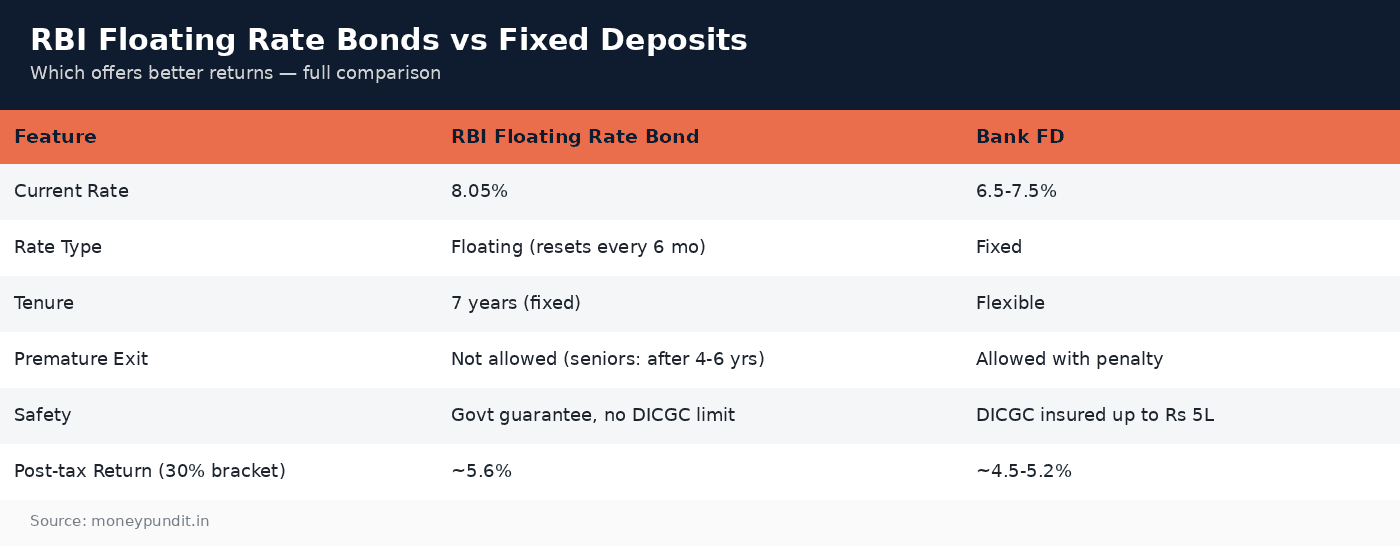
RBI Floating Rate Savings Bonds (FRSB 2020) are a government-guaranteed investment offering interest rates linked to the NSC rate plus a 35 basis point spread. With the current rate at 8.05%, these bonds offer a compelling alternative to bank fixed deposits, especially for conservative investors seeking higher guaranteed returns.
How RBI Floating Rate Bonds Work
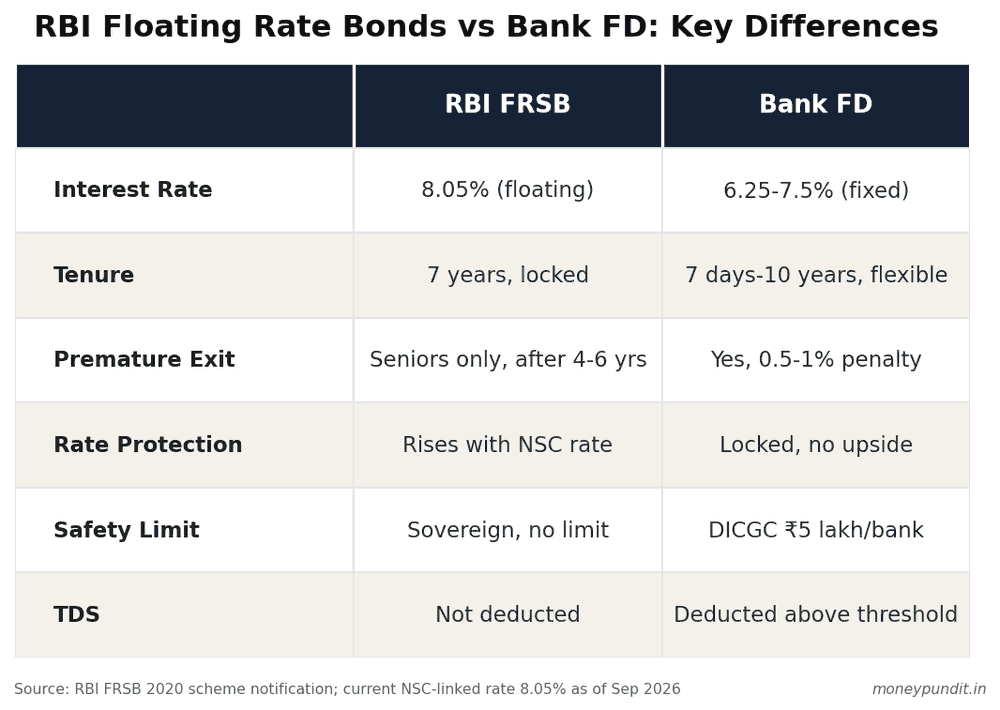
The interest rate resets every 6 months based on the prevailing NSC rate plus 0.35%. Current rate is 8.05% (NSC 7.7% + 0.35%). Interest is paid semi-annually on January 1 and July 1. The tenure is fixed at 7 years with no premature withdrawal option (except for senior citizens above 60 who can exit after 4 years, and those above 70 after 5 years, and above 80 after 6 years). Minimum investment is ₹1,000 with no maximum limit. Available through select banks in demat or certificate form.
FRSB vs Bank Fixed Deposits
FRSB rate of 8.05% beats most bank FDs by 0.5-1.5%. Government guarantee makes FRSB as safe as PPF, no DICGC limit concerns that exist for bank FDs above ₹5 lakh. The floating rate protects against falling rates (rate cannot drop below the NSC benchmark) while benefiting from rate increases. However, FDs offer flexible tenure and premature withdrawal, while FRSB locks you in for 7 years. For money you do not need for 7 years, FRSB clearly wins on returns and safety.
Tax Treatment
Interest from FRSB is fully taxable at your income slab rate, similar to FD interest. TDS is not deducted on FRSB interest (unlike FDs), so you must account for the tax liability while filing ITR. The bonds do not qualify for Section 80C deduction. For investors in the 30% bracket, post-tax returns of approximately 5.6% are still competitive with post-tax FD returns of 4.5-5.2%.
Who Should Invest in FRSB
Conservative investors with a 7-year horizon seeking the highest guaranteed returns. Retirees who have maxed out SCSS (₹30 lakh limit) and need additional fixed-income allocation. Investors with surplus above ₹5 lakh per bank seeking government-guaranteed safety without DICGC limit concerns. Those who expect interest rates to remain elevated or rise further, as the floating rate mechanism benefits from higher rates.
Combining FRSB with Other Instruments
A diversified fixed-income portfolio could include: SCSS (₹30 lakh) at 8.2% for quarterly income, FRSB at 8.05% for 7-year growth, PPF at 7.1% for tax-free returns and 80C benefit, and liquid funds for emergency reserves. This combination provides safety, regular income, tax efficiency, and liquidity across different time horizons.
Can I buy FRSB online?
FRSB are available through authorized banks like SBI, HDFC, ICICI, and others. Some banks allow online application through their net banking portal. You need a savings account with the bank and KYC documents. The bonds are held in demat form or as a certificate based on your preference.
RBI Floating Rate Savings Bonds: Key Features
RBI Floating Rate Savings Bonds 2020 (Taxable) offer an interest rate pegged at 35 basis points (0.35%) above the prevailing NSC rate, reset every 6 months. With the current NSC rate at 7.7%, the bond yields 8.05%, one of the highest rates available in the government-backed fixed-income space. The 7-year tenure makes it a medium-to-long-term investment suitable for investors seeking predictable income with sovereign guarantee.
Interest is paid semi-annually (January 1 and July 1), providing regular income flow. The bonds have no upper investment limit. You can invest any amount in multiples of ₹1,000. However, unlike NSC or PPF, there’s no Section 80C tax deduction on the investment, and the interest is fully taxable at your income tax slab rate. This makes the effective post-tax return approximately 5.6% for the 30% tax bracket, still better than most bank FDs after tax.
Floating Rate Bonds vs Fixed Deposits
The primary advantage of RBI bonds over FDs is the floating rate mechanism. When interest rates rise, your bond yield automatically increases, you’re protected against rate hikes. In contrast, an FD locks you at a fixed rate for the entire tenure. Since 2022, when RBI raised repo rates significantly, floating rate bond holders saw their yields increase from 7.15% to 8.05%, while FD holders were stuck at their original rates.
However, the floating rate works both ways: if rates decrease, your yield drops too. FDs protect you from falling rates since your rate is locked. The 7-year lock-in is another disadvantage: premature encashment is only permitted after 4 years for senior citizens (60+), 5 years for those 70+, and 6 years for those 80+. Non-senior citizens cannot exit early at all. Bank FDs offer much better liquidity with premature withdrawal (typically with a 0.5-1% penalty). Use our FD Calculator to compare FD returns across different banks and tenures.
Who Should Invest in RBI Floating Rate Bonds?
These bonds are ideal for: senior citizens seeking the highest government-backed interest rate for regular income (SCSS at 8.2% offers even better rates but has a ₹30 lakh limit. RBI bonds have no limit and serve as an overflow option), conservative investors with a 7-year horizon who don’t need interim liquidity, and anyone expecting interest rates to remain stable or increase.
For a diversified fixed-income portfolio, combine RBI floating rate bonds (rate protection + highest yield) with PPF (tax-free returns + Section 80C benefit), SCSS (highest rate for senior citizens), and short-term debt mutual funds (liquidity). Avoid putting all your fixed-income allocation into any single instrument. The 7-year lock-in of RBI bonds means you need other liquid investments for emergencies and short-term needs. Compare all government savings options including NSC and Post Office schemes to build the optimal fixed-income portfolio for your tax bracket and investment timeline.
Compare current FD rates across banks before deciding: check our Best FD Rates in India 2026 guide for the latest rates from all major institutions.
References: Amfiindia.com
Source: amfiindia.com
Frequently Asked Questions About RBI Floating Rate Bonds vs Fixed Deposits
How does the interest rate on RBI Floating Rate Savings Bonds work?
The rate resets every 6 months at the prevailing NSC rate plus 0.35%. Interest is paid semi-annually, on January 1 and July 1.
Can I withdraw RBI Floating Rate Bonds before maturity?
The tenure is fixed at 7 years and there is no premature withdrawal for most investors. Only senior citizens can exit early, with the lock-in depending on their age band.
Are RBI Floating Rate Bonds better than a bank fixed deposit?
They carry a government guarantee and their rate moves with the NSC rate every 6 months, while a fixed deposit locks one rate for its tenure. A bank FD offers more tenure choices and easier premature withdrawal, so the better option depends on how long you can stay invested.
Who should invest in RBI Floating Rate Savings Bonds?
Conservative investors who want sovereign safety and a rate that follows small-savings rates, and who will not need the money for 7 years.