

How to invest stock market in brief: Opening a demat account takes about ten minutes online today, but the harder part, deciding what to actually buy once it’s open, is where most beginners freeze or make expensive mistakes.
Opening a demat account takes about ten minutes online today, but the harder part, deciding what to actually buy once it’s open, is where most beginners freeze or make expensive mistakes. Here’s a complete, step-by-step walkthrough for a first-time stock market investor in India.
Investing in the stock market is one of the most effective ways to build long-term wealth in India. With more than 23 crore demat accounts opened by July 2026, retail participation is at an all-time high. Yet many beginners feel overwhelmed by the jargon, fear of losses, and confusion about where to start. This guide breaks down stock market investing step by step, from opening your first demat account to building a diversified portfolio.
What Is the Stock Market?
The stock market is a platform where shares (ownership units) of publicly listed companies are bought and sold. India has two major stock exchanges, the Bombay Stock Exchange (BSE, established 1875) and the National Stock Exchange (NSE, established 1992). When you buy shares of a company, you become a part-owner and benefit from the company’s growth through price appreciation and dividends. All stock market transactions are regulated by the Securities and Exchange Board of India (SEBI).
Step 1: Open a Demat and Trading Account
To invest in stocks, you need two accounts: a demat account (to hold shares in electronic form) and a trading account (to place buy/sell orders). Most brokers offer both as a combined “2-in-1” account. You can open an account with discount brokers like Zerodha, Groww, or Angel One (low brokerage, app-based) or full-service brokers like ICICI Direct, HDFC Securities, or Kotak Securities (research reports, advisory services, higher fees). The account opening process is fully online. You need your PAN card, Aadhaar, bank account, and a selfie.
Step 2: Learn the Basics Before Investing
Before putting money in, understand some key concepts. Market capitalisation (market cap) is the total value of a company’s shares. Large-cap companies (top 100 by market cap) are more stable, while small-cap companies offer higher growth potential with more risk. PE ratio (Price-to-Earnings) tells you how expensive a stock is relative to its earnings, lower PE suggests the stock may be undervalued. Dividend yield shows the annual dividend as a percentage of the stock price. And an index like Nifty 50 or Sensex represents the overall market performance through a basket of top stocks.
Step 3: Decide Your Investment Approach
Long-Term Investing (Recommended for Beginners)
Buy quality stocks and hold them for 3-5+ years. This approach benefits from compounding, requires less time monitoring markets, and has historically delivered 12-15% annual returns in India. Focus on fundamentally strong companies with consistent revenue growth, healthy profit margins, and manageable debt.
SIP in Index Funds/ETFs (Easiest Approach)
If picking individual stocks feels daunting, start with index funds or ETFs that track the Nifty 50 or Sensex. You get automatic diversification across 50 top companies, no need for stock analysis, and returns that mirror the overall market. At an assumed 12% a year, a monthly SIP of ₹5,000 in a Nifty 50 index fund grows to about ₹11.6 lakh in 10 years (₹6 lakh invested). Returns are not guaranteed; the table below shows other rates.
Intraday Trading (Not Recommended for Beginners)
Intraday trading involves buying and selling stocks within the same day. While it offers quick profit potential, SEBI’s study of FY 2022-23 found that about 7 in 10 individual intraday traders in the cash segment lost money. It requires technical analysis skills, constant market monitoring, and high emotional discipline.
What a ₹5,000 Monthly SIP Becomes in 10 Years
Last verified: 22 October 2026. Illustrative maths, not a forecast: ₹5,000 invested at the start of each month for 120 months, assumed annual return compounded monthly.
| Assumed return | Invested | Value after 10 years |
|---|---|---|
| 8% | ₹6 lakh | ₹9.2 lakh |
| 10% | ₹6 lakh | ₹10.3 lakh |
| 12% | ₹6 lakh | ₹11.6 lakh |
| 14% | ₹6 lakh | ₹13.1 lakh |
Run your own numbers in our SIP calculator.
Step 4: Build Your First Portfolio
A well-diversified beginner portfolio might look like this: 40-50% in large-cap stocks or Nifty 50 index funds for stability, 20-30% in mid-cap stocks for growth, 10-20% in sector-specific picks (IT, banking, pharma) based on your research, and 10-20% kept as cash or in liquid funds for buying opportunities during market dips.
Start with 5-10 stocks across different sectors to reduce risk. Avoid putting all your money in one stock or one sector, no matter how promising it looks.
Step 5: How Much Money Do You Need to Start?
You can start investing in the stock market with as little as ₹100. Many quality stocks are available under ₹500 per share, and mutual fund SIPs can be started with ₹100-500/month. There’s no minimum balance requirement for demat accounts with most discount brokers. The key is to start small, learn from experience, and gradually increase your investment as your knowledge and income grow.
Common Mistakes Beginners Should Avoid
The biggest mistake is investing based on tips from friends, social media, or Telegram groups without doing your own research. Other common errors include trying to time the market (waiting for the “perfect” entry point), panic selling during market corrections, over-trading (excessive buying and selling increases brokerage costs and taxes), investing money you might need in the short term (stock markets are volatile in the short run), and ignoring diversification by putting everything into one “hot” stock.
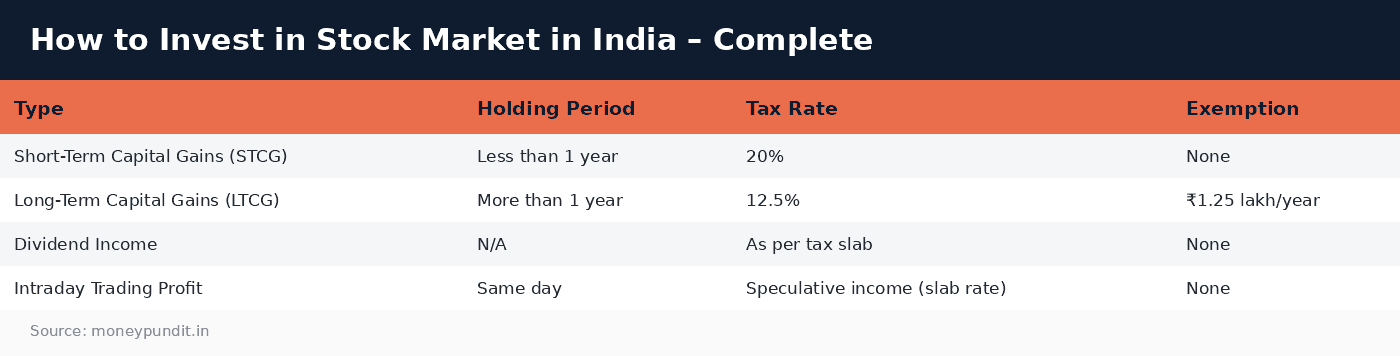
Tax on Stock Market Gains in India
| Type | Holding Period | Tax Rate | Exemption |
|---|---|---|---|
| Short-Term Capital Gains (STCG) | Less than 1 year | 20% | None |
| Long-Term Capital Gains (LTCG) | More than 1 year | 12.5% | ₹1.25 lakh/year |
| Dividend Income | N/A | As per tax slab | None |
| Intraday Trading Profit | Same day | Speculative income (slab rate) | None |
What a Delivery Trade Costs You in STT
Last verified: 22 October 2026. Securities Transaction Tax on equity delivery is 0.1% on both buy and sell. On a ₹10,000 purchase that is ₹10, and another ₹10 when you sell. Brokerage, exchange charges, GST and stamp duty come on top and differ by broker. See our guide to STT rates.
Frequently Asked Questions
Is stock market investing safe?
Stock markets carry risk: prices can go up and down in the short term. However, historically, the Indian stock market (Nifty 50) has delivered approximately 12-14% compound annual returns over 15-20 year periods. The key is to invest for the long term, diversify, and invest only money you won’t need for at least 3-5 years.
Which stocks should I buy as a beginner?
Start with well-known large-cap companies from the Nifty 50 index. Companies like Reliance Industries, TCS, HDFC Bank, Infosys, and ITC. These are industry leaders with proven track records, stable earnings, and good liquidity. Alternatively, simply invest in a Nifty 50 index fund to own all 50 stocks at once.
How much return can I expect from stock market?
Over the long term (10-15+ years), equity investments in India have historically delivered 12-15% annual returns. Individual stock returns vary widely, some may give 50%+ in a year while others may lose value. Index fund returns typically mirror the market average of 12-14% over long periods.
What is the best time to invest in stocks?
The best time to invest is when you have the money and a long-term horizon. Trying to time the market perfectly is nearly impossible even for professionals. Instead, use a systematic approach. Invest a fixed amount every month regardless of market conditions. This strategy, called rupee cost averaging, ensures you buy more shares when prices are low and fewer when prices are high.
Can I have more than one demat account?
Yes. You can hold demat accounts with different brokers, though each account adds its own annual charges and paperwork. One account is enough for most beginners.
Do I pay tax if I only hold shares and never sell?
Capital gains tax arises only when you sell. Dividends are taxed in the year you receive them, at your slab rate.
Is it better to start with an index fund or direct stocks?
An index fund gives instant diversification with no stock selection. Direct stocks need research and time. Many beginners start with an index fund SIP and add a few stocks later.
References: SEBI Investor Portal
Related Resources
Ready to read charts? See our Technical Analysis for Beginners guide.
How to invest stock market: Key Takeaways
Key points on how to invest stock market:
- The stock market is a platform where shares (ownership units) of publicly listed companies are bought and sold.
- To invest in stocks, you need two accounts: a demat account (to hold shares in electronic form) and a trading account (to place buy/sell orders).
- Market capitalisation (market cap) is the total value of a company’s shares.
Verify the latest how to invest stock market figures with SEBI before you act.