

Fd interest rate history in brief: Fixed deposit rates in India don’t move in a vacuum: they rise and fall largely in step with the Reserve Bank of India’s repo rate.
Fixed deposit rates in India don’t move in a vacuum: they rise and fall largely in step with the Reserve Bank of India’s repo rate. Understanding that relationship helps you time your FD bookings and know whether today’s rate is actually good, or just average for the cycle.
RBI policy update (7 October 2026): the RBI raised the repo rate by 25 bps to 5.50%. Banks usually reprice deposits a few weeks later, and the history below runs to early October 2026. Read our RBI repo rate hike guide for FDs and EMIs.
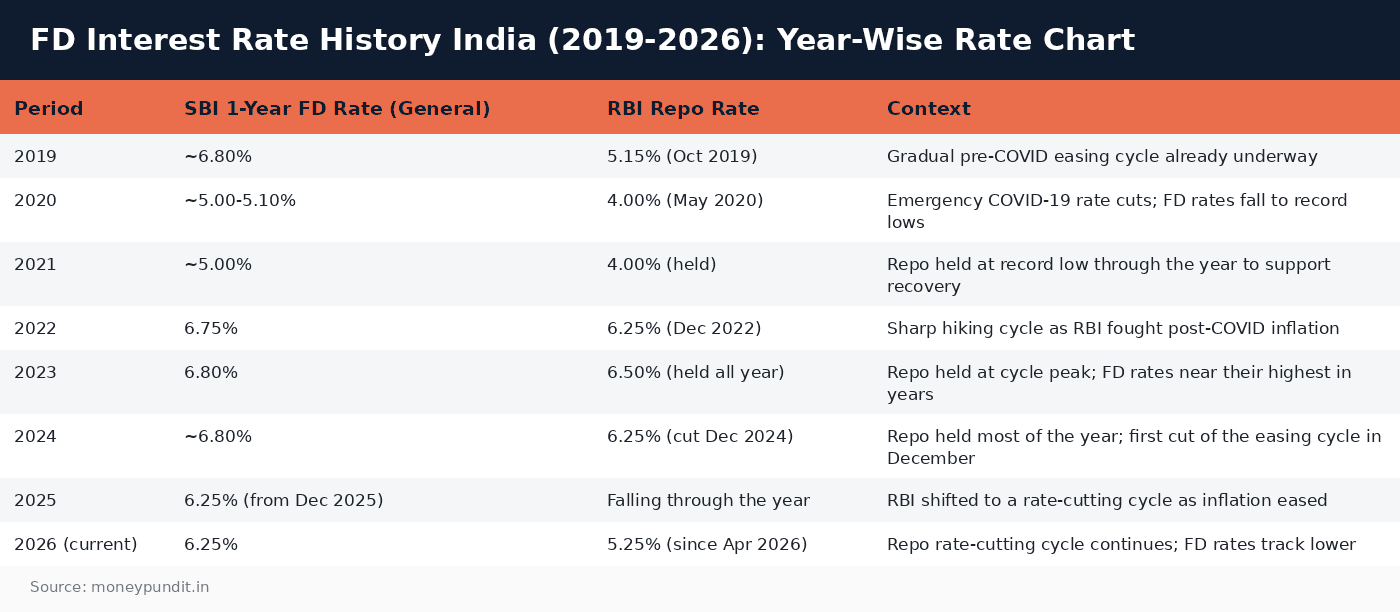
Current SBI FD Interest Rate (2026)
As of the rates effective 15 December 2025, SBI’s 1-year to less-than-2-year retail domestic term deposit rate stands at 6.25% for general citizens and 6.75% for senior citizens. For a full bank-by-bank comparison across tenures, see our Best FD Rates India 2026 guide, or run the numbers on the FD Calculator.
Full FD Interest Rate History (2019-2026)
The table below tracks SBI’s 1-year retail FD rate (the most-referenced benchmark tenure) alongside the RBI repo rate at each major policy turn. Rates for other banks and other tenures move on a similar curve, though the exact numbers vary.
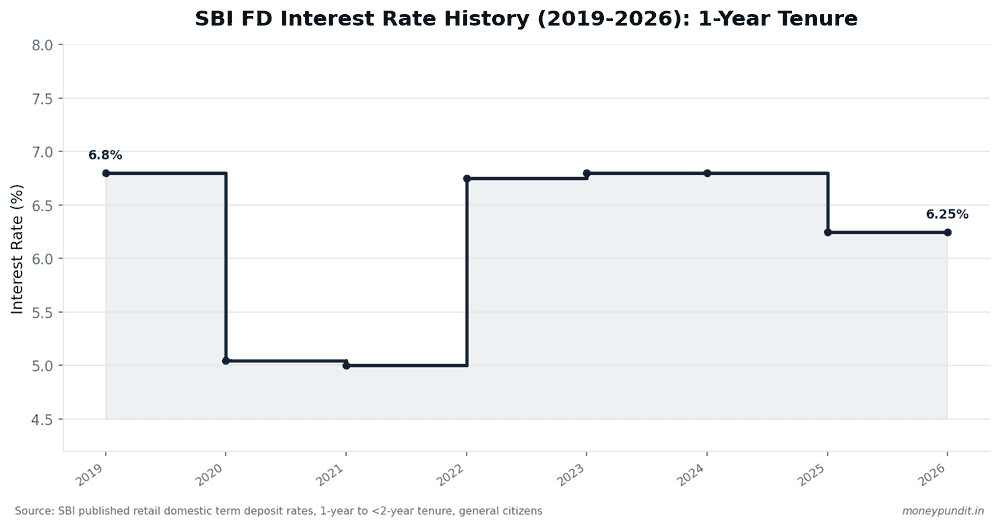
| Period | SBI 1-Year FD Rate (General) | RBI Repo Rate | Context |
|---|---|---|---|
| 2019 | ~6.80% | 5.15% (Oct 2019) | Gradual pre-COVID easing cycle already underway |
| 2020 | ~5.00-5.10% | 4.00% (May 2020) | Emergency COVID-19 rate cuts; FD rates fall to record lows |
| 2021 | ~5.00% | 4.00% (held) | Repo held at record low through the year to support recovery |
| 2022 | 6.75% | 6.25% (Dec 2022) | Sharp hiking cycle as RBI fought post-COVID inflation |
| 2023 | 6.80% | 6.50% (held all year) | Repo held at cycle peak; FD rates near their highest in years |
| 2024 | ~6.80% | 6.25% (cut Dec 2024) | Repo held most of the year; first cut of the easing cycle in December |
| 2025 | 6.25% (from Dec 2025) | Falling through the year | RBI shifted to a rate-cutting cycle as inflation eased |
| 2026 (current) | 6.25% | 5.25% (since Apr 2026) | Repo rate-cutting cycle continues; FD rates track lower |
Figures are SBI’s published retail (below Rs 3 crore) domestic term deposit rates for the 1-year to less-than-2-year bucket, the tenure most commonly used as an industry benchmark. Other banks and other tenures differ, check our bank-by-bank comparison for current cross-bank rates.
How FD Interest Rates Are Decided
Banks don’t set FD rates in isolation. Three forces drive the number you see quoted at the branch or on an app:
- The RBI repo rate. This is the rate at which the RBI lends to commercial banks. When repo rises, banks’ own cost of funds rises, so they raise FD rates to attract deposits. When repo falls, FD rates typically follow within a few months.
- Liquidity and credit demand. If banks are flush with deposits but loan demand is weak, they have less incentive to offer high FD rates even if the repo rate is elevated, and vice versa.
- Competition from small savings schemes. Government-backed instruments like PPF, NSC, and the Senior Citizen Savings Scheme compete for the same saver’s rupee. Banks watch these rates (reviewed quarterly by the Ministry of Finance) when setting their own.
There’s no fixed formula linking repo rate to FD rate: unlike PPF or NSC, which move on a published small-savings formula. Each bank decides its own FD rates based on its Asset-Liability Committee’s (ALCO) assessment, which is why rates vary from bank to bank even when the repo rate is the same for everyone.
What Rate Changes Mean for Your FD Returns
A swing of even 1-1.5 percentage points compounds meaningfully over a 5-year FD. Here’s how a lump sum of Rs 5,00,000 grows at three different rate scenarios drawn from the table above:
| Rate Scenario | Rate | Maturity Value (5 years, cumulative) | Total Interest Earned |
|---|---|---|---|
| 2021 lows | 5.00% | ~Rs 6,40,000 | ~Rs 1,40,000 |
| 2023 cycle peak | 6.80% | ~Rs 6,97,000 | ~Rs 1,97,000 |
| 2026 current | 6.25% | ~Rs 6,79,000 | ~Rs 1,79,000 |
That’s roughly a Rs 57,000 difference in interest earned on the same Rs 5,00,000 deposit, purely from booking at the cycle peak versus the cycle low. This is why laddering FDs across multiple tenures, rather than locking the full amount into one rate, is a common strategy to smooth out this timing risk. Use the FD Calculator to run your own numbers at today’s rate.
FD Rate vs Inflation: Is It Still Worth It?
A 6.25% FD rate looks solid on paper, but the number that actually matters is the post-tax, inflation-adjusted return. For someone in the 30% tax bracket, a 6.25% FD yields roughly 4.4% after tax. If retail inflation is running at 4-5%, the real (inflation-adjusted) return on that FD is close to zero or even negative, meaning the deposit preserves capital but barely grows your purchasing power.
This is the trade-off FDs are built for: capital safety and predictability, not high real returns. Investors seeking inflation-beating growth over the long term typically pair FDs with equity or hybrid instruments rather than relying on FDs alone. For a side-by-side look at how FDs stack up against PPF and equity options, see our SIP vs Lumpsum vs FD vs PPF comparison.
Where FD Rates Are Officially Announced
Each bank publishes and revises its own FD rates independently, there’s no single central notification like there is for PPF or NSC. SBI publishes its current and historical retail term deposit rates on its official interest rates page. The RBI repo rate, which drives the broader trend, is announced after each Monetary Policy Committee (MPC) meeting, typically held every two months, and published on the RBI website.
Related Guides & Tools
- Best FD Rates India 2026: Compare Top Banks
- FD Calculator
- SBI FD Calculator
- PPF Interest Rate History (1986-2026)
- RD (Recurring Deposit) Calculator
Frequently Asked Questions
What was the highest FD rate in the last few years?
SBI’s 1-year retail FD rate peaked around 6.80% in 2023, when the RBI repo rate was held at 6.50% following its post-COVID hiking cycle. Some smaller finance banks offered considerably higher rates during the same period.
Why did FD rates fall so low in 2020-2021?
The RBI cut the repo rate to a then-record low of 4% in May 2020 to support the economy through the COVID-19 disruption, and held it there through 2021. Banks passed this through directly into lower FD rates, which fell to around 5% for the benchmark 1-year tenure.
Do all banks change FD rates at the same time as the RBI repo rate?
No. Each bank’s Asset-Liability Committee decides FD rates independently based on its own funding needs and competitive position. Rate changes typically follow a repo rate move within a few weeks to a few months, but the timing and magnitude vary by bank.
Is it better to book a long-tenure FD when rates are high?
Locking a longer tenure at a cycle-peak rate can be a sound strategy, since it protects you from future rate cuts. The trade-off is reduced liquidity and, for large sums, the risk of missing a subsequent rate hike. Laddering, splitting a deposit across multiple tenures, is a common way to balance both concerns.
How often do FD interest rates change?
There’s no fixed schedule. Banks revise FD rates whenever their ALCO reassesses funding costs and competitive positioning. This can happen several times a year during a rate-cutting or rate-hiking cycle, or remain unchanged for a year or more during stable periods.
References: Sbi.bank.in, Rbi.org.in
Looking at alternatives to bank FDs? Compare against RBI Floating Rate Bonds, currently paying 8.05% with a 6-monthly rate reset.
FD interest rate history: Key Takeaways
Key points on fd interest rate history:
- As of the rates effective 15 December 2025, SBI’s 1-year to less-than-2-year retail domestic term deposit rate stands at 6.25% for general citizens and 6.75% for senior citizens.
- Rates for other banks and other tenures move on a similar curve, though the exact numbers vary.
- There’s no fixed formula linking repo rate to FD rate: unlike PPF or NSC, which move on a published small-savings formula.
Verify the latest fd interest rate history figures with RBI before you act.