

Why Budgeting is the Foundation of Financial Health
Budgeting is the process of creating a plan for how you spend and save your money. Without a budget, even high-income earners often live paycheck to paycheck, wondering where their money goes. A 2024 survey found that 78% of Indian salaried professionals have no formal budget, and 63% run out of money before month-end at least once per quarter.
A good budget is not about restriction — it is about awareness and intentionality. It ensures you cover essentials, save for the future, and still enjoy life without guilt. The most effective budgets are simple, realistic, and sustainable.
The 50-30-20 Rule for Indian Incomes
| Category | % of Take-Home | Example (₹80K take-home) | Includes |
|---|---|---|---|
| Needs | 50% | ₹40,000 | Rent, groceries, utilities, insurance, EMIs, fuel, children’s school fees |
| Wants | 30% | ₹24,000 | Dining out, entertainment, shopping, subscriptions, vacations, hobbies |
| Savings/Investments | 20% | ₹16,000 | SIP, PPF, emergency fund, NPS, insurance premium |
In metro cities with high rent, you may need to adjust to 55-25-20 or even 60-20-20. The key is that savings/investments should never drop below 20% — treat this as a non-negotiable expense that gets deducted first (pay yourself first principle).
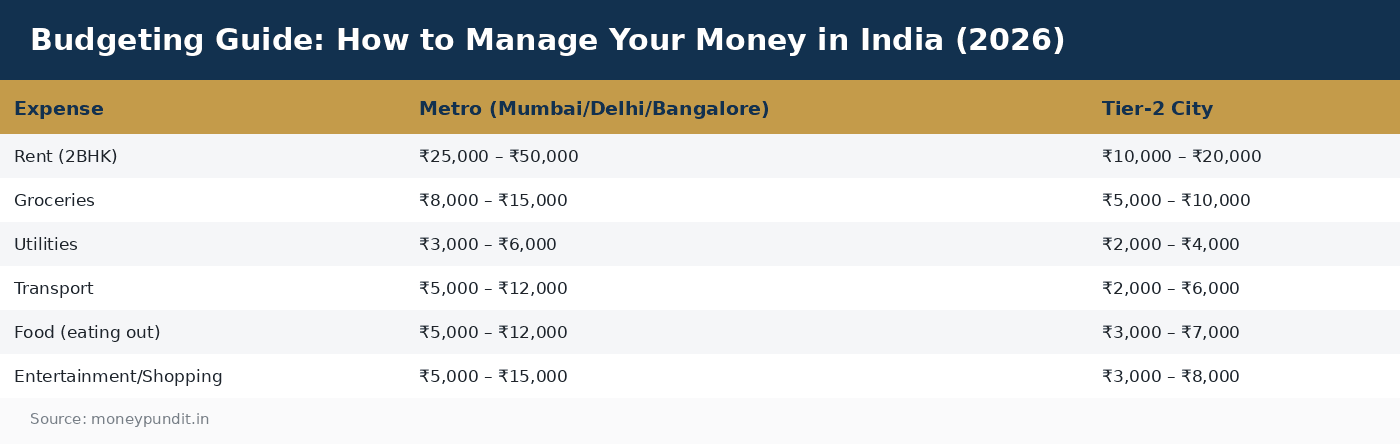
Monthly Expense Benchmarks for Indian Cities
| Expense | Metro (Mumbai/Delhi/Bangalore) | Tier-2 City |
|---|---|---|
| Rent (2BHK) | ₹25,000 – ₹50,000 | ₹10,000 – ₹20,000 |
| Groceries | ₹8,000 – ₹15,000 | ₹5,000 – ₹10,000 |
| Utilities | ₹3,000 – ₹6,000 | ₹2,000 – ₹4,000 |
| Transport | ₹5,000 – ₹12,000 | ₹2,000 – ₹6,000 |
| Food (eating out) | ₹5,000 – ₹12,000 | ₹3,000 – ₹7,000 |
| Entertainment/Shopping | ₹5,000 – ₹15,000 | ₹3,000 – ₹8,000 |
Building an Emergency Fund
Before investing for any goal, build an emergency fund covering 6 months of expenses. For someone spending ₹60,000/month, this means ₹3.6 lakh kept in: savings account (₹50K for instant access), liquid mutual fund (₹2 lakh for next-day access), and short-term FD (₹1.1 lakh for backup). Never invest your emergency fund in equity or lock-in instruments. This fund protects you from using credit cards or loans during job loss, medical emergencies, or unexpected expenses.
Common Money Leaks to Plug
Track your spending for one month and you will find common leaks: unused subscriptions (₹500-₹2,000/month), excessive food delivery and dining out (₹3,000-₹8,000 over budget), impulse online shopping (₹2,000-₹5,000/month), premium gym/club memberships not fully used, and unnecessary insurance riders. Plugging just ₹5,000/month of leaks and investing it in SIP at 12% creates ₹50 lakh over 20 years.
Budgeting Tools and Apps
Popular budgeting approaches for Indians: Google Sheets/Excel (custom, free, full control), Walnut app (auto-tracks UPI/card transactions), ETMONEY (investing + expense tracking), or the envelope method (allocate cash to categories). Start simple — even tracking expenses in a phone notepad for 30 days reveals powerful insights about your spending habits.
How do I budget when my income is variable?
Freelancers and business owners with irregular income should: budget based on the lowest month’s income from the past 12 months, build a larger emergency fund (9-12 months), keep business and personal finances strictly separate, and save aggressively in high-income months to cover lean periods. Set up automatic SIP on the 5th of each month — it forces minimum saving discipline regardless of income fluctuation.
How much of my salary should go to rent?
Financial advisors recommend keeping rent under 25-30% of take-home salary. In expensive cities like Mumbai or Bangalore, this may stretch to 35%, but beyond that, consider: sharing accommodation, moving slightly further from city center (save 30-40%), or negotiating with landlords during low-demand months. Remember, every extra ₹5,000 spent on rent is ₹5,000 less invested — costing you ₹50+ lakh over 20 years.
Should I pay off debt before saving?
High-interest debt (credit card at 36-42%, personal loan at 12-20%) should be paid off aggressively before investing, as no investment reliably beats these rates. However, low-interest debt (home loan at 8.5%, education loan at 8-10%) can coexist with investing — the opportunity cost of not investing in equity (12-15% returns) exceeds the loan interest. Always maintain minimum emergency fund even while paying off debt.
Related Resources
- Want a simple framework? Try the 50-30-20 Budgeting Rule.
- Before you budget for goals, build a safety net first — see our Emergency Fund Guide.
