

Confused between similar financial products? This guide compares the most common investment and savings options in India to help you make informed decisions.
SIP vs Lumpsum Investment
| Factor | SIP | Lumpsum |
|---|---|---|
| Minimum Amount | Rs. 500/month | Rs. 1,000-5,000 |
| Market Timing Risk | Low (rupee cost averaging) | High (single entry point) |
| Best When Market Is | Volatile or falling | At a low/correction |
| Discipline Required | Automated | Manual decision |
| Suitable For | Salaried individuals | Windfall/bonus amounts |
Verdict: For most investors, SIP is better due to discipline and rupee cost averaging. Lumpsum works when you have a large amount and markets are at a correction. Ideally, combine both strategies.
PPF vs ELSS vs NPS (Tax-Saving Comparison)
| Feature | PPF | ELSS | NPS |
|---|---|---|---|
| Returns (Historical) | 7.1% (guaranteed) | 12-15% (market-linked) | 9-12% (market-linked) |
| Lock-in Period | 15 years | 3 years | Till age 60 |
| Tax on Returns | Fully tax-free | LTCG above Rs. 1.25L @12.5% | 60% tax-free at maturity |
| Extra Tax Benefit | No | No | Rs. 50,000 extra u/s 80CCD(1B) |
| Risk Level | Zero | High (equity) | Moderate (mixed) |
| Liquidity | Low (partial from 7th year) | High (after 3 years) | Very Low (till 60) |
Verdict: For maximum tax savings in the 30% bracket: invest Rs. 1.5L in PPF/ELSS under 80C + Rs. 50,000 in NPS under 80CCD(1B) = total Rs. 2L deduction, saving Rs. 62,400 in taxes. For growth: ELSS wins. For safety: PPF wins. For retirement: NPS wins.
FD vs Debt Mutual Funds
| Feature | Fixed Deposit | Debt Mutual Fund |
|---|---|---|
| Returns | 6.5-7.5% (fixed) | 7-9% (variable) |
| Tax Treatment | At income slab rate | At income slab rate (since 2023) |
| Safety | Very high (DICGC insured up to Rs. 5L) | High (but not guaranteed) |
| Liquidity | Penalty on premature withdrawal | Redeem anytime (T+1 settlement) |
| TDS | Yes (10% above Rs. 40K interest) | No TDS on redemption |
Verdict: Since 2023 tax rule changes, FDs and debt funds have similar tax treatment. Choose FD for guaranteed returns and simplicity. Choose debt funds for better liquidity, no TDS hassle, and potential for marginally higher returns.
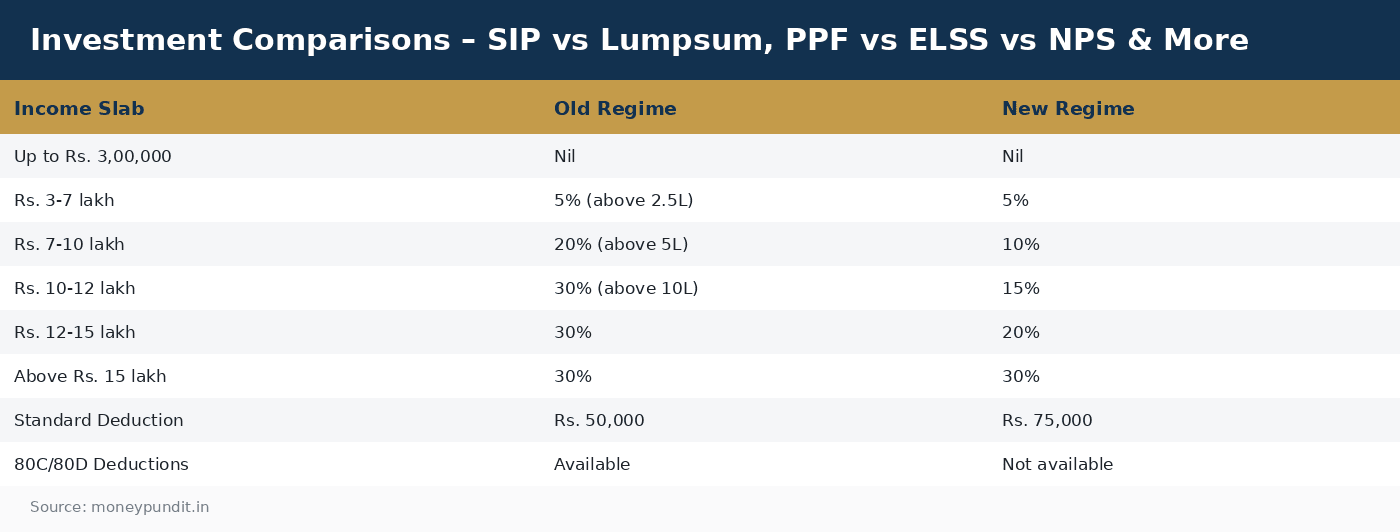
Old Tax Regime vs New Tax Regime (FY 2025-26)
| Income Slab | Old Regime | New Regime |
|---|---|---|
| Up to Rs. 3,00,000 | Nil | Nil |
| Rs. 3-7 lakh | 5% (above 2.5L) | 5% |
| Rs. 7-10 lakh | 20% (above 5L) | 10% |
| Rs. 10-12 lakh | 30% (above 10L) | 15% |
| Rs. 12-15 lakh | 30% | 20% |
| Above Rs. 15 lakh | 30% | 30% |
| Standard Deduction | Rs. 50,000 | Rs. 75,000 |
| 80C/80D Deductions | Available | Not available |
Verdict: New regime is better if total deductions are below Rs. 3.75 lakh. Old regime wins for high deductions (80C + 80D + HRA + home loan). Use our Income Tax Calculator to compare both regimes for your specific salary.
Term Insurance vs ULIP vs Endowment Plan
| Feature | Term Insurance | ULIP | Endowment |
|---|---|---|---|
| Purpose | Pure protection | Insurance + investment | Insurance + savings |
| Premium (Rs. 1 Cr cover, age 30) | Rs. 700-1000/month | Rs. 8,000-12,000/month | Rs. 6,000-8,000/month |
| Returns | Nil (pure cover) | 8-12% (market-linked) | 4-6% (guaranteed) |
| Maturity Benefit | None (or return of premium) | Fund value | Sum assured + bonus |
Verdict: Always buy term insurance for pure life cover (cheapest protection). Never mix insurance with investment. For wealth creation, use SIP in mutual funds separately — you’ll get 3-4x better returns than ULIPs or endowment plans.
Home Loan: Fixed Rate vs Floating Rate
| Feature | Fixed Rate | Floating Rate |
|---|---|---|
| Current Rate | 9.5-11% | 8.25-9.5% |
| EMI Changes | Never (fixed for tenure) | Changes with RBI repo rate |
| Prepayment Penalty | 2-4% of outstanding | None (RBI mandate) |
| Risk | Overpay if rates fall | EMI increases if rates rise |
Verdict: Floating rate is almost always better in India — lower initial rate, no prepayment penalty, and historically more cost-effective over 15-20 year tenures.
Note: All rates and figures are indicative as of 2026 and subject to change. Use our free financial calculators for personalized calculations based on current rates.
