

Is This the Right Time to Buy a House?
Buying a home is the largest financial decision most Indians make. Before taking a home loan, evaluate: Can you afford an EMI that is under 40% of your net income? Do you have 20-25% of the property value as down payment? Will you stay in the same city for at least 7-10 years? If yes to all three, buying makes financial sense. If your career requires frequent relocation or you cannot comfortably afford the EMI, renting and investing the difference is often wiser.
Home Loan Process Step by Step
Step 1: Check eligibility — Use our eligibility calculator to understand how much you can borrow. Step 2: Compare lenders — Get quotes from 3-4 banks and HFCs. Focus on interest rate (not just EMI), processing fee, prepayment terms, and customer service. Step 3: Get pre-approved — A pre-approval letter strengthens your negotiating position with sellers. Step 4: Select property — Ensure the property is RERA registered and the builder is approved by your bank. Step 5: Submit documents — Income proof, property documents, KYC. Step 6: Disbursement — Loan is disbursed directly to the seller/builder.
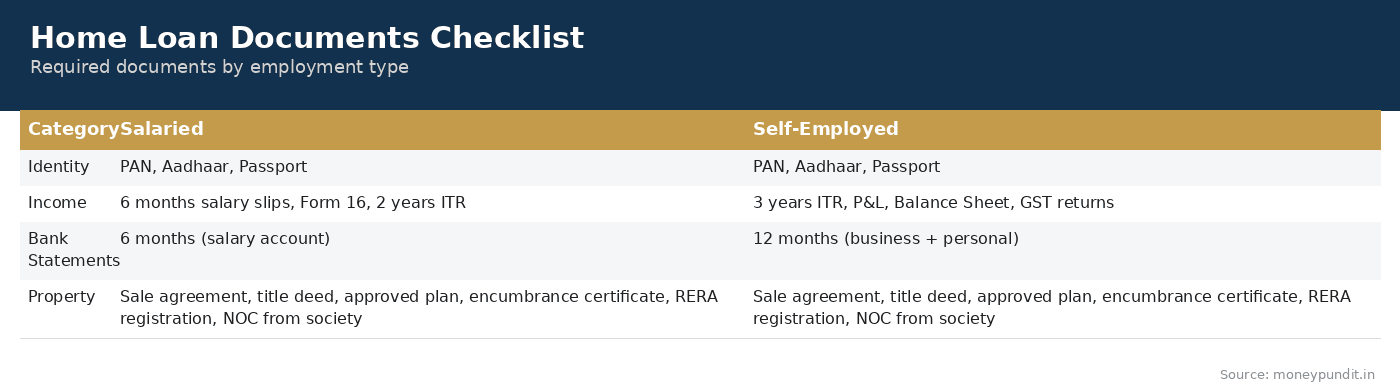
Documents Required for Home Loan
| Category | Salaried | Self-Employed |
|---|---|---|
| Identity | PAN, Aadhaar, Passport | PAN, Aadhaar, Passport |
| Income | 6 months salary slips, Form 16, 2 years ITR | 3 years ITR, P&L, Balance Sheet, GST returns |
| Bank Statements | 6 months (salary account) | 12 months (business + personal) |
| Property | Sale agreement, title deed, approved plan, encumbrance certificate, RERA registration, NOC from society | |
Understanding Interest Rate Types
Floating Rate: Linked to bank’s repo rate + spread. Changes when RBI adjusts rates. Most common and usually cheaper. No prepayment penalty (RBI mandate). Fixed Rate: Stays same for a fixed period (usually 2-5 years), then resets. Higher than floating by 1-2%. Prepayment penalty may apply. Recommendation: Choose floating rate — it gives lower cost and free prepayment flexibility.
Hidden Costs of Buying a Home
Beyond the property price, budget for: stamp duty (5-7% of property value), registration charges (1%), brokerage (1-2%), GST on under-construction (5%), home loan processing fee (0.5-1%), home insurance, interior and furnishing (₹5-15 lakh), society maintenance deposits, parking charges, and property tax. These additional costs typically add 10-15% to the property price.
RERA: Your Rights as a Buyer
The Real Estate Regulation Act (RERA) protects buyers: builders must register projects and disclose all details, carpet area must be clearly stated (no more super built-up area confusion), project delays entitle you to interest compensation, builders cannot change plans without 2/3rd buyer consent, and a portion of buyer funds is kept in escrow to prevent diversion. Always verify RERA registration on your state’s RERA website before booking.
How to negotiate the best home loan rate?
Get written quotes from 3-4 lenders and use them as leverage. Apply at the bank where you have a salary account (existing relationship discount). Maintain a CIBIL score of 750+ before applying. Time your application during festivals when banks offer promotional rates. Ask for processing fee waiver (often negotiable). Consider home loan balance transfer if your existing rate is 0.5%+ higher than current market rates.
Buy a flat or build an independent house?
Flats offer: easier home loan (banks prefer apartments), lower maintenance hassle, amenities (gym, security, parking), and better resale liquidity. Independent houses offer: no monthly maintenance, freedom to modify/expand, potentially better appreciation in growing areas, and no society politics. For investment, flats in good locations offer better rental yield. For lifestyle, independent houses offer more space and freedom. Budget plays a major role — independent house plots in metros are prohibitively expensive.
Should I buy under-construction or ready-to-move?
Ready-to-move properties: no GST, no delay risk, what-you-see-is-what-you-get, immediate possession and tax benefits. Under-construction: typically 20-30% cheaper, GST at 5%, risk of delay (common in India), and EMI starts without possession (pre-EMI interest only is an option). If budget allows, ready-to-move is safer. If buying under-construction, choose only RERA-registered projects from reputed builders with a strong delivery track record.
